I WAS A BIT DISAPPOINTED
DROGHEDA STREET ART AND GRAFFITI AT RANDOM - GOOD AND NOT SO GOOD [9 SEPTEMBER 2026]
A return to Drogheda reveals an urban canvas in transition, shifting steadily from raw, informal expression to structured, sanctioned public art. Yet, returning two years after a September 2024 visit, the pace of evolution feels surprisingly muted—yielding only two major additions to the streetscape. While a proper survey of the town’s flagship murals will require a dedicated follow-up trip, the broader trajectory of Drogheda’s visual landscape over the past two decades remains striking.
The Early Outpost: During the late 2000s and 2010s, Drogheda earned an organic reputation as a favoured haven for writers and painters. Railway arches, industrial laneways, and the stone spans along the River Boyne served as accessible, low-pressure havens for spontaneous work long before formal municipal art trails took shape.
The DRAWDA Initiative: A decisive turning point arrived through a collaboration between Droichead Arts Centre, Love Drogheda B.I.D.S., Louth County Council, and curator Dee Walsh. Moving away from isolated decorative pieces, the town pivoted toward curated public art, commissioning leading Irish and international figures to interpret the rich mythology of the Boyne Valley.
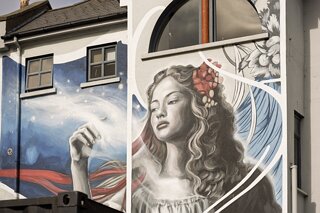
Curated Urban Storytelling: Notable works—such as Lula Goce’s Boann on Abbey Lane, Nina Valkhoff’s Étaín on Meat Market Lane, and ThisIsFriz’s Morrígan on Patrick Street—have transformed Drogheda into an open-air gallery, complete with self-guided audio trails that anchor regional folklore directly into the street architecture.
A return to Drogheda reveals an urban canvas in transition, shifting steadily from raw, informal expression to structured, sanctioned public art. Yet, returning two years after a September 2024 visit, the pace of evolution feels surprisingly muted—yielding only two major additions to the streetscape. While a proper survey of the town’s flagship murals will require a dedicated follow-up trip, the broader trajectory of Drogheda’s visual landscape over the past two decades remains striking.
The Early Outpost: During the late 2000s and 2010s, Drogheda earned an organic reputation as a favoured haven for writers and painters. Railway arches, industrial laneways, and the stone spans along the River Boyne served as accessible, low-pressure havens for spontaneous work long before formal municipal art trails took shape.
The DRAWDA Initiative: A decisive turning point arrived through a collaboration between Droichead Arts Centre, Love Drogheda B.I.D.S., Louth County Council, and curator Dee Walsh. Moving away from isolated decorative pieces, the town pivoted toward curated public art, commissioning leading Irish and international figures to interpret the rich mythology of the Boyne Valley.
Curated Urban Storytelling: Notable works—such as Lula Goce’s Boann on Abbey Lane, Nina Valkhoff’s Étaín on Meat Market Lane, and ThisIsFriz’s Morrígan on Patrick Street—have transformed Drogheda into an open-air gallery, complete with self-guided audio trails that anchor regional folklore directly into the street architecture.
RANDOM STREET ART