AND ANOTHER HOTEL IS ON THE WAY
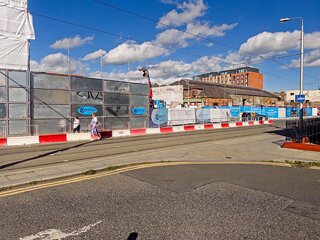
THE WRECKING BALL HAS ARRIVED FOR FEGAN'S [CHANCERY STREET 21 SEPTEMBER 2026]
The Fegan's Site on Chancery Street: A Dublin Landmark Falls to the Wrecking Ball
A walk down Chancery Street confirms what local planning notices had signalled: demolition is actively underway across the former Fegan’s Cash & Carry site. Scaffolding, protective hoardings, and heavy plant now enclose the corner of Chancery Street and St. Michan’s Place, systematically taking down the multi-storey brick and warehouse structures. The ongoing works mark the physical conclusion of a commercial presence woven into the fabric of Dublin’s north inner city for over a century.
James Fegan, originally from Rathfriland, County Down, arrived in Dublin in the early 1920s. Finding employment scarce, he took the entrepreneurial route, establishing a small shop in Smithfield. Through sheer determination, he nurtured the venture into Fegan’s Cash & Carry. While the exact opening date of the earliest premises remains informal lore, "Fegan’s 1924"—the restaurant and café that traded on the site until shortly before the pandemic—commemorated the company’s founding year.
Over the decades, the business transitioned from WM Fegan into Fegan’s Cash & Carry, eventually shifting primary wholesale operations out to Finglas. However, the Chancery Street hub retained deep local resonance as an evocative survivor of Dublin’s traditional inner-city merchant past.
What Is Replacing It? Planning Details and Recent Amendments
Following the initial planning application (Ref: WEB2214/24), Dublin City Council granted permission for total demolition, and after an appeal to An Coimisiún Pleanála was withdrawn, a final grant of permission was secured. Subsequent minor amendment filings by developers OBA Chancery Limited refined the internal layouts and overall floor plans.
The site—bounded by Chancery Street to the south, St. Michan’s Place to the west, Dublin City Council lands/car park to the north, and St. Michan’s Street to the east—is being redeveloped into a high-density, mixed-use scheme rising 7 to 8 storeys (approximately 26.4 metres in height) over a reconfigured basement:
Large-Scale Tourist Hostel: A major accommodation facility comprising 93 to 96 bedrooms arranged to sleep upwards of 500 to nearly 600 guests across private rooms and 4-to-10-person dormitories. Amenities include an expansive ground-floor reception lobby featuring an ancillary café/bar and co-working hub fronting Chancery Street, alongside an on-site gym, guest kitchen/dining room, guest cinema, and luggage storage.
12 Build-to-Rent / Residential Apartments: Dedicated residential accommodation comprising six 1-bedroom and six 2-bedroom units spanning the first to sixth floors. Each home includes a private balcony, access via a separate entrance lobby on St. Michan’s Street, and use of a 7th-floor communal roof terrace.
Ancillary Infrastructure: Plant equipment, refuse and laundry storage, ESB substations, green/blue roofs, and extensive indoor bicycle parking across the ground and basement levels.
The Changing Face of Dublin 7's Wholesale Quarter
The sight of excavators breaking through Fegan's masonry is part of a sweeping structural shift across Dublin's historic wholesale district. The traditional markets ecosystem—long defined by early-morning lorry traffic, fruit and vegetable crates, and sprawling storage yards—is rapidly giving way to hotels, short-stay hostels, and student accommodation.
Several forces continue to drive this transformation:
Commercial Realities: Modern logistics models, edge-of-city distribution centres, and online wholesale have made central, street-level depots commercially unviable for haulage and trade.
Tourism and Bed-Space Demand: With Dublin 7 bordering the city centre, the Luas Red Line, and major cultural attractions, high-density visitor accommodation delivers exceptional operational yield per square metre.
Planning Policy and Urban Density: City planners actively encourage the regeneration of underutilised brownfield land close to transit links, favouring taller, compact buildings over low-slung warehouse sheds.
Weighing the Local Impact
Realised and Potential Benefits:
Street Life and Footfall: Generates sustained day-and-night foot traffic, supports a vibrant streetscape, and introduces new ground-floor café life.
Built Environment: Replaces dated, energy-inefficient, and partly derelict structures with modern, sustainable building standards.
Local Economy: Creates permanent hospitality employment and channels visitor spending directly into neighbouring Dublin 7 shops, bars, and eateries.
Long-Term Concerns:
Community Fabric: Increases the ratio of transient, short-stay visitor populations relative to settled, long-term neighbourhood residents.
Heritage Loss: Accelerates the erasure of Dublin's vernacular 20th-century commercial and industrial architectural character.
Market Pressures: Contributes to broader commercial rate increases and real-estate appreciation, placing cost pressures on remaining traditional merchants and residents.
Watching the Chancery Street buildings come down brings home just how swiftly Dublin is turning the page on its mercantile heritage. The new development will inject substantial footfall into St. Michan's and Chancery Street, yet another tangible chapter of traditional Dublin street life slips into history.
The Fegan's Site on Chancery Street: A Dublin Landmark Falls to the Wrecking Ball
A walk down Chancery Street confirms what local planning notices had signalled: demolition is actively underway across the former Fegan’s Cash & Carry site. Scaffolding, protective hoardings, and heavy plant now enclose the corner of Chancery Street and St. Michan’s Place, systematically taking down the multi-storey brick and warehouse structures. The ongoing works mark the physical conclusion of a commercial presence woven into the fabric of Dublin’s north inner city for over a century.
James Fegan, originally from Rathfriland, County Down, arrived in Dublin in the early 1920s. Finding employment scarce, he took the entrepreneurial route, establishing a small shop in Smithfield. Through sheer determination, he nurtured the venture into Fegan’s Cash & Carry. While the exact opening date of the earliest premises remains informal lore, "Fegan’s 1924"—the restaurant and café that traded on the site until shortly before the pandemic—commemorated the company’s founding year.
Over the decades, the business transitioned from WM Fegan into Fegan’s Cash & Carry, eventually shifting primary wholesale operations out to Finglas. However, the Chancery Street hub retained deep local resonance as an evocative survivor of Dublin’s traditional inner-city merchant past.
What Is Replacing It? Planning Details and Recent Amendments
Following the initial planning application (Ref: WEB2214/24), Dublin City Council granted permission for total demolition, and after an appeal to An Coimisiún Pleanála was withdrawn, a final grant of permission was secured. Subsequent minor amendment filings by developers OBA Chancery Limited refined the internal layouts and overall floor plans.
The site—bounded by Chancery Street to the south, St. Michan’s Place to the west, Dublin City Council lands/car park to the north, and St. Michan’s Street to the east—is being redeveloped into a high-density, mixed-use scheme rising 7 to 8 storeys (approximately 26.4 metres in height) over a reconfigured basement:
Large-Scale Tourist Hostel: A major accommodation facility comprising 93 to 96 bedrooms arranged to sleep upwards of 500 to nearly 600 guests across private rooms and 4-to-10-person dormitories. Amenities include an expansive ground-floor reception lobby featuring an ancillary café/bar and co-working hub fronting Chancery Street, alongside an on-site gym, guest kitchen/dining room, guest cinema, and luggage storage.
12 Build-to-Rent / Residential Apartments: Dedicated residential accommodation comprising six 1-bedroom and six 2-bedroom units spanning the first to sixth floors. Each home includes a private balcony, access via a separate entrance lobby on St. Michan’s Street, and use of a 7th-floor communal roof terrace.
Ancillary Infrastructure: Plant equipment, refuse and laundry storage, ESB substations, green/blue roofs, and extensive indoor bicycle parking across the ground and basement levels.
The Changing Face of Dublin 7's Wholesale Quarter
The sight of excavators breaking through Fegan's masonry is part of a sweeping structural shift across Dublin's historic wholesale district. The traditional markets ecosystem—long defined by early-morning lorry traffic, fruit and vegetable crates, and sprawling storage yards—is rapidly giving way to hotels, short-stay hostels, and student accommodation.
Several forces continue to drive this transformation:
Commercial Realities: Modern logistics models, edge-of-city distribution centres, and online wholesale have made central, street-level depots commercially unviable for haulage and trade.
Tourism and Bed-Space Demand: With Dublin 7 bordering the city centre, the Luas Red Line, and major cultural attractions, high-density visitor accommodation delivers exceptional operational yield per square metre.
Planning Policy and Urban Density: City planners actively encourage the regeneration of underutilised brownfield land close to transit links, favouring taller, compact buildings over low-slung warehouse sheds.
Weighing the Local Impact
Realised and Potential Benefits:
Street Life and Footfall: Generates sustained day-and-night foot traffic, supports a vibrant streetscape, and introduces new ground-floor café life.
Built Environment: Replaces dated, energy-inefficient, and partly derelict structures with modern, sustainable building standards.
Local Economy: Creates permanent hospitality employment and channels visitor spending directly into neighbouring Dublin 7 shops, bars, and eateries.
Long-Term Concerns:
Community Fabric: Increases the ratio of transient, short-stay visitor populations relative to settled, long-term neighbourhood residents.
Heritage Loss: Accelerates the erasure of Dublin's vernacular 20th-century commercial and industrial architectural character.
Market Pressures: Contributes to broader commercial rate increases and real-estate appreciation, placing cost pressures on remaining traditional merchants and residents.
Watching the Chancery Street buildings come down brings home just how swiftly Dublin is turning the page on its mercantile heritage. The new development will inject substantial footfall into St. Michan's and Chancery Street, yet another tangible chapter of traditional Dublin street life slips into history.
THE LAST DAYS OF FEGAN'S