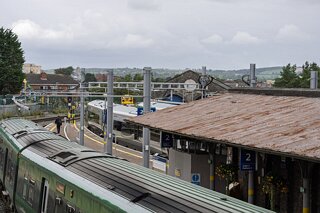
PHOTOGRAPHED 9 SEPTEMBER 2026
Drogheda railway station (officially Drogheda MacBride railway station) serves as a critical junction on Ireland's eastern transport corridor, linking County Louth directly with Dublin and Belfast
History
1844 Opening: The railway arrived in Drogheda on 25 May 1844 under the Dublin and Drogheda Railway Company. The initial terminus was located south of the River Boyne.
The Boyne Viaduct (1855): Through-running to Dundalk and Belfast required spanning the deep Boyne valley. Designed by civil engineer Sir John Macneill and engineer William Bindon Blood, the iconic 30-metre-high Boyne Viaduct opened for rail traffic in 1855, creating an uninterrupted Dublin–Belfast railway line.
The Great Northern Era: In 1876, several regional lines merged to form the Great Northern Railway (Ireland) — the GNR(I) — making Drogheda a key intermediate hub with extensive locomotive maintenance facilities, goods sidings, and a branch line inland toward Navan and Oldcastle.
1966 Renaming: Marking the 50th anniversary of the 1916 Easter Rising, Córas Iompair Éireann (CIÉ) renamed the station Drogheda MacBride in honour of the executed republican leader Major John MacBride.
Current Status
Drogheda MacBride is operated by Iarnród Éireann (Irish Rail) and acts as one of the busiest regional rail stations outside Dublin.
Northern Commuter Services: It serves as the primary northern terminus for Dublin commuter services, running frequent diesel multiple-unit (DMU) trains through to Dublin Connolly, Tara Street, and Dublin Pearse.
Enterprise InterCity Link: Drogheda is a scheduled stop on the cross-border Enterprise service jointly operated by Iarnród Éireann and Translink, providing direct rail connections between Dublin Connolly and Belfast Grand Central.
Freight and Operational Role: The station retains a loop and sidings for operational movements, including freight operations associated with regional industry (such as tara zinc and cement traffic).
Facilities: Amenities include a staffed ticket office, automated ticket vending machines, waiting rooms, sheltered platforms, a multi-storey car park, and step-free accessibility with lifts servicing both main platforms.
Future Plans
Drogheda is the northern anchor of the multi-billion-euro DART+ Programme, specifically the DART+ Coastal North project.
Full Route Electrification: Overhead 1,500V DC electrification is being extended approximately 37 kilometres northward from Malahide to Drogheda, converting the route into a full rapid-transit corridor.
Battery-Electric Rollout (BEMU): To deliver capacity ahead of overhead wiring works, Iarnród Éireann ordered a fleet of Alstom battery-electric DART trains capable of running under overhead wires to Malahide and switching to on-board battery power north to Drogheda, supported by fast-charging infrastructure at Drogheda depot facilities.
Capacity and Frequency Doubling: Peak capacity between Drogheda and Dublin city centre will more than double, taking peak hourly passenger capacity from roughly 12,500 to over 26,000.
Station Enhancements & Stabling: Works include reconfiguring approach tracks, upgrading signalling systems, adding dedicated train stabling facilities, and providing an additional turnback platform to manage high-frequency arrivals and departures.
History
1844 Opening: The railway arrived in Drogheda on 25 May 1844 under the Dublin and Drogheda Railway Company. The initial terminus was located south of the River Boyne.
The Boyne Viaduct (1855): Through-running to Dundalk and Belfast required spanning the deep Boyne valley. Designed by civil engineer Sir John Macneill and engineer William Bindon Blood, the iconic 30-metre-high Boyne Viaduct opened for rail traffic in 1855, creating an uninterrupted Dublin–Belfast railway line.
The Great Northern Era: In 1876, several regional lines merged to form the Great Northern Railway (Ireland) — the GNR(I) — making Drogheda a key intermediate hub with extensive locomotive maintenance facilities, goods sidings, and a branch line inland toward Navan and Oldcastle.
1966 Renaming: Marking the 50th anniversary of the 1916 Easter Rising, Córas Iompair Éireann (CIÉ) renamed the station Drogheda MacBride in honour of the executed republican leader Major John MacBride.
Current Status
Drogheda MacBride is operated by Iarnród Éireann (Irish Rail) and acts as one of the busiest regional rail stations outside Dublin.
Northern Commuter Services: It serves as the primary northern terminus for Dublin commuter services, running frequent diesel multiple-unit (DMU) trains through to Dublin Connolly, Tara Street, and Dublin Pearse.
Enterprise InterCity Link: Drogheda is a scheduled stop on the cross-border Enterprise service jointly operated by Iarnród Éireann and Translink, providing direct rail connections between Dublin Connolly and Belfast Grand Central.
Freight and Operational Role: The station retains a loop and sidings for operational movements, including freight operations associated with regional industry (such as tara zinc and cement traffic).
Facilities: Amenities include a staffed ticket office, automated ticket vending machines, waiting rooms, sheltered platforms, a multi-storey car park, and step-free accessibility with lifts servicing both main platforms.
Future Plans
Drogheda is the northern anchor of the multi-billion-euro DART+ Programme, specifically the DART+ Coastal North project.
Full Route Electrification: Overhead 1,500V DC electrification is being extended approximately 37 kilometres northward from Malahide to Drogheda, converting the route into a full rapid-transit corridor.
Battery-Electric Rollout (BEMU): To deliver capacity ahead of overhead wiring works, Iarnród Éireann ordered a fleet of Alstom battery-electric DART trains capable of running under overhead wires to Malahide and switching to on-board battery power north to Drogheda, supported by fast-charging infrastructure at Drogheda depot facilities.
Capacity and Frequency Doubling: Peak capacity between Drogheda and Dublin city centre will more than double, taking peak hourly passenger capacity from roughly 12,500 to over 26,000.
Station Enhancements & Stabling: Works include reconfiguring approach tracks, upgrading signalling systems, adding dedicated train stabling facilities, and providing an additional turnback platform to manage high-frequency arrivals and departures.
DROGHEDA TRAIN STATION