The Drogheda Viaduct In Context 9 September 2026
IN DROGHEDA THE MAIN ATTRACTION IS THE BOYNE VIADUCT [IN CONTEXT 9 SEPTEMBER 2026]
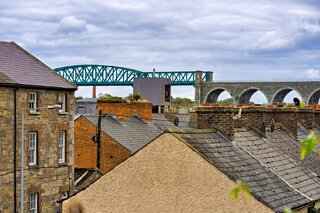
The Boyne Viaduct in Drogheda, County Louth, is one of the most celebrated civil engineering achievements in nineteenth-century railway history, serving as the final link in the continuous rail corridor between Dublin and Belfast.
Engineering History & Original Conception
Bridging the Divide: When the Dublin & Drogheda Railway opened in 1844 and the Dublin & Belfast Junction Railway pushed south from Dundalk, trains could not cross the deep river valley of the River Boyne. Passengers and freight had to be transferred by horse-drawn omnibuses and carts through the town of Drogheda between the two separate termini.
The Pioneer Behind the Line: Sir John Macneill, a prominent Irish civil engineer and former assistant to Thomas Telford, served as chief engineer. Confronted by a river valley nearly 30 metres (100 feet) deep and over 500 metres wide, he designed a structure comprising massive masonry approach viaducts spanning either bank, joined over the river by a continuous wrought-iron lattice girder.
Theoretical Groundwork: Irish engineer William Bindon Blood assisted Macneill by developing fundamental mathematical analyses of stresses in multiple-lattice webs. This groundbreaking theoretical work helped transform bridge engineering from empirical guesswork into a calculated science.
Construction & Opening (1851–1855): Construction began in 1851 with the sinking of deep foundation piers and the erection of Irish limestone and granite arches. The original viaduct carried its first test train in March 1855 and formally opened to double-track traffic shortly after, proving to be the seventh-longest bridge in the world at the time of its completion.
Original Structural Design
Approach Arches: The viaduct extends across fifteen semicircular masonry approach arches: twelve on the south bank leading out of Drogheda station and three on the north bank.
Central Metal Spans: The river crossing was bridged by three continuous wrought-iron lattice spans—a central navigation span measuring 81 metres (267 feet) flanked by two 43-metre (141-foot) side spans.
Continuous Girder Innovation: The superstructure was constructed as a continuous beam across its supports rather than independent simply-supported spans, making it one of the earliest large-scale continuous-girder railway bridges erected worldwide.
Navigation Clearance: The deck was fixed at roughly 29 metres above high-water mark to allow tall-masted sailing vessels unhindered access to Drogheda's busy inland quays.
Reconstruction in the 1930s
Rising Locomotive Axle Loads: By the 1920s, heavier steam locomotives—such as the Great Northern Railway’s three-cylinder compound 4-4-0s—placed stress levels on the original wrought-iron lattice that exceeded safe operating margins.
The 1930–1932 Overhaul: Between 1930 and 1932, the Great Northern Railway undertook a complete reconstruction of the superstructure. The British steel engineering firm the Motherwell Bridge & Engineering Co. designed and fabricated new steel Pratt trusses to replace the mid-nineteenth-century lattice work.
Conversion to Single Track: To balance the weight of modern heavier rolling stock with the bearing capacity of the original limestone river piers, the bridge deck was reconfigured from a twin-track layout to a single interlaced/single track across the steel spans, flanked by wide pedestrian inspection walkways.
Uninterrupted Operations: The reconstruction stands out as a remarkable operational feat: the replacement trusses were assembled around and rolled into place while scheduled train services were maintained across the crossing with minimal disruptions.
Modern Refurbishment & Preservation
Extensive Restoration (2013–2015): Iarnród Éireann carried out an extensive €6.1 million conservation programme on the viaduct. Work included full grit-blasting, anti-corrosion repainting of the 1930s steel trusses, repointing of the stone masonry, and timber deck replacements.
Protected Heritage Asset: The structure is designated a National Monument of architectural and engineering heritage and remains fully operational, accommodating high-frequency daily commuter trains and cross-border Enterprise passenger services.
THE BOYNE VIADUCT