First Look: Testing the Sony FE 100-400mm f/5.6-8 OSS across Broadstone and Grangegorman
Sourcing the Glass: A Serendipitous Dublin Encounter
Yesterday, 7 September 2026, I finally got my hands on the newly released Sony FE 100-400mm f/5.6-8 OSS. Like many others, I placed a pre-order the moment Sony officially unveiled the optic. However, product dispatch delays left my regular photographic dealer with no firm arrival date.
A chance encounter solved the impasse: while out in town a few days ago, I spotted a fellow photographer carrying this exact lens mounted to a Sony body. A quick query pointed me towards an alternative local dealer. After verifying that my original shop remained in limbo, I cancelled the standing order and walked straight into the competitor’s shop, which had three boxed units sitting on the shelf ready to buy.
Revisiting the Benchmark: Broadstone and Grangegorman
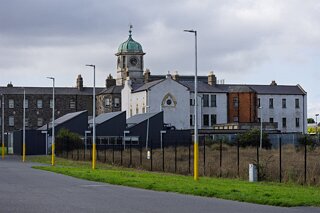
Back in December 2022, when I acquired the Sony FX30 paired with the FE 24-105mm f/4 G OSS, I took it straight through Broadstone and Grangegorman to establish a baseline. Returning to the exact same urban territory offers a dependable, repeatable visual reference.
For this inaugural run, I kept the camera in full auto mode. The primary objective was not nuanced artistic deliberation, but standard quality assurance: verifying that the autofocus locks promptly, image stabilisation engages properly, and aperture communication between camera and mount operates without issue. The lens handled every initial test without missing a beat.
Industry Reception: What Reviews and Early Adopters Say
Online reception and professional teardowns highlight several distinct strengths and operational realities regarding Sony’s budget-friendly super-telephoto:
Remarkable Portability: Weighing approximately 654 grams with a 67 mm filter thread, it weighs less than half of the FE 100-400mm f/4.5-5.6 GM. Reviewers consistently praise its handheld balance for walking tours, street vantage points, and packable travel.
The Aperture Trade-Off: The maximum aperture transitions relatively quickly, stepping down to f/8 around the 205 mm mark. In bright daylight this is negligible, but reviewers caution that dusk or overcast conditions push sensor sensitivity noticeably upwards.
Optical Delivery: Central sharpness is crisp throughout the focal range. While corner resolution softens slightly at extreme minimum focus distances on the 100 mm end, edge-to-edge rendering tightens up well at standard street and architectural working distances.
Autofocus and Handling: Driven by dual linear motors, autofocus tracking is swift, quiet, and responsive. It retains full compatibility with Sony’s 1.4x and 2.0x teleconverters—a welcome bonus for a compact lens in this class.
Weather Sealing Nuances: While Sony specifies basic dust and moisture sealing at joints and seams, user feedback stresses that it lacks the heavy-duty gaskets of G Master chassis. Cautious handling during inclement weather remains essential.
Looking Ahead
With the benchmark run completed around Broadstone, the next evaluation will be a dedicated shooting excursion to Drogheda. Provided performance remains consistent, the lens will earn a place in the bag for upcoming photographic work in Limerick this October, followed by Belfast towards Christmas—fair weather permitting.
And Of Course Sony Announces Another Lens
Sony announced the FE 8-14mm f/3.5 Fisheye G (SEL814G) on September 8, 2026, marking their first native full-frame fisheye for the E-mount system. Rather than going the traditional route of an ultra-wide prime, they engineered a dual-personality fisheye zoom directly addressing one of the few remaining gaps in their catalogue.
Specifications & Optical Profile
Circular to Diagonal in One Barrel: On a full-frame sensor, 8mm delivers an authentic 180° circular fisheye with circular projection and full black vignette borders. Zooming to 14mm expands the coverage into a 180° diagonal (frame-filling) fisheye.
Physical Footprint: At roughly 314 g and measuring 63.1 × 82.8 mm, it is remarkably lightweight and compact compared to adapted DSLR classics (such as the Canon EF 8-15mm f/4L or Nikon AF-S 8-15mm).
Aperture & Mechanics: Constant f/3.5 through the zoom range. It features an internal zoom mechanism (critical for gimbal and balance stability) and includes an aperture ring (de-clickable for video).
Dedicated Hardware Controls: Includes a physical Zoom Lock (to prevent drifting out of the distinct 8mm or 14mm sweet spots), an AF/MF switch with a Focus Hold (FH) setting, and a removable hood.
Focusing: Dual linear motors driving swift AF capable of 120 fps tracking, down to a minimum focusing distance of 0.15 m (0.22x magnification).
Pricing & Availability: Priced at $1,599.99 USD (£1,499 / €1,700 tier), shipping in October 2026.
Practical Considerations & Shooting Dynamics
Sensor Matching (Full-Frame vs. Super 35 / APS-C)
On Full-Frame, the lens delivers the complete split personality. At 8mm you have the circular portal aesthetic (often favoured for hemispherical panoramas, VR, and spherical ceiling captures); by 14mm it covers corner-to-corner as an ultra-wide diagonal fisheye. The intermediate focal lengths between 9mm and 13mm introduce partial cut-offs that require cropping or specific framing.
On APS-C / Super 35, the sensor crop cuts out the circular border at 8mm, turning it into a diagonal fisheye from 8mm through to a mild curvilinear wide at 14mm.
Handling the Curvilinear Perspective
Unlike rectilinear ultra-wides (like a 12-24mm or 16-35mm), straight lines bend aggressively unless placed precisely dead centre through the optical axis. For architecture, tight laneways, street murals, and interiors, this affords dramatic hemispherical immersion without the edge stretching common to rectilinear optics. However, it requires deliberate composition to ensure barrel distortion enhances the geometry rather than distracting from it.
Front Element and Filter Logistics
Due to the bulbous front element necessary for a 180° field of view, standard screw-on front filters are not supported. Sony has implemented a rear gelatin/sheet filter holder at the mount. The lens hood must be removed when shooting at 8mm to prevent physical vignetting, and attached at 14mm to shield against stray flare.
Choosing between the Sony FE 8-14mm f/3.5 Fisheye G and an ultra-wide rectilinear zoom like the FE 12-24mm f/4 G (or f/2.8 GM) comes down to how each handles geometry, spatial tension, and practical street craft.
Core Specifications at a Glance
Optical Mapping: The 8-14mm uses curvilinear projection with barrel distortion, whereas the 12-24mm is strictly rectilinear, rendering straight lines straight.
Field of View: The 8-14mm provides up to a 180° diagonal or circular view. The 12-24mm covers 122° at 12mm down to 84° at 24mm.
Dimensions and Weight: The 8-14mm is exceptionally compact at 314 g (63.1 × 82.8 mm). The 12-24mm f/4 G weighs 565 g (87 × 117.4 mm), while the f/2.8 GM reaches 847 g.
Edge Proportions: The 8-14mm preserves local subject proportions across the frame while bending linear structures. The 12-24mm keeps straight lines true, but introduces noticeable rectilinear edge stretching ("volume anamorphosis").
Post-Processing Demands: Defishing an 8-14mm file requires severe pixel interpolation and heavy cropping. The 12-24mm requires only standard optical profile corrections and keystone adjustments.
Architectural Documentation
The Case for the 12-24mm: For structural recording, the rectilinear 12-24mm remains the proper standard. Architectural documentation relies on orthographic fidelity—parallel facades, vertical columns, and level bands. While a 12mm rectilinear perspective introduces converging keystones when tilted, straight lines remain straight and can be brought plumb in post-processing without losing corner detail.
The Fisheye Reality: On a full-frame sensor, the 8-14mm bends every line that does not run dead centre through the optical axis. In civic architecture or heritage recording, this curvilinear rendering can obscure true structural proportions. Defishing an image shot at 14mm in software like DxO ViewPoint or Lightroom stretches corner pixels substantially, visibly softening edge definition and cropping away much of the field of view.
Where the 8-14mm Shines: Grand vaulted spaces, including cathedral naves, rail terminuses, rotunda ceilings, and spiral stairwells, where spherical curves accentuate the volumetric sweep rather than fighting it.
Street Photography & Public Art
Handling and Packability: At just 314 g, the 8-14mm is substantially smaller and lighter than either version of the 12-24mm. For walking routes through city streets, it offers superior balance handheld and draws far less attention.
People Near the Edges: Because rectilinear lenses force a spherical view onto a flat plane, subjects near the outer frame stretch sideways. A pedestrian walking into the edge of a 12mm frame appears unnaturally widened. The 8-14mm fisheye preserves human scale and body mass organically, even if pavements and lamp posts bend around them.
Tight Laneways and Murals: In narrow alleys or confined urban spaces, a 14mm diagonal fisheye allows you to capture an entire multi-storey mural or overhead structure without stepping backwards into traffic. Furthermore, the 0.15 m minimum focus distance allows you to isolate small street details or textures against an expansive, curved contextual background.
The Practical Verdict
Choose the 12-24mm for disciplined, faithful urban documentation where building facades, bridge engineering, and public monuments must remain square and true to reality.
Choose the 8-14mm Fisheye G for an ultra-compact secondary lens to capture immersive, dynamic street atmospheres—enveloping murals, tight interiors, underpasses, and towering public works where dramatic spherical curves serve the image.
Yesterday, 7 September 2026, I finally got my hands on the newly released Sony FE 100-400mm f/5.6-8 OSS. Like many others, I placed a pre-order the moment Sony officially unveiled the optic. However, product dispatch delays left my regular photographic dealer with no firm arrival date.
A chance encounter solved the impasse: while out in town a few days ago, I spotted a fellow photographer carrying this exact lens mounted to a Sony body. A quick query pointed me towards an alternative local dealer. After verifying that my original shop remained in limbo, I cancelled the standing order and walked straight into the competitor’s shop, which had three boxed units sitting on the shelf ready to buy.
Revisiting the Benchmark: Broadstone and Grangegorman
Back in December 2022, when I acquired the Sony FX30 paired with the FE 24-105mm f/4 G OSS, I took it straight through Broadstone and Grangegorman to establish a baseline. Returning to the exact same urban territory offers a dependable, repeatable visual reference.
For this inaugural run, I kept the camera in full auto mode. The primary objective was not nuanced artistic deliberation, but standard quality assurance: verifying that the autofocus locks promptly, image stabilisation engages properly, and aperture communication between camera and mount operates without issue. The lens handled every initial test without missing a beat.
Industry Reception: What Reviews and Early Adopters Say
Online reception and professional teardowns highlight several distinct strengths and operational realities regarding Sony’s budget-friendly super-telephoto:
Remarkable Portability: Weighing approximately 654 grams with a 67 mm filter thread, it weighs less than half of the FE 100-400mm f/4.5-5.6 GM. Reviewers consistently praise its handheld balance for walking tours, street vantage points, and packable travel.
The Aperture Trade-Off: The maximum aperture transitions relatively quickly, stepping down to f/8 around the 205 mm mark. In bright daylight this is negligible, but reviewers caution that dusk or overcast conditions push sensor sensitivity noticeably upwards.
Optical Delivery: Central sharpness is crisp throughout the focal range. While corner resolution softens slightly at extreme minimum focus distances on the 100 mm end, edge-to-edge rendering tightens up well at standard street and architectural working distances.
Autofocus and Handling: Driven by dual linear motors, autofocus tracking is swift, quiet, and responsive. It retains full compatibility with Sony’s 1.4x and 2.0x teleconverters—a welcome bonus for a compact lens in this class.
Weather Sealing Nuances: While Sony specifies basic dust and moisture sealing at joints and seams, user feedback stresses that it lacks the heavy-duty gaskets of G Master chassis. Cautious handling during inclement weather remains essential.
Looking Ahead
With the benchmark run completed around Broadstone, the next evaluation will be a dedicated shooting excursion to Drogheda. Provided performance remains consistent, the lens will earn a place in the bag for upcoming photographic work in Limerick this October, followed by Belfast towards Christmas—fair weather permitting.
And Of Course Sony Announces Another Lens
Sony announced the FE 8-14mm f/3.5 Fisheye G (SEL814G) on September 8, 2026, marking their first native full-frame fisheye for the E-mount system. Rather than going the traditional route of an ultra-wide prime, they engineered a dual-personality fisheye zoom directly addressing one of the few remaining gaps in their catalogue.
Specifications & Optical Profile
Circular to Diagonal in One Barrel: On a full-frame sensor, 8mm delivers an authentic 180° circular fisheye with circular projection and full black vignette borders. Zooming to 14mm expands the coverage into a 180° diagonal (frame-filling) fisheye.
Physical Footprint: At roughly 314 g and measuring 63.1 × 82.8 mm, it is remarkably lightweight and compact compared to adapted DSLR classics (such as the Canon EF 8-15mm f/4L or Nikon AF-S 8-15mm).
Aperture & Mechanics: Constant f/3.5 through the zoom range. It features an internal zoom mechanism (critical for gimbal and balance stability) and includes an aperture ring (de-clickable for video).
Dedicated Hardware Controls: Includes a physical Zoom Lock (to prevent drifting out of the distinct 8mm or 14mm sweet spots), an AF/MF switch with a Focus Hold (FH) setting, and a removable hood.
Focusing: Dual linear motors driving swift AF capable of 120 fps tracking, down to a minimum focusing distance of 0.15 m (0.22x magnification).
Pricing & Availability: Priced at $1,599.99 USD (£1,499 / €1,700 tier), shipping in October 2026.
Practical Considerations & Shooting Dynamics
Sensor Matching (Full-Frame vs. Super 35 / APS-C)
On Full-Frame, the lens delivers the complete split personality. At 8mm you have the circular portal aesthetic (often favoured for hemispherical panoramas, VR, and spherical ceiling captures); by 14mm it covers corner-to-corner as an ultra-wide diagonal fisheye. The intermediate focal lengths between 9mm and 13mm introduce partial cut-offs that require cropping or specific framing.
On APS-C / Super 35, the sensor crop cuts out the circular border at 8mm, turning it into a diagonal fisheye from 8mm through to a mild curvilinear wide at 14mm.
Handling the Curvilinear Perspective
Unlike rectilinear ultra-wides (like a 12-24mm or 16-35mm), straight lines bend aggressively unless placed precisely dead centre through the optical axis. For architecture, tight laneways, street murals, and interiors, this affords dramatic hemispherical immersion without the edge stretching common to rectilinear optics. However, it requires deliberate composition to ensure barrel distortion enhances the geometry rather than distracting from it.
Front Element and Filter Logistics
Due to the bulbous front element necessary for a 180° field of view, standard screw-on front filters are not supported. Sony has implemented a rear gelatin/sheet filter holder at the mount. The lens hood must be removed when shooting at 8mm to prevent physical vignetting, and attached at 14mm to shield against stray flare.
Choosing between the Sony FE 8-14mm f/3.5 Fisheye G and an ultra-wide rectilinear zoom like the FE 12-24mm f/4 G (or f/2.8 GM) comes down to how each handles geometry, spatial tension, and practical street craft.
Core Specifications at a Glance
Optical Mapping: The 8-14mm uses curvilinear projection with barrel distortion, whereas the 12-24mm is strictly rectilinear, rendering straight lines straight.
Field of View: The 8-14mm provides up to a 180° diagonal or circular view. The 12-24mm covers 122° at 12mm down to 84° at 24mm.
Dimensions and Weight: The 8-14mm is exceptionally compact at 314 g (63.1 × 82.8 mm). The 12-24mm f/4 G weighs 565 g (87 × 117.4 mm), while the f/2.8 GM reaches 847 g.
Edge Proportions: The 8-14mm preserves local subject proportions across the frame while bending linear structures. The 12-24mm keeps straight lines true, but introduces noticeable rectilinear edge stretching ("volume anamorphosis").
Post-Processing Demands: Defishing an 8-14mm file requires severe pixel interpolation and heavy cropping. The 12-24mm requires only standard optical profile corrections and keystone adjustments.
Architectural Documentation
The Case for the 12-24mm: For structural recording, the rectilinear 12-24mm remains the proper standard. Architectural documentation relies on orthographic fidelity—parallel facades, vertical columns, and level bands. While a 12mm rectilinear perspective introduces converging keystones when tilted, straight lines remain straight and can be brought plumb in post-processing without losing corner detail.
The Fisheye Reality: On a full-frame sensor, the 8-14mm bends every line that does not run dead centre through the optical axis. In civic architecture or heritage recording, this curvilinear rendering can obscure true structural proportions. Defishing an image shot at 14mm in software like DxO ViewPoint or Lightroom stretches corner pixels substantially, visibly softening edge definition and cropping away much of the field of view.
Where the 8-14mm Shines: Grand vaulted spaces, including cathedral naves, rail terminuses, rotunda ceilings, and spiral stairwells, where spherical curves accentuate the volumetric sweep rather than fighting it.
Street Photography & Public Art
Handling and Packability: At just 314 g, the 8-14mm is substantially smaller and lighter than either version of the 12-24mm. For walking routes through city streets, it offers superior balance handheld and draws far less attention.
People Near the Edges: Because rectilinear lenses force a spherical view onto a flat plane, subjects near the outer frame stretch sideways. A pedestrian walking into the edge of a 12mm frame appears unnaturally widened. The 8-14mm fisheye preserves human scale and body mass organically, even if pavements and lamp posts bend around them.
Tight Laneways and Murals: In narrow alleys or confined urban spaces, a 14mm diagonal fisheye allows you to capture an entire multi-storey mural or overhead structure without stepping backwards into traffic. Furthermore, the 0.15 m minimum focus distance allows you to isolate small street details or textures against an expansive, curved contextual background.
The Practical Verdict
Choose the 12-24mm for disciplined, faithful urban documentation where building facades, bridge engineering, and public monuments must remain square and true to reality.
Choose the 8-14mm Fisheye G for an ultra-compact secondary lens to capture immersive, dynamic street atmospheres—enveloping murals, tight interiors, underpasses, and towering public works where dramatic spherical curves serve the image.
MY NEW 100-400mm LENS