6 MAY 2026 VISIT TO KINGS INNS PARK
While the Honorable Society of King's Inns is renowned as Ireland's oldest legal institution, its grounds offer a tranquil, green sanctuary in Dublin 7 that serves as a vital public amenity for the local community. The park provides a quiet pedestrian link between Henrietta Street and Constitution Hill, often remaining a "hidden gem" compared to the city’s more crowded squares.
Some claim that if I leave by my Front Door I am in D1 and if I use the back Door I am in Dublin 7. This actually caused some issues in the past but my Eircode is now D01. It would appear that the buildings are considered to be in D1 while the park gate gates are considered to be in D7.
The Park at King's Inns
The grounds are an excellent example of Georgian landscaping, designed to complement the magnificent architecture of James Gandon, who was commissioned in 1800 to design the main buildings (King's Inns, n.d.). Unlike many private institutional gardens, the parkland is generally open to the public daily between 7:00 am and 7:30 pm, offering a peaceful atmosphere that draws a mix of law students, tourists, and local residents (Wikipedia, 2025).
The "Hungry Tree"
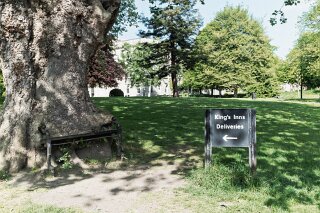
The park's most eccentric inhabitant is undoubtedly the Hungry Tree, an approximately 80-year-old London Plane (Platanus × hispanica) located near the Henrietta Street entrance (Atlas Obscura, n.d.).
The Phenomenon: The tree is famous for its slow-motion "consumption" of a 19th-century cast-iron bench. Over decades, the trunk has grown around and over the backrest, making it appear as though the metal is being swallowed by the bark (Griffin, 2018).
Heritage Status: Recognised for its unique cultural and botanical value, the tree is listed by the Tree Council of Ireland as one of the country's "Heritage Trees" and has been the subject of protection motions by Dublin City councillors (Dublin Live, 2017).
Popularity with Dogs
King's Inns Park is a favourite destination for Dublin's dog owners, primarily due to its fenced-in, off-leash areas and quiet nature (DogPack App, 2026).
Social Hub: Because it is less manicured and sprawling than St Stephen's Green, it provides a more relaxed environment for dogs to socialise.
Scent and Shade: The heavy presence of mature trees—including the Hungry Tree—provides ample shade and a rich sensory environment that dogs find particularly engaging.
Local Community: The park's relatively small size makes it a consistent meeting spot for a "pack" of regulars, fostering a tight-knit community of urban pet owners.
Despite the institution being the pinnacle of the Irish legal system—which uses British/Hiberno-English—the name itself contains a "missing" letter from the perspective of modern British spelling.
The Honorable Society of King's Inns uses the spelling "Honorable" (without the 'u') rather than the standard British "Honourable."
Why the American-style spelling?
While it looks like a modern "Americanism," it is actually a linguistic fossil.
Archaic Orthography: At the time of the Society’s formalisation and the naming of many such legal bodies, spelling was not yet strictly standardised. The "Honorable" spelling was a common variant in the 16th and 17th centuries before the 'u' became the rigid standard in British English.
Tradition over Trend: Because legal institutions are built on precedent and tradition, they almost never update their formal titles to match modern spelling conventions.
Distinction: It serves as a unique identifier for the Society, distinguishing its formal title from the general adjective used in everyday British or Irish prose.
So, while we might write about the "honourable" profession of law in Dublin, we must always refer to the Honorable Society of King's Inns to remain historically accurate.
Some claim that if I leave by my Front Door I am in D1 and if I use the back Door I am in Dublin 7. This actually caused some issues in the past but my Eircode is now D01. It would appear that the buildings are considered to be in D1 while the park gate gates are considered to be in D7.
The Park at King's Inns
The grounds are an excellent example of Georgian landscaping, designed to complement the magnificent architecture of James Gandon, who was commissioned in 1800 to design the main buildings (King's Inns, n.d.). Unlike many private institutional gardens, the parkland is generally open to the public daily between 7:00 am and 7:30 pm, offering a peaceful atmosphere that draws a mix of law students, tourists, and local residents (Wikipedia, 2025).
The "Hungry Tree"
The park's most eccentric inhabitant is undoubtedly the Hungry Tree, an approximately 80-year-old London Plane (Platanus × hispanica) located near the Henrietta Street entrance (Atlas Obscura, n.d.).
The Phenomenon: The tree is famous for its slow-motion "consumption" of a 19th-century cast-iron bench. Over decades, the trunk has grown around and over the backrest, making it appear as though the metal is being swallowed by the bark (Griffin, 2018).
Heritage Status: Recognised for its unique cultural and botanical value, the tree is listed by the Tree Council of Ireland as one of the country's "Heritage Trees" and has been the subject of protection motions by Dublin City councillors (Dublin Live, 2017).
Popularity with Dogs
King's Inns Park is a favourite destination for Dublin's dog owners, primarily due to its fenced-in, off-leash areas and quiet nature (DogPack App, 2026).
Social Hub: Because it is less manicured and sprawling than St Stephen's Green, it provides a more relaxed environment for dogs to socialise.
Scent and Shade: The heavy presence of mature trees—including the Hungry Tree—provides ample shade and a rich sensory environment that dogs find particularly engaging.
Local Community: The park's relatively small size makes it a consistent meeting spot for a "pack" of regulars, fostering a tight-knit community of urban pet owners.
Despite the institution being the pinnacle of the Irish legal system—which uses British/Hiberno-English—the name itself contains a "missing" letter from the perspective of modern British spelling.
The Honorable Society of King's Inns uses the spelling "Honorable" (without the 'u') rather than the standard British "Honourable."
Why the American-style spelling?
While it looks like a modern "Americanism," it is actually a linguistic fossil.
Archaic Orthography: At the time of the Society’s formalisation and the naming of many such legal bodies, spelling was not yet strictly standardised. The "Honorable" spelling was a common variant in the 16th and 17th centuries before the 'u' became the rigid standard in British English.
Tradition over Trend: Because legal institutions are built on precedent and tradition, they almost never update their formal titles to match modern spelling conventions.
Distinction: It serves as a unique identifier for the Society, distinguishing its formal title from the general adjective used in everyday British or Irish prose.
So, while we might write about the "honourable" profession of law in Dublin, we must always refer to the Honorable Society of King's Inns to remain historically accurate.
KINGS INNS PARK