ABOUT DICK JOYNT AND HIS DAUGHTER RACHEL
A COASTAL DIALOGUE IN STONE AND BRONZE [THE ART OF DICK AND RACHEL JOYNT]
Along the sweeping coastline connecting Dún Laoghaire and Glasthule, a unique artistic conversation spans two generations. Just about, maybe less, a kilometre apart stand two landmark public sculptures: Celebration by the late Dick Joynt, and Mothership by his daughter, Rachel Joynt. Though bound by blood and a shared mastery of physical form, the two artists navigated entirely different orbits when it came to materials, philosophy, and how art should inhabit a landscape.
Dick Joynt: Gravity and the Eternal Stone
Dick Joynt belonged to a generation of Irish sculptors who viewed their craft as an act of primal extraction. Initially training as a painter before shifting decisively to sculpture in the early 1970s, his practice was defined by direct carving. He did not seek to assemble or construct; he sought to find the form already sleeping within massive blocks of native Irish stone.
His sculpture Celebration, erected in 1986 during the historic Tír Cualainn Sculpture Symposium, is a masterclass in this earthbound philosophy. Carved from a massive block of Kilkenny limestone, the piece stands over two metres high near the Glasthule and Sandycove DART station precinct. It depicts stylized, heavy figures holding a child aloft.
The thought process here is centered on the timeless, unyielding strength of human connection. Joynt’s style relies on monumental weight and smooth, volumetric curves that give the figures an ancient, almost Neolithic presence. The location within the community green space of Eden Park was a deliberate choice to ground this universal monument within the daily fabric of residential life, offering a solid, unchanging anchor to the neighbourhood.
Rachel Joynt: Fluidity and the Civic Landscape
Where the father found truth in the solid mass of stone, Rachel Joynt embraces the fluid, the industrial, and the site-specific. A graduate of the National College of Art and Design, her career has been defined by expansive public commissions that utilize an additive, multi-material language—fusing cast bronze, stainless steel, glass, and iron.
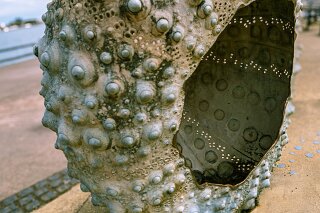
Her iconic Mothership, commissioned in 1999 and installed on the Newtownsmith promenade, represents a completely different relationship with the Dublin coast. Affectionately dubbed the "Sea Urchin" by locals, this massive bronze structure looks as if it were cast up by a high tide, leaving a dynamic trail of polished stainless steel droplets embedded in the walkway.
The brilliance of Mothership lies in its concept, which binds environmental beauty to heavy civil engineering. The piece was funded through the Percent for Art scheme tied to the major Dún Laoghaire Drainage Scheme. In an inspired bit of industrial synchronicity, Rachel designed the diameter of the bronze urchin to match the exact dimensions of the massive tunnelling pipes buried deep beneath the seafront.
The selection of the Newtownsmith seafront location was deeply intentional. Unlike her father's solid, self-contained limestone monument, Rachel’s bronze shell is hollow and interactive. It acts as an organic lens that frames the shifting light of the Irish Sea, inviting coastal walkers, children, and dogs to climb inside its frame. It does not just watch the community; it actively participates in their seaside recreation.
Two Philosophies, One Coastline
To walk from Celebration to Mothership is to witness a profound shift in twentieth-century Irish art. Dick Joynt used the heavy, ancient permanence of limestone to capture an enduring emotional truth. Rachel Joynt used the industrial flexibility of bronze and steel to mirror the marine environment and celebrate the invisible infrastructure keeping the coastline clean. Together, they form an extraordinary multi-generational landmark on the edge of the Dublin shoreline.
Along the sweeping coastline connecting Dún Laoghaire and Glasthule, a unique artistic conversation spans two generations. Just about, maybe less, a kilometre apart stand two landmark public sculptures: Celebration by the late Dick Joynt, and Mothership by his daughter, Rachel Joynt. Though bound by blood and a shared mastery of physical form, the two artists navigated entirely different orbits when it came to materials, philosophy, and how art should inhabit a landscape.
Dick Joynt: Gravity and the Eternal Stone
Dick Joynt belonged to a generation of Irish sculptors who viewed their craft as an act of primal extraction. Initially training as a painter before shifting decisively to sculpture in the early 1970s, his practice was defined by direct carving. He did not seek to assemble or construct; he sought to find the form already sleeping within massive blocks of native Irish stone.
His sculpture Celebration, erected in 1986 during the historic Tír Cualainn Sculpture Symposium, is a masterclass in this earthbound philosophy. Carved from a massive block of Kilkenny limestone, the piece stands over two metres high near the Glasthule and Sandycove DART station precinct. It depicts stylized, heavy figures holding a child aloft.
The thought process here is centered on the timeless, unyielding strength of human connection. Joynt’s style relies on monumental weight and smooth, volumetric curves that give the figures an ancient, almost Neolithic presence. The location within the community green space of Eden Park was a deliberate choice to ground this universal monument within the daily fabric of residential life, offering a solid, unchanging anchor to the neighbourhood.
Rachel Joynt: Fluidity and the Civic Landscape
Where the father found truth in the solid mass of stone, Rachel Joynt embraces the fluid, the industrial, and the site-specific. A graduate of the National College of Art and Design, her career has been defined by expansive public commissions that utilize an additive, multi-material language—fusing cast bronze, stainless steel, glass, and iron.
Her iconic Mothership, commissioned in 1999 and installed on the Newtownsmith promenade, represents a completely different relationship with the Dublin coast. Affectionately dubbed the "Sea Urchin" by locals, this massive bronze structure looks as if it were cast up by a high tide, leaving a dynamic trail of polished stainless steel droplets embedded in the walkway.
The brilliance of Mothership lies in its concept, which binds environmental beauty to heavy civil engineering. The piece was funded through the Percent for Art scheme tied to the major Dún Laoghaire Drainage Scheme. In an inspired bit of industrial synchronicity, Rachel designed the diameter of the bronze urchin to match the exact dimensions of the massive tunnelling pipes buried deep beneath the seafront.
The selection of the Newtownsmith seafront location was deeply intentional. Unlike her father's solid, self-contained limestone monument, Rachel’s bronze shell is hollow and interactive. It acts as an organic lens that frames the shifting light of the Irish Sea, inviting coastal walkers, children, and dogs to climb inside its frame. It does not just watch the community; it actively participates in their seaside recreation.
Two Philosophies, One Coastline
To walk from Celebration to Mothership is to witness a profound shift in twentieth-century Irish art. Dick Joynt used the heavy, ancient permanence of limestone to capture an enduring emotional truth. Rachel Joynt used the industrial flexibility of bronze and steel to mirror the marine environment and celebrate the invisible infrastructure keeping the coastline clean. Together, they form an extraordinary multi-generational landmark on the edge of the Dublin shoreline.
DICK AND RACHEL JOYNT