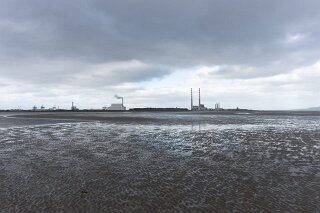
ST PATRICK'S DAY 2026 I PHOTOGRAPHED SANDYMOUNT STRAND
THIS ST PATRICK'S DAY I PHOTOGRAPHED SANDYMOUNT STRAND [TUESDAY 17 MARCH 2026]
Sandymount Strand is one of Dublin's most iconic coastal landmarks, stretching along the south side of Dublin Bay. It is a place where the city's literary history, industrial utility, and natural beauty collide in a vast expanse of sand and sky.
Strand vs. Beach: What’s in a Name?
While often used interchangeably, the term strand (from the Old English strend) specifically refers to the land bordering a body of water, typically a wide, flat area exposed by the tide.
Topography: Sandymount is technically a "strand" because of its extremely shallow gradient. When the tide goes out, it reveals kilometres of ribbed sand and "Cockle Lake," a large pool that remains even at low water.
Function: Unlike a traditional "beach" designed for deep-water swimming, Sandymount’s waters are often too shallow for a proper dip. It is a place for "stranding"—walking and exploring the tidal flats—rather than surf and turf.
A Paradise for Dogs
If you visit the strand at any hour, you will see it is essentially a social club for Dublin’s canine population.
The Scale: At low tide, the strand offers a massive, unobstructed playground where dogs can run for miles without the constraints of a narrow shoreline.
The "Cockle Lake" Factor: The shallow pools are perfect for dogs who love to splash but aren't strong swimmers, providing a safe environment away from heavy currents.
Community: It has become a self-reinforcing hub; owners go there because the space is so vast that even "energetic" dogs have room to burn off steam without bothering others.
The Old Baths and the ESB Interconnector
The strand’s skyline is defined by both its Victorian ruins and its modern infrastructure.
The Merrion Pier and Baths: Opened in 1883, these were once a thriving leisure destination featuring a bandstand and separate swimming sections for men and women. However, poor construction and the harsh Irish Sea led to their decline; a wall collapse in 1920 effectively ended their life. Today, the skeletal concrete ruins remain a haunting, graffiti-covered landmark.
The ESB Interconnector: Beneath the surface and nearby infrastructure lies the East-West Interconnector (EWIC). This high-voltage direct current (HVDC) link connects the Irish and British electricity grids. It allows Ireland to export excess wind energy and import power when needed, playing a critical role in national energy security and the transition to renewables.
History and Current Status
In the 18th century, the area was known as "Brickfields," where the sand was used to manufacture bricks for Dublin’s famous Georgian squares. The construction of the South Bull Wall in 1795 changed the currents, leading to the massive accumulation of sand that created the strand we see today.
Current Status: Today, it is part of the Dublin Bay Biosphere Reserve. However, it faces environmental challenges. Recent water quality reports have occasionally moved it into the "Poor" category due to urban runoff and overflows from the Ailesbury Pumping Station, leading to temporary bathing prohibitions. It remains a protected area of international importance for migratory birds.
Joyce and Ulysses
Sandymount Strand is perhaps the most famous beach in world literature. It features prominently in James Joyce’s Ulysses:
Episode 3 (Proteus): Stephen Dedalus walks along the strand, famously closing his eyes and wondering, "Am I walking into eternity along Sandymount strand?" as he ponders the nature of perception.
Episode 13 (Nausicaa): Leopold Bloom sits on the rocks near the Star of the Sea Church, watching Gerty MacDowell. This scene, involving Bloom's "solitary lewdness," led to the book being banned for obscenity in the United States for over a decade.
Sandymount Strand is one of Dublin's most iconic coastal landmarks, stretching along the south side of Dublin Bay. It is a place where the city's literary history, industrial utility, and natural beauty collide in a vast expanse of sand and sky.
Strand vs. Beach: What’s in a Name?
While often used interchangeably, the term strand (from the Old English strend) specifically refers to the land bordering a body of water, typically a wide, flat area exposed by the tide.
Topography: Sandymount is technically a "strand" because of its extremely shallow gradient. When the tide goes out, it reveals kilometres of ribbed sand and "Cockle Lake," a large pool that remains even at low water.
Function: Unlike a traditional "beach" designed for deep-water swimming, Sandymount’s waters are often too shallow for a proper dip. It is a place for "stranding"—walking and exploring the tidal flats—rather than surf and turf.
A Paradise for Dogs
If you visit the strand at any hour, you will see it is essentially a social club for Dublin’s canine population.
The Scale: At low tide, the strand offers a massive, unobstructed playground where dogs can run for miles without the constraints of a narrow shoreline.
The "Cockle Lake" Factor: The shallow pools are perfect for dogs who love to splash but aren't strong swimmers, providing a safe environment away from heavy currents.
Community: It has become a self-reinforcing hub; owners go there because the space is so vast that even "energetic" dogs have room to burn off steam without bothering others.
The Old Baths and the ESB Interconnector
The strand’s skyline is defined by both its Victorian ruins and its modern infrastructure.
The Merrion Pier and Baths: Opened in 1883, these were once a thriving leisure destination featuring a bandstand and separate swimming sections for men and women. However, poor construction and the harsh Irish Sea led to their decline; a wall collapse in 1920 effectively ended their life. Today, the skeletal concrete ruins remain a haunting, graffiti-covered landmark.
The ESB Interconnector: Beneath the surface and nearby infrastructure lies the East-West Interconnector (EWIC). This high-voltage direct current (HVDC) link connects the Irish and British electricity grids. It allows Ireland to export excess wind energy and import power when needed, playing a critical role in national energy security and the transition to renewables.
History and Current Status
In the 18th century, the area was known as "Brickfields," where the sand was used to manufacture bricks for Dublin’s famous Georgian squares. The construction of the South Bull Wall in 1795 changed the currents, leading to the massive accumulation of sand that created the strand we see today.
Current Status: Today, it is part of the Dublin Bay Biosphere Reserve. However, it faces environmental challenges. Recent water quality reports have occasionally moved it into the "Poor" category due to urban runoff and overflows from the Ailesbury Pumping Station, leading to temporary bathing prohibitions. It remains a protected area of international importance for migratory birds.
Joyce and Ulysses
Sandymount Strand is perhaps the most famous beach in world literature. It features prominently in James Joyce’s Ulysses:
Episode 3 (Proteus): Stephen Dedalus walks along the strand, famously closing his eyes and wondering, "Am I walking into eternity along Sandymount strand?" as he ponders the nature of perception.
Episode 13 (Nausicaa): Leopold Bloom sits on the rocks near the Star of the Sea Church, watching Gerty MacDowell. This scene, involving Bloom's "solitary lewdness," led to the book being banned for obscenity in the United States for over a decade.
SANDYMOUNT STRAND