TODAY I USED A SONY A7RVI WITH THE 16-35MM F2.8GM LENS
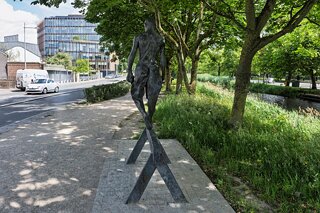
THE NORTH BANK OF THE GRAND CANAL AT WILTON PLACE [PHOTOGRAPHED 17 JUNE 2026]
One of the most notable additions to the North Bank of the Grand Canal at Wilton Terrace is a new sculpture, Man on Trestle, by the acclaimed Armagh-born artist, Carolyn Mulholland. Positioned at the Leeson Street Bridge entrance, the bronze sculpture welcomes visitors to the newly developed path, which is now significantly wider than the two narrower paths it replaced. The project has also incorporated a mix of contemporary seating and nine meticulously restored original cast-iron benches, providing ample opportunities for people to pause and appreciate the scenic views.
Field Notes: Testing the Sony α7R VI and 16-35mm f/2.8 GM II at Wilton Terrace
As part of an ongoing equipment evaluation programme, I spent the afternoon putting the Sony α7R VI through its paces around the Wilton Terrace and Wilton Place area of Dublin. Up ultra-wide for the session, the body was paired with the Sony FE 16-35mm f/2.8 GM II.
Evaluating a modern, high-resolution ecosystem means looking past the spec sheet and focusing on how components handle real-world light, geometry, and colour rendering. Today’s shoot threw up a few surprises—especially regarding colour—and provided an ideal benchmark to contrast against another camera frequently chosen for high-end urban documentary: the Leica Q3.
The Wilton Terrace Session: Unexpected Colour Profiles
When tracking through the architectural lines and public spaces near the canal, the primary surprise came down to modern colour science. Traditionally, Sony’s default profiles have carried a reputation for being somewhat clinical, leaning slightly cool or neutral to a fault.
However, the files pulled from this afternoon's shoot delivered an entirely different character. The rendering was richer, warmer, and carried a distinct structural density that I simply didn’t expect from a modern Alpha-series body straight out of the box. Sony appears to have quietly re-engineered their deep learning-based auto white balance and colour-matrix handling. It handles the specific tonal palette of Dublin’s built environment—where stone, brick, and overcast northern skies collide—with far greater organic warmth than its predecessors.
Paired with the 16-35mm GM II, the sensor captures detail with surgical precision, but it is the tone and micro-contrast that redefine the character of the image.
Architecture & Engineering: Sony vs. The Leica Q3
Because the Leica Q3 is so often touted as the definitive tool for unstructured urban documentation, it makes for a fascinating point of comparison against this high-resolution Sony setup. Having evaluated both frameworks thoroughly, my field notes point to a definitive conclusion: the Sony combination outperforms the Leica Q3 in almost every operational and optical metric.
Optical Versatility: The Sony provides an ultra-wide to standard zoom range (16-35mm) with zero optical compromises at the focal extremes. By contrast, the Leica Q3 features a fixed 28mm prime lens, relying on aggressive digital cropping to mimic longer focal lengths.
Corner-to-Corner Sharpness: The GM II optical layout delivers exceptional edge performance, eliminating peripheral soft corners even wide open at f/2.8. The Leica Q3 exhibits high central sharpness but suffers from noticeable native distortion and soft fall-off at the extreme corners before digital software correction steps in.
Autofocus Tracking: Sony's advanced tracking layer offers instantaneous, intelligent acquisition regardless of complex background elements. The Q3 uses a Contrast and Phase hybrid mechanism which, while highly reliable, is noticeably slower to lock in fast-moving environments.
Low-Light Performance: The Leica Q3 retains a slight advantage here. The combination of a dedicated f/1.7 Summilux aperture and its specific sensor tuning allows it to preserve cleaner shadow detail in deep low-light scenarios, whereas the ultra-dense pixel pitch of the Sony challenges extreme ISO settings.
While the Leica Q3 maintains an iconic aesthetic and remains a strong performer for twilight work, it lacks the sheer flexibility required for technical architectural documentation. When you are framing complex facades or tight street furniture, having a true 16mm ultra-wide perspective that transitions seamlessly to 35mm completely shifts how you can interact with the built environment.
Challenging the Compact Myth: Size and Form Factor
One of the most persistent narratives across photography reviews is the "huge size advantage" of the Leica Q3 over a professional interchangeable-lens mirrorless system. In practice, this advantage is largely a myth.
Reviewers frequently compare camera bodies alone, forgetting that optics dictate the physical reality of a workflow. Consider the actual physical footprint:
The Leica Q3 features a significantly prominent lens barrel that extends far from the camera body. It cannot be slid into a standard coat pocket; it requires a dedicated pouch or a neck strap.
The Sony α7R VI body is remarkably compact for a high-resolution machine, and the redesigned 16-35mm GM II is roughly 20% lighter and 10% smaller than its predecessor.
When you place the setups side by side or carry them over your shoulder for a five-hour street session, the perceived volumetric difference vanishes. The Sony system feels perfectly balanced in the hand, handles a wider variety of architectural challenges, and strips away the limitations of a single, fixed focal length without inflicting a real-world weight penalty.
A Note on Our Approach: Personal Experience vs. Technical Reviews
Here at The Urban Cartographer, we are fortunate to have access to a wide variety of camera systems, high-end lenses, and evolving imaging technologies. Testing these tools in the field is a vital part of our workflow, and we frequently share our thoughts on how specific combinations perform when documenting the built environment.
Lately, however, we have received a number of comments suggesting that our notes have "failed to consider" certain technical charts, or that specific outcomes must be down to "incorrect settings" or uncalibrated profiles.
To clear up any confusion, it helps to understand what these posts are—and what they are deliberately not:
We do not publish formal gear reviews. We leave the bench-testing, lab charts, and exhaustive feature lists to dedicated hardware review sites. They do a wonderful job of measuring sensors in sterile environments.
We share real-world, personal field experiences. Our notes reflect how a specific camera and lens combination behaves in the hand during a five-hour session on the streets of Dublin, Cork, or Waterford. They describe how the gear handles real-world light, real-world geometry, and changing weather conditions.
Photography is as much about operational ergonomics, muscle memory, and intuitive response as it is about technical specifications. A camera setup that breaks records on a test bench might feel entirely unbalanced or restrictive when framing a tight facade near a canal. Conversely, a system with known quirks might deliver an organic warmth or a seamless workflow that makes it a joy to use in the field.
When we share our findings, we are documenting a personal, practical relationship with the equipment at a specific moment in time. We welcome healthy discussion about different workflows, but our focus will always remain on the reality of the street, not the perfection of the laboratory.
Thank you, as always, for reading and engaging with the work.
One of the most notable additions to the North Bank of the Grand Canal at Wilton Terrace is a new sculpture, Man on Trestle, by the acclaimed Armagh-born artist, Carolyn Mulholland. Positioned at the Leeson Street Bridge entrance, the bronze sculpture welcomes visitors to the newly developed path, which is now significantly wider than the two narrower paths it replaced. The project has also incorporated a mix of contemporary seating and nine meticulously restored original cast-iron benches, providing ample opportunities for people to pause and appreciate the scenic views.
Field Notes: Testing the Sony α7R VI and 16-35mm f/2.8 GM II at Wilton Terrace
As part of an ongoing equipment evaluation programme, I spent the afternoon putting the Sony α7R VI through its paces around the Wilton Terrace and Wilton Place area of Dublin. Up ultra-wide for the session, the body was paired with the Sony FE 16-35mm f/2.8 GM II.
Evaluating a modern, high-resolution ecosystem means looking past the spec sheet and focusing on how components handle real-world light, geometry, and colour rendering. Today’s shoot threw up a few surprises—especially regarding colour—and provided an ideal benchmark to contrast against another camera frequently chosen for high-end urban documentary: the Leica Q3.
The Wilton Terrace Session: Unexpected Colour Profiles
When tracking through the architectural lines and public spaces near the canal, the primary surprise came down to modern colour science. Traditionally, Sony’s default profiles have carried a reputation for being somewhat clinical, leaning slightly cool or neutral to a fault.
However, the files pulled from this afternoon's shoot delivered an entirely different character. The rendering was richer, warmer, and carried a distinct structural density that I simply didn’t expect from a modern Alpha-series body straight out of the box. Sony appears to have quietly re-engineered their deep learning-based auto white balance and colour-matrix handling. It handles the specific tonal palette of Dublin’s built environment—where stone, brick, and overcast northern skies collide—with far greater organic warmth than its predecessors.
Paired with the 16-35mm GM II, the sensor captures detail with surgical precision, but it is the tone and micro-contrast that redefine the character of the image.
Architecture & Engineering: Sony vs. The Leica Q3
Because the Leica Q3 is so often touted as the definitive tool for unstructured urban documentation, it makes for a fascinating point of comparison against this high-resolution Sony setup. Having evaluated both frameworks thoroughly, my field notes point to a definitive conclusion: the Sony combination outperforms the Leica Q3 in almost every operational and optical metric.
Optical Versatility: The Sony provides an ultra-wide to standard zoom range (16-35mm) with zero optical compromises at the focal extremes. By contrast, the Leica Q3 features a fixed 28mm prime lens, relying on aggressive digital cropping to mimic longer focal lengths.
Corner-to-Corner Sharpness: The GM II optical layout delivers exceptional edge performance, eliminating peripheral soft corners even wide open at f/2.8. The Leica Q3 exhibits high central sharpness but suffers from noticeable native distortion and soft fall-off at the extreme corners before digital software correction steps in.
Autofocus Tracking: Sony's advanced tracking layer offers instantaneous, intelligent acquisition regardless of complex background elements. The Q3 uses a Contrast and Phase hybrid mechanism which, while highly reliable, is noticeably slower to lock in fast-moving environments.
Low-Light Performance: The Leica Q3 retains a slight advantage here. The combination of a dedicated f/1.7 Summilux aperture and its specific sensor tuning allows it to preserve cleaner shadow detail in deep low-light scenarios, whereas the ultra-dense pixel pitch of the Sony challenges extreme ISO settings.
While the Leica Q3 maintains an iconic aesthetic and remains a strong performer for twilight work, it lacks the sheer flexibility required for technical architectural documentation. When you are framing complex facades or tight street furniture, having a true 16mm ultra-wide perspective that transitions seamlessly to 35mm completely shifts how you can interact with the built environment.
Challenging the Compact Myth: Size and Form Factor
One of the most persistent narratives across photography reviews is the "huge size advantage" of the Leica Q3 over a professional interchangeable-lens mirrorless system. In practice, this advantage is largely a myth.
Reviewers frequently compare camera bodies alone, forgetting that optics dictate the physical reality of a workflow. Consider the actual physical footprint:
The Leica Q3 features a significantly prominent lens barrel that extends far from the camera body. It cannot be slid into a standard coat pocket; it requires a dedicated pouch or a neck strap.
The Sony α7R VI body is remarkably compact for a high-resolution machine, and the redesigned 16-35mm GM II is roughly 20% lighter and 10% smaller than its predecessor.
When you place the setups side by side or carry them over your shoulder for a five-hour street session, the perceived volumetric difference vanishes. The Sony system feels perfectly balanced in the hand, handles a wider variety of architectural challenges, and strips away the limitations of a single, fixed focal length without inflicting a real-world weight penalty.
A Note on Our Approach: Personal Experience vs. Technical Reviews
Here at The Urban Cartographer, we are fortunate to have access to a wide variety of camera systems, high-end lenses, and evolving imaging technologies. Testing these tools in the field is a vital part of our workflow, and we frequently share our thoughts on how specific combinations perform when documenting the built environment.
Lately, however, we have received a number of comments suggesting that our notes have "failed to consider" certain technical charts, or that specific outcomes must be down to "incorrect settings" or uncalibrated profiles.
To clear up any confusion, it helps to understand what these posts are—and what they are deliberately not:
We do not publish formal gear reviews. We leave the bench-testing, lab charts, and exhaustive feature lists to dedicated hardware review sites. They do a wonderful job of measuring sensors in sterile environments.
We share real-world, personal field experiences. Our notes reflect how a specific camera and lens combination behaves in the hand during a five-hour session on the streets of Dublin, Cork, or Waterford. They describe how the gear handles real-world light, real-world geometry, and changing weather conditions.
Photography is as much about operational ergonomics, muscle memory, and intuitive response as it is about technical specifications. A camera setup that breaks records on a test bench might feel entirely unbalanced or restrictive when framing a tight facade near a canal. Conversely, a system with known quirks might deliver an organic warmth or a seamless workflow that makes it a joy to use in the field.
When we share our findings, we are documenting a personal, practical relationship with the equipment at a specific moment in time. We welcome healthy discussion about different workflows, but our focus will always remain on the reality of the street, not the perfection of the laboratory.
Thank you, as always, for reading and engaging with the work.
WILTON PLACE JUNE 2026