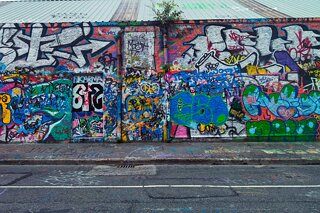
GRAFFITI AT WINDMILL LANE IN DUBLIN DOCKLANDS
In August 2009, Windmill Lane was less of a street and more of a living, breathing archive. It was a pilgrimage site, a chaotic canvas of spray paint and scrawled lyrics tracing the perimeter of the old U2 recording studios. Tourists and locals alike moved along the walls, reading the layers of tribute, dissent, and raw artistic energy that had accumulated over decades.
That summer, I spent my days exploring those lanes with a Sigma DP1 slung over my shoulder. It was a quirky, demanding little camera, powered by that unique Foveon sensor. It didn't behave like standard digital bodies; it required patience, but when the light hit right, it captured textures—the gritty, matte look of aerosol on brick, the peeling corners of wheat-paste posters—with an almost film-like honesty.
Looking through the fixed lens that August afternoon, it never crossed my mind that what I was framing was entirely ephemeral. The wall seemed like an institution, a permanent fixture of Dublin's cultural geography.
But both the art and the instrument recording it were quietly approaching the end of their respective lives.
The shift happened slowly, then all at once. Over the next decade and a half, Dublin's urban core underwent a radical sanitisation. The wild, uncurated spaces where street artists could leave an unauthorised mark without a permit began to vanish, swallowed by glass-fronted developments and corporate regeneration projects.
By the time I walked back down to the area in June 2026, the transformation was absolute. Standing on the pavement, I looked around for even a trace, a single preserved brick or a faded tag from the old studio wall. There was nothing. The original structure was entirely gone, replaced by the sleek, sanitised landscape of the modern docklands.
The nature of Dublin's street art had completely morphed. The raw, chaotic "shout in the dark" of Windmill Lane had been replaced by curated, approved commercial murals. Today, local artists are commissioned by trendy coffee shops to neatly decorate their evening security shutters, and structured summer festivals invite international names to paint massive, council-approved gable ends. It is visually impressive, and certainly better for the artists' pockets, but the dangerous, thrilling spontaneity of 2009 has been entirely scrubbed away.
As for the Sigma DP1, its own end came just a few months after that August shoot, falling victim to a flaw well-known to anyone who carried those early DP compacts.
That winter, I brought the camera with me on a trip to Brussels for Christmas. Amidst the festive lights of the Grand Place, the bitter, freezing European cold proved fatal for the temperamental Japanese hardware. When I clicked the power switch, the camera's battery sagged in the chill, and the internal lubricants thickened.
The lens froze in place, refusing to retract, and the camera quietly quit for good. It was a fitting parallel, perhaps. The unique, fragile mechanics that had rendered the gritty textures of Windmill Lane so beautifully couldn't survive the harsh winter, just as the raw graffiti of the U2 wall couldn't survive the oncoming march of urban development.
Today, when I walk through the clean lines of the modern docklands, I carry its ultimate spiritual successor: a Leica Q3. At ten times the cost of that original Sigma, it is a vastly different instrument—weather-sealed, blisteringly fast, and carrying a full-frame sensor that captures the city in microscopic detail. Yet the core philosophy remains identical to the day I stood at Windmill Lane in 2009: a fixed wide lens, a massive sensor, and a lone photographer tracking the fleeting, shifting skin of a changing city. All that remains of that original era are the digital files safely stored away in the archive—fragments of a wilder, rougher Dublin that exists now only in memory.
To be completely fair to the Sigma DP1, it was an incredibly ambitious piece of engineering—essentially a pioneering attempt to squeeze a massive, DSLR-sized Foveon sensor into a pocketable compact body.
To achieve that form factor, Sigma had to rely on a complex, highly compact motorised lens assembly. Pushing that heavy glass out of such a small housing required a lot of torque. When you drop a camera like that into an extreme Brussels winter, physics simply takes over. The sub-zero temperatures immediately cause the battery voltage to drop precisely when the motor needs maximum power to push through lubricants that have turned to the consistency of molasses.
Most consumer electronics from that era simply weren’t rated for extreme winter conditions, let alone a niche, enthusiast camera pushing the absolute limits of micro-mechanics. In a way, it wasn't a failure of quality—it was just the reality of operating a highly specialised instrument outside its comfort zone.
That summer, I spent my days exploring those lanes with a Sigma DP1 slung over my shoulder. It was a quirky, demanding little camera, powered by that unique Foveon sensor. It didn't behave like standard digital bodies; it required patience, but when the light hit right, it captured textures—the gritty, matte look of aerosol on brick, the peeling corners of wheat-paste posters—with an almost film-like honesty.
Looking through the fixed lens that August afternoon, it never crossed my mind that what I was framing was entirely ephemeral. The wall seemed like an institution, a permanent fixture of Dublin's cultural geography.
But both the art and the instrument recording it were quietly approaching the end of their respective lives.
The shift happened slowly, then all at once. Over the next decade and a half, Dublin's urban core underwent a radical sanitisation. The wild, uncurated spaces where street artists could leave an unauthorised mark without a permit began to vanish, swallowed by glass-fronted developments and corporate regeneration projects.
By the time I walked back down to the area in June 2026, the transformation was absolute. Standing on the pavement, I looked around for even a trace, a single preserved brick or a faded tag from the old studio wall. There was nothing. The original structure was entirely gone, replaced by the sleek, sanitised landscape of the modern docklands.
The nature of Dublin's street art had completely morphed. The raw, chaotic "shout in the dark" of Windmill Lane had been replaced by curated, approved commercial murals. Today, local artists are commissioned by trendy coffee shops to neatly decorate their evening security shutters, and structured summer festivals invite international names to paint massive, council-approved gable ends. It is visually impressive, and certainly better for the artists' pockets, but the dangerous, thrilling spontaneity of 2009 has been entirely scrubbed away.
As for the Sigma DP1, its own end came just a few months after that August shoot, falling victim to a flaw well-known to anyone who carried those early DP compacts.
That winter, I brought the camera with me on a trip to Brussels for Christmas. Amidst the festive lights of the Grand Place, the bitter, freezing European cold proved fatal for the temperamental Japanese hardware. When I clicked the power switch, the camera's battery sagged in the chill, and the internal lubricants thickened.
The lens froze in place, refusing to retract, and the camera quietly quit for good. It was a fitting parallel, perhaps. The unique, fragile mechanics that had rendered the gritty textures of Windmill Lane so beautifully couldn't survive the harsh winter, just as the raw graffiti of the U2 wall couldn't survive the oncoming march of urban development.
Today, when I walk through the clean lines of the modern docklands, I carry its ultimate spiritual successor: a Leica Q3. At ten times the cost of that original Sigma, it is a vastly different instrument—weather-sealed, blisteringly fast, and carrying a full-frame sensor that captures the city in microscopic detail. Yet the core philosophy remains identical to the day I stood at Windmill Lane in 2009: a fixed wide lens, a massive sensor, and a lone photographer tracking the fleeting, shifting skin of a changing city. All that remains of that original era are the digital files safely stored away in the archive—fragments of a wilder, rougher Dublin that exists now only in memory.
To be completely fair to the Sigma DP1, it was an incredibly ambitious piece of engineering—essentially a pioneering attempt to squeeze a massive, DSLR-sized Foveon sensor into a pocketable compact body.
To achieve that form factor, Sigma had to rely on a complex, highly compact motorised lens assembly. Pushing that heavy glass out of such a small housing required a lot of torque. When you drop a camera like that into an extreme Brussels winter, physics simply takes over. The sub-zero temperatures immediately cause the battery voltage to drop precisely when the motor needs maximum power to push through lubricants that have turned to the consistency of molasses.
Most consumer electronics from that era simply weren’t rated for extreme winter conditions, let alone a niche, enthusiast camera pushing the absolute limits of micro-mechanics. In a way, it wasn't a failure of quality—it was just the reality of operating a highly specialised instrument outside its comfort zone.
WIND MILL LANE AUGUST 2009