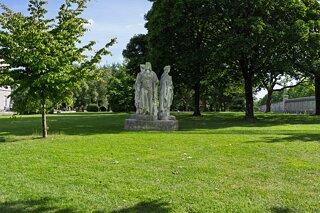
HENRIETTA WAS REPLACED BY THE THREE FATES
FROM HENRIETTA TO THE THREE GRACES [ARCHAEOLOGY IN KING'S INNS PARK]
When capturing the leafy grounds of King's Inns Park on a modern digital camera in May of 2026, the sheer resolution highlights details that older sensors simply could not register. However, looking at the initial frames, the photographs of the Three Graces felt isolated, completely stripped of their geographic context.
My original intention for this showcase was strictly minimalist: to publish three isolated photographs focusing solely on the figures. But because of a personal fondness for this specific park, I decided to shift my approach. To truly tell their story, I have included wider landscape photographs of the park itself. This provides vital context, anchoring these 19th-century industrial wanderers within the historic fabric of the environment that replaced Henrietta's original home.
The Tragic Fate of 'Henrietta': How a Film Truck Undid 230 Years of Dublin History
To the casual passer-by strolling through the Temple grounds off Constitution Hill today, the empty space where a single plinth once stood might look like a minor, nameless casualty of urban decay. Some have even argued that the missing statue had little artistic value. However, the history of this lone figure—formally sculpted as an allegory of Truth—reveals a heritage that survived the foundational violence of the Irish State, only to be modernly undone by the logistics of a movie production. For those fortunate enough to capture her on film before her sudden disappearance, she stands as a poignant reminder of how fragile street-level material history truly is.
A Masterpiece Born of Enlightenment Dublin
"Truth" was far from a minor piece of modern garden ornamentation; she was an authentic late 18th-century work deeply tied to the grandest architectural era of the city. Sculpted in the 1780s or 1790s from Portland stone, the work is attributed to the circle of James Gandon, the visionary architect behind the Custom House and the Four Courts, and Edward Smyth, Dublin's premier neoclassical sculptor.
The statue originally stood as part of the decorative, symbolic fabric of the Four Courts on Inns Quay. From that prominent vantage point, she stood as a silent witness to the legal, political, and social upheavals of the 19th century.
Surviving the Civil War Bombardment
When the Irish Civil War erupted in June 1922, the Four Courts became the main stronghold for anti-Treaty forces. The subsequent bombardment by National Army artillery and the catastrophic explosion of the Public Record Office completely gutted the complex. While centuries of irreplaceable legal records evaporated into smoke and magnificent interior carvings were turned to ash, "Truth" miraculously survived.
She emerged from the shellfire and smoke without a scratch. Following the conflict, when the courts were rebuilt and reconfigured, the intact statue was relocated to the safety of the gardens at the Honorable Society of King’s Inns, sitting peacefully just steps from Henrietta Street.
Toppled by the Silver Screen
By the 21st century, the timeless, untouched Georgian architecture of Henrietta Street and the Temple had turned the area into a regular extension of busy film studios, frequently standing in for Victorian London or historic Dublin.
In April 2012, while a production crew was active in the locality, a large facility vehicle backed into the plinth. The impact toppled the 230-year-old Portland stone sculpture, slamming her onto the tarmac. The fall shattered her into pieces and severed her head.
The destruction sparked immediate local outrage, notably championed by independent councillor Mannix Flynn, who raised formal inquiries with Dublin City Council. Fragments of the masterpiece were gathered and moved into secure internal storage within King's Inns to protect them from further weathering.
The Industrial Wanderers: The Three Graces in High Definition
The three female classical figures that occupy the park today bring a remarkably deep and well-travelled history that perfectly aligns with a keen interest in urban archaeology and industrial heritage.
While a common local myth claimed these figures were merely props left behind by a film crew, they are actually authentic, late 19th-century allegorical stone sculptures. Carved in 1872, they were originally commissioned for the Great Industrial Exhibition held at Earlsfort Terrace, on the site where the National Concert Hall stands today. They were sculpted specifically to celebrate the foundation of the nation's economy, explicitly representing Irish Manufactures in Wood, Metal, and Stone.
Travel Timeline of the Three Graces:
[1872] Carved for Great Industrial Exhibition (Earlsfort Terrace)
[Mid-20th Century] Relocated to Millennium Park / Barnardo Square (Dame Street)
[Post-Square Redesign] Uprooted and moved to King's Inns Park (Constitution Hill)
Before arriving on the northside, these statues spent decades in a pocket park near Dame Street. They were prominently situated in Millennium Park—which was later redesigned and renamed Barnardo Square—the plaza directly beside Dublin City Hall. For years, they sat clustered together in the centre of a decorative water pond on that site.
When Barnardo Square was cleared and flattened into its current open, stone-paved configuration, the statues were uprooted. Seeking a fitting home for them, authorities relocated the trio to the Temple grounds. They were installed on a new, modern concrete plinth just down the path from the famous "Hungry Tree".
The Contrast in the Lens
Photographing the site in June 2026 reveals architectural friction that early 2010 photography obscured. Where the old Sigma DP1 captured soft, atmospheric winter tones of "Henrietta" in the snow, a modern 2026 camera sensor explicitly highlights the textures of the current installation. The sharp clarity exposes the weathered, soot-stained surfaces of the 1872 industrial allegories contrasting starkly against the brutalist, clean edge of their heavy concrete base.
This modern layout remains controversial. Critics note that while the industrial statues themselves are historically significant, installing them as a dense, collective block on a heavy, modern concrete plinth feels architecturally out of place within the delicate, historic layout of the King's Inns grounds.
Though Henrietta no longer graces the park, comparing the legacy archive photographs of 2010 with high-resolution images from 2026 creates a vital visual record. It bridges the gap between a lost survivor of the 1922 Civil War bombardment and the 19th-century industrial wanderers standing in her place today.
When capturing the leafy grounds of King's Inns Park on a modern digital camera in May of 2026, the sheer resolution highlights details that older sensors simply could not register. However, looking at the initial frames, the photographs of the Three Graces felt isolated, completely stripped of their geographic context.
My original intention for this showcase was strictly minimalist: to publish three isolated photographs focusing solely on the figures. But because of a personal fondness for this specific park, I decided to shift my approach. To truly tell their story, I have included wider landscape photographs of the park itself. This provides vital context, anchoring these 19th-century industrial wanderers within the historic fabric of the environment that replaced Henrietta's original home.
The Tragic Fate of 'Henrietta': How a Film Truck Undid 230 Years of Dublin History
To the casual passer-by strolling through the Temple grounds off Constitution Hill today, the empty space where a single plinth once stood might look like a minor, nameless casualty of urban decay. Some have even argued that the missing statue had little artistic value. However, the history of this lone figure—formally sculpted as an allegory of Truth—reveals a heritage that survived the foundational violence of the Irish State, only to be modernly undone by the logistics of a movie production. For those fortunate enough to capture her on film before her sudden disappearance, she stands as a poignant reminder of how fragile street-level material history truly is.
A Masterpiece Born of Enlightenment Dublin
"Truth" was far from a minor piece of modern garden ornamentation; she was an authentic late 18th-century work deeply tied to the grandest architectural era of the city. Sculpted in the 1780s or 1790s from Portland stone, the work is attributed to the circle of James Gandon, the visionary architect behind the Custom House and the Four Courts, and Edward Smyth, Dublin's premier neoclassical sculptor.
The statue originally stood as part of the decorative, symbolic fabric of the Four Courts on Inns Quay. From that prominent vantage point, she stood as a silent witness to the legal, political, and social upheavals of the 19th century.
Surviving the Civil War Bombardment
When the Irish Civil War erupted in June 1922, the Four Courts became the main stronghold for anti-Treaty forces. The subsequent bombardment by National Army artillery and the catastrophic explosion of the Public Record Office completely gutted the complex. While centuries of irreplaceable legal records evaporated into smoke and magnificent interior carvings were turned to ash, "Truth" miraculously survived.
She emerged from the shellfire and smoke without a scratch. Following the conflict, when the courts were rebuilt and reconfigured, the intact statue was relocated to the safety of the gardens at the Honorable Society of King’s Inns, sitting peacefully just steps from Henrietta Street.
Toppled by the Silver Screen
By the 21st century, the timeless, untouched Georgian architecture of Henrietta Street and the Temple had turned the area into a regular extension of busy film studios, frequently standing in for Victorian London or historic Dublin.
In April 2012, while a production crew was active in the locality, a large facility vehicle backed into the plinth. The impact toppled the 230-year-old Portland stone sculpture, slamming her onto the tarmac. The fall shattered her into pieces and severed her head.
The destruction sparked immediate local outrage, notably championed by independent councillor Mannix Flynn, who raised formal inquiries with Dublin City Council. Fragments of the masterpiece were gathered and moved into secure internal storage within King's Inns to protect them from further weathering.
The Industrial Wanderers: The Three Graces in High Definition
The three female classical figures that occupy the park today bring a remarkably deep and well-travelled history that perfectly aligns with a keen interest in urban archaeology and industrial heritage.
While a common local myth claimed these figures were merely props left behind by a film crew, they are actually authentic, late 19th-century allegorical stone sculptures. Carved in 1872, they were originally commissioned for the Great Industrial Exhibition held at Earlsfort Terrace, on the site where the National Concert Hall stands today. They were sculpted specifically to celebrate the foundation of the nation's economy, explicitly representing Irish Manufactures in Wood, Metal, and Stone.
Travel Timeline of the Three Graces:
[1872] Carved for Great Industrial Exhibition (Earlsfort Terrace)
[Mid-20th Century] Relocated to Millennium Park / Barnardo Square (Dame Street)
[Post-Square Redesign] Uprooted and moved to King's Inns Park (Constitution Hill)
Before arriving on the northside, these statues spent decades in a pocket park near Dame Street. They were prominently situated in Millennium Park—which was later redesigned and renamed Barnardo Square—the plaza directly beside Dublin City Hall. For years, they sat clustered together in the centre of a decorative water pond on that site.
When Barnardo Square was cleared and flattened into its current open, stone-paved configuration, the statues were uprooted. Seeking a fitting home for them, authorities relocated the trio to the Temple grounds. They were installed on a new, modern concrete plinth just down the path from the famous "Hungry Tree".
The Contrast in the Lens
Photographing the site in June 2026 reveals architectural friction that early 2010 photography obscured. Where the old Sigma DP1 captured soft, atmospheric winter tones of "Henrietta" in the snow, a modern 2026 camera sensor explicitly highlights the textures of the current installation. The sharp clarity exposes the weathered, soot-stained surfaces of the 1872 industrial allegories contrasting starkly against the brutalist, clean edge of their heavy concrete base.
This modern layout remains controversial. Critics note that while the industrial statues themselves are historically significant, installing them as a dense, collective block on a heavy, modern concrete plinth feels architecturally out of place within the delicate, historic layout of the King's Inns grounds.
Though Henrietta no longer graces the park, comparing the legacy archive photographs of 2010 with high-resolution images from 2026 creates a vital visual record. It bridges the gap between a lost survivor of the 1922 Civil War bombardment and the 19th-century industrial wanderers standing in her place today.
HENRITTA AND THE 3 FATES