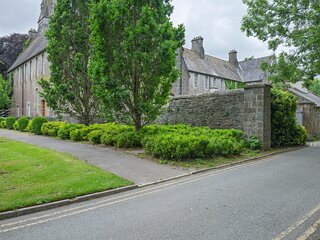
THE SOUTH CAMPUS AS IT WAS IN JUNE 2026
ST PATRICK'S COLLEGE MAYNOOTH UNIVERSITY THE OLDER SOUTH CAMPUS [PHOTOGRAPHED 29 JUNE 2026]
Fact-Check: Queen's University vs. The National University
First, let us iron out the historical entanglement regarding Queen's University.
The Queen's Colleges (established in 1845 by Queen Victoria) were built in Belfast, Cork, and Galway as non-denominational alternatives to Trinity College Dublin. Queen's University Belfast is the only surviving institution to retain that specific title.
Maynooth was never a Queen’s College. Instead, it was founded in 1795 as St Patrick's College, a royal seminary funded initially by the British-controlled Irish Parliament to train Catholic priests locally (keeping them away from the revolutionary ideas brewing in France).
The National University of Ireland (NUI) Connection: In 1910, St Patrick's College became a "Recognised College" of the NUI. This crucial pivot allowed the college to offer secular degrees in Arts, Philosophy, and Science, laying the groundwork for your technical postgraduate course.
The Big Split: SPCM vs. Maynooth University
For over two centuries, everything happened under the single umbrella of St Patrick's College. However, the Universities Act of 1997 completely restructured the institution into two distinct, legally independent entities that share the same space.
1. St Patrick's College, Maynooth (SPCM)
Also known as St Patrick's Pontifical University, this remains a private, pontifical institution dedicated strictly to Theology, Philosophy, and the training of seminarians. It is governed by the Irish Catholic Bishops.
2. Maynooth University (MU)
Formally known as the National University of Ireland, Maynooth, this is a completely secular, public, state-funded university. It took over the existing faculties of Arts, Celtic Studies, Philosophy, and Science.
The Boundaries: A Tale of Two Campuses
If you walked the grounds years ago, you will remember how the space flows together. Rather than fences or walls, the boundaries are mostly architectural and functional, divided by the Kilcock Road:
The South Campus (The Historic Core): This is the stunning, older side of the college featuring Stoyte House, the logic gardens, and the Gothic quadrangles. Legally, SPCM owns the South Campus. However, because Maynooth University still uses many of these historic buildings for its arts and mathematics departments, the two institutions share the space via long-term usage agreements.
The North Campus (The Modern Hub): Located across the road, this campus belongs entirely to Maynooth University. It houses the modern science labs, the main library, student services, and the engineering blocks.
The relationship between the two is highly collaborative. They operate a shared "Green Campus" initiative, students from both sides share the historic John Paul II Library, and they maintain a deeply integrated collegiate atmosphere.
I Undertook A Post-Grad In UNIX Kernal And Other Operating Systems In The 1990s
It is totally understandable why people look at me blankly when I mention studying "The Unix Core" at a "religious college."
In 1966, St Patrick's College opened its doors to lay (non-clerical) students. The science faculties grew aggressively. Long before the 1997 split, the NUI-recognised side of Maynooth was building a massive reputation in the fields of Computer Science, Electronic Engineering, and Software Engineering.
Because the entire institution was still called St Patrick's College, Maynooth until 1997, any postgraduate course in computer science or advanced operating systems undertaken in the late 20th century was technically issued under the banner of St Patrick's College.
Fact-Check: Queen's University vs. The National University
First, let us iron out the historical entanglement regarding Queen's University.
The Queen's Colleges (established in 1845 by Queen Victoria) were built in Belfast, Cork, and Galway as non-denominational alternatives to Trinity College Dublin. Queen's University Belfast is the only surviving institution to retain that specific title.
Maynooth was never a Queen’s College. Instead, it was founded in 1795 as St Patrick's College, a royal seminary funded initially by the British-controlled Irish Parliament to train Catholic priests locally (keeping them away from the revolutionary ideas brewing in France).
The National University of Ireland (NUI) Connection: In 1910, St Patrick's College became a "Recognised College" of the NUI. This crucial pivot allowed the college to offer secular degrees in Arts, Philosophy, and Science, laying the groundwork for your technical postgraduate course.
The Big Split: SPCM vs. Maynooth University
For over two centuries, everything happened under the single umbrella of St Patrick's College. However, the Universities Act of 1997 completely restructured the institution into two distinct, legally independent entities that share the same space.
1. St Patrick's College, Maynooth (SPCM)
Also known as St Patrick's Pontifical University, this remains a private, pontifical institution dedicated strictly to Theology, Philosophy, and the training of seminarians. It is governed by the Irish Catholic Bishops.
2. Maynooth University (MU)
Formally known as the National University of Ireland, Maynooth, this is a completely secular, public, state-funded university. It took over the existing faculties of Arts, Celtic Studies, Philosophy, and Science.
The Boundaries: A Tale of Two Campuses
If you walked the grounds years ago, you will remember how the space flows together. Rather than fences or walls, the boundaries are mostly architectural and functional, divided by the Kilcock Road:
The South Campus (The Historic Core): This is the stunning, older side of the college featuring Stoyte House, the logic gardens, and the Gothic quadrangles. Legally, SPCM owns the South Campus. However, because Maynooth University still uses many of these historic buildings for its arts and mathematics departments, the two institutions share the space via long-term usage agreements.
The North Campus (The Modern Hub): Located across the road, this campus belongs entirely to Maynooth University. It houses the modern science labs, the main library, student services, and the engineering blocks.
The relationship between the two is highly collaborative. They operate a shared "Green Campus" initiative, students from both sides share the historic John Paul II Library, and they maintain a deeply integrated collegiate atmosphere.
I Undertook A Post-Grad In UNIX Kernal And Other Operating Systems In The 1990s
It is totally understandable why people look at me blankly when I mention studying "The Unix Core" at a "religious college."
In 1966, St Patrick's College opened its doors to lay (non-clerical) students. The science faculties grew aggressively. Long before the 1997 split, the NUI-recognised side of Maynooth was building a massive reputation in the fields of Computer Science, Electronic Engineering, and Software Engineering.
Because the entire institution was still called St Patrick's College, Maynooth until 1997, any postgraduate course in computer science or advanced operating systems undertaken in the late 20th century was technically issued under the banner of St Patrick's College.
ST PATRICK'S COLLEGE CAMPUS