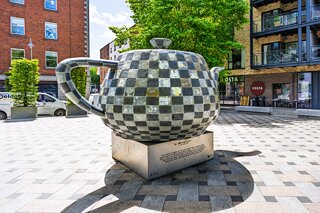
AN INTERESTING SCULPTURE THAT NEEDS TO BE CLEANED
THE SMITHFIELD UTAH SCULPTURE By ALAN BUTLER [LOCATED AT SMITHFIELD SQUARE IN DUBLIN]
While the real city of Smithfield, Utah, is a growing community nestled by the Wasatch Mountains, its name carries an entirely different, legendary meaning in the realm of computer science. It is this digital history that links a quiet American town directly to a public square in Dublin, Ireland.
Here is a look at the fascinating cross-section of digital heritage and Irish street art represented by Alan Butler's sculpture, alongside the history of the world-famous computer graphic it honours.
The Sculpture: "Smithfield Utah" by Alan Butler
Unveiled in October 2021 as part of Dublin City Council’s Sculpture Dublin initiative, "Smithfield Utah" is a permanent public artwork located at Smithfield Square Lower in Dublin.
Created by Dublin-based artist Alan Butler, the sculpture takes the form of an oversized, chequered bronze teapot. Butler chose this form because it operates on multiple conceptual layers:
Cultural Resonance: On a local level, a teapot is a universal symbol of Irish warmth, hospitality, and congregation, fitting seamlessly into the historic marketplace legacy of Smithfield.
The Digital Connection: On a global, technological level, the sculpture is a physical manifestation of a digital ghost. By using bronze—one of humanity’s oldest sculpting mediums—Butler casted a virtual mathematical model into the physical world.
The location itself is highly deliberate. Smithfield is home to a bustling hub of contemporary creative, architectural, and digital animation firms (such as Brown Bag Films). The sculpture serves as a nod to the foundational tech that allows these modern industries to exist.
The Theory and Background of the Utah Teapot
The sculpture is styled specifically after the Utah Teapot (or the Newell Teapot), an absolute icon in the world of 3D computer graphics.
The Origin (1975)
In 1975, a British computer scientist and mathematician named Martin Newell was a member of the pioneering computer graphics programme at the University of Utah. He needed a reasonably complex, familiar three-dimensional object to test his rendering algorithms. He wanted something with shadows, curves, and self-occlusion (where one part of the object blocks the view of another part, like the handle blocking the body).
While having tea with his wife, Sandra, she suggested he digitise their own household Melitta teapot.
Newell sketched the teapot on graph paper and calculated the mathematical coordinates using Bézier patches—a method of modeling smooth, scalable curves using control points. He wrote out a single page of computer numerical code that defined the geometry of the teapot.
Because Newell made this code completely open and publicly available, it became the universal benchmark for testing graphics software. For decades, if a computer scientist invented a new technique for simulating light, texture, reflection, or depth, they tested it on the Utah Teapot first.
Pop Culture Legacy
Because the model was pre-packaged into almost every early 3D graphics application, computer animators began sneaking it into projects as an "Easter egg." You can spot the Utah Teapot in:
Pixar's Toy Story (during Buzz Lightyear's tea party scene)
The Simpsons (the famous 3D "Homer³" episode)
Classic Windows "3D Pipes" screensavers
Dozens of modern video games
By placing the bronze teapot in Dublin, Alan Butler transformed an unsung hero of the digital age into a tangible community landmark.
While the real city of Smithfield, Utah, is a growing community nestled by the Wasatch Mountains, its name carries an entirely different, legendary meaning in the realm of computer science. It is this digital history that links a quiet American town directly to a public square in Dublin, Ireland.
Here is a look at the fascinating cross-section of digital heritage and Irish street art represented by Alan Butler's sculpture, alongside the history of the world-famous computer graphic it honours.
The Sculpture: "Smithfield Utah" by Alan Butler
Unveiled in October 2021 as part of Dublin City Council’s Sculpture Dublin initiative, "Smithfield Utah" is a permanent public artwork located at Smithfield Square Lower in Dublin.
Created by Dublin-based artist Alan Butler, the sculpture takes the form of an oversized, chequered bronze teapot. Butler chose this form because it operates on multiple conceptual layers:
Cultural Resonance: On a local level, a teapot is a universal symbol of Irish warmth, hospitality, and congregation, fitting seamlessly into the historic marketplace legacy of Smithfield.
The Digital Connection: On a global, technological level, the sculpture is a physical manifestation of a digital ghost. By using bronze—one of humanity’s oldest sculpting mediums—Butler casted a virtual mathematical model into the physical world.
The location itself is highly deliberate. Smithfield is home to a bustling hub of contemporary creative, architectural, and digital animation firms (such as Brown Bag Films). The sculpture serves as a nod to the foundational tech that allows these modern industries to exist.
The Theory and Background of the Utah Teapot
The sculpture is styled specifically after the Utah Teapot (or the Newell Teapot), an absolute icon in the world of 3D computer graphics.
The Origin (1975)
In 1975, a British computer scientist and mathematician named Martin Newell was a member of the pioneering computer graphics programme at the University of Utah. He needed a reasonably complex, familiar three-dimensional object to test his rendering algorithms. He wanted something with shadows, curves, and self-occlusion (where one part of the object blocks the view of another part, like the handle blocking the body).
While having tea with his wife, Sandra, she suggested he digitise their own household Melitta teapot.
Newell sketched the teapot on graph paper and calculated the mathematical coordinates using Bézier patches—a method of modeling smooth, scalable curves using control points. He wrote out a single page of computer numerical code that defined the geometry of the teapot.
Because Newell made this code completely open and publicly available, it became the universal benchmark for testing graphics software. For decades, if a computer scientist invented a new technique for simulating light, texture, reflection, or depth, they tested it on the Utah Teapot first.
Pop Culture Legacy
Because the model was pre-packaged into almost every early 3D graphics application, computer animators began sneaking it into projects as an "Easter egg." You can spot the Utah Teapot in:
Pixar's Toy Story (during Buzz Lightyear's tea party scene)
The Simpsons (the famous 3D "Homer³" episode)
Classic Windows "3D Pipes" screensavers
Dozens of modern video games
By placing the bronze teapot in Dublin, Alan Butler transformed an unsung hero of the digital age into a tangible community landmark.
TEAPOT SCULPTURE