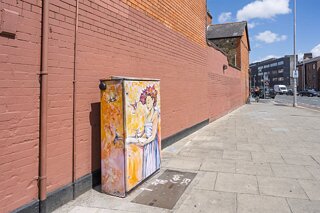
TODAY I USED A SONY A7RVI AND A LOXIA 21MM F2.8 LENS
The North King Street Massacre remains one of the most tragic and deeply contested episodes of the 1916 Easter Rising, highlighting the immense civilian toll of the conflict.
The North King Street Massacre (April 1916)
During the final hours of the Easter Rising, on the night of Friday 28th and morning of Saturday 29th April 1916, North King Street was the scene of exceptionally fierce, close-quarters urban combat. The area was a stronghold for the 1st Battalion of the Irish Volunteers, commanded by Edward Daly, who had heavily fortified the narrow warren of streets surrounding the Four Courts.
Tasked with breaking through these formidable barricades was the South Staffordshire Regiment of the British Army. Encountering intense sniper fire and suffering heavy casualties, the frustrated soldiers adopted a brutal room-by-room clearing strategy.
Using crowbars and picks, the troops broke into the terraced brick houses along the street, tunneling through internal walls to avoid the exposed roadways. Believing the male residents to be rebel combatants in plain clothes, soldiers shot or bayoneted 16 innocent civilian men and boys who were sheltering in their own homes.
"On the night of Friday/Saturday 28th/29th April 1916... sixteen innocent civilians, who were sheltering in their homes, were brutally murdered by British crown forces."
— Inscription from the memorial plaque
The bodies of several victims were buried hastily in cellars or backyards by the troops to conceal the deaths. Although a military court of inquiry was later held, and the British authorities acknowledged that the civilians had been killed, no soldiers were ever disciplined or prosecuted. Sir John Maxwell, the British commander-in-chief in Ireland, famously minimised the atrocity by stating that such casualties were "unavoidable" in house-to-house fighting.
The Commemorative Plaque
To ensure this atrocity was not forgotten by history, a bronze plaque was erected by the Stoneybatter and Smithfield People’s History Project on the wall of Kevin Barry House, situated at the junction of North King Street and Coleraine Street. It bears the names of the 16 victims, which included fathers and sons, such as Thomas Hickey (38) and his 16-year-old son Christopher.
The History and Evolution of North King Street
North King Street (or King Street North) is an ancient Dublin thoroughfare connecting Bolton Street to Blackhall Place. It has a rich architectural and social history that stretches back long before the 20th century.
Past Names and Origins
The street has been heavily documented since the medieval period. If you were to track its names through history, you would find the following evolution:
1438: It is heavily recorded in medieval deeds as King’s Lane, Oxmanstown. "Oxmanstown" was the old Viking enclave on the north side of the River Liffey, settled by the Norsemen after they were expelled from the old city south of the river by the Anglo-Normans.
1551: The name evolved into King Street, Oxmanstown.
1700s: As the city expanded and formalized its layout, it simply became known as King Street, later gaining the prefix "North" to distinguish it from South King Street near Stephen's Green.
The name "King Street" itself is widely believed by historians to have been designated due to its close proximity to Queen Street, reflecting the traditional British colonial practice of naming major urban arteries after royalty.
While it was a highly fashionable residential district in the 17th century—even hosting a prestigious school run by the Poor Clare nuns—by 1916, it had transformed into a bustling, densely populated working-class district filled with tenements, bakeries, dairies, and coach factories. Today, it sits inside the vibrantly regenerated Smithfield area, though the widening of principal road junctions has altered much of the intimate, tight-knit streetscape that existed during the Rising.
The North King Street Massacre (April 1916)
During the final hours of the Easter Rising, on the night of Friday 28th and morning of Saturday 29th April 1916, North King Street was the scene of exceptionally fierce, close-quarters urban combat. The area was a stronghold for the 1st Battalion of the Irish Volunteers, commanded by Edward Daly, who had heavily fortified the narrow warren of streets surrounding the Four Courts.
Tasked with breaking through these formidable barricades was the South Staffordshire Regiment of the British Army. Encountering intense sniper fire and suffering heavy casualties, the frustrated soldiers adopted a brutal room-by-room clearing strategy.
Using crowbars and picks, the troops broke into the terraced brick houses along the street, tunneling through internal walls to avoid the exposed roadways. Believing the male residents to be rebel combatants in plain clothes, soldiers shot or bayoneted 16 innocent civilian men and boys who were sheltering in their own homes.
"On the night of Friday/Saturday 28th/29th April 1916... sixteen innocent civilians, who were sheltering in their homes, were brutally murdered by British crown forces."
— Inscription from the memorial plaque
The bodies of several victims were buried hastily in cellars or backyards by the troops to conceal the deaths. Although a military court of inquiry was later held, and the British authorities acknowledged that the civilians had been killed, no soldiers were ever disciplined or prosecuted. Sir John Maxwell, the British commander-in-chief in Ireland, famously minimised the atrocity by stating that such casualties were "unavoidable" in house-to-house fighting.
The Commemorative Plaque
To ensure this atrocity was not forgotten by history, a bronze plaque was erected by the Stoneybatter and Smithfield People’s History Project on the wall of Kevin Barry House, situated at the junction of North King Street and Coleraine Street. It bears the names of the 16 victims, which included fathers and sons, such as Thomas Hickey (38) and his 16-year-old son Christopher.
The History and Evolution of North King Street
North King Street (or King Street North) is an ancient Dublin thoroughfare connecting Bolton Street to Blackhall Place. It has a rich architectural and social history that stretches back long before the 20th century.
Past Names and Origins
The street has been heavily documented since the medieval period. If you were to track its names through history, you would find the following evolution:
1438: It is heavily recorded in medieval deeds as King’s Lane, Oxmanstown. "Oxmanstown" was the old Viking enclave on the north side of the River Liffey, settled by the Norsemen after they were expelled from the old city south of the river by the Anglo-Normans.
1551: The name evolved into King Street, Oxmanstown.
1700s: As the city expanded and formalized its layout, it simply became known as King Street, later gaining the prefix "North" to distinguish it from South King Street near Stephen's Green.
The name "King Street" itself is widely believed by historians to have been designated due to its close proximity to Queen Street, reflecting the traditional British colonial practice of naming major urban arteries after royalty.
While it was a highly fashionable residential district in the 17th century—even hosting a prestigious school run by the Poor Clare nuns—by 1916, it had transformed into a bustling, densely populated working-class district filled with tenements, bakeries, dairies, and coach factories. Today, it sits inside the vibrantly regenerated Smithfield area, though the widening of principal road junctions has altered much of the intimate, tight-knit streetscape that existed during the Rising.
NORTH KING STREET