CHURCH STREET IS ONE OF THE OLDEST STREETS IN THE CITY
CHURCH STREET IS ONE OF THE OLDEST IN DUBLIN [IT WAS WITNESS TO A NUMBER OF UNFORTUNATE EVENTS]
Church Street is one of Dublin’s oldest and most historically layered thoroughfares, serving as a vital artery on the city’s northside for over a millennium. Steeped in Norse, medieval, and revolutionary history, it encapsulates Dublin's evolution from an early Christian settlement into a dense Victorian industrial core, and eventually into the modern inner-city landscape we see today.
The Ancient Highway: Origins and Earlier Names
Long before it was known as Church Street, this route was part of the Slí Mór (the Great Highway), one of Ireland’s five ancient royal roads that intersected at the historic ford across the River Liffey.
When the Vikings established their walled settlement on the south side of the river, the north side evolved into an area known as Oxmantown (a corruption of "Ostmentown," or the town of the Eastmen/Norsemen). Church Street became the central spine of this northern suburb.
While it has been recorded as Church Street for centuries—named after the prominent presence of St. Michan’s Church—older historical maps and deeds from the medieval period occasionally refer to parts of this layout simply as the "road to Oxmantown Green" or "The Pill" near its southern terminus, referencing an old water inlet of the Liffey that once ran close by.
St. Michan’s and the Capuchin Friary
The spiritual heart of the street is anchored by two massive ecclesiastical landmarks:
St. Michan's Church (Church of Ireland): Originally founded by the Norse-Vikings in 1095, the current structure dates largely from a 17th-century rebuild. It is globally renowned for its subterranean vaults, where unique atmospheric conditions created by the surrounding limestone naturally mummified centuries-old remains. Among those interred are the Sheares brothers, executed after the 1798 Rebellion.
A Tragic Loss: Regrettably, much of what was preserved in the vaults suffered catastrophic, irreparable damage as a result of a deliberate arson attack. While the fire itself charred several of the priceless mummies—including the famous 800-year-old "Crusader"—much of the widespread destruction to the historic contents was caused by the thousands of gallons of water used by the fire crews to douse the flames, which pooled over a foot deep and instantly ruined the hyper-specific dry atmosphere required to preserve the remains.
St. Mary of the Angels (Capuchin Friary): Built in the late 19th century, this striking Gothic Revival church represents a massive chapter in the Catholic history of the area, serving the dense, working-class communities of the north inner city.
Security Gates and Contemporary Realities
For a street photographer documenting the built environment, the exterior of St. Mary of the Angels offers a stark visual story of how Dublin's historic streetscapes adapt to modern urban realities. The presence of locked metal security gates in front of the main doors at the Capuchin Friary (St. Mary of the Angels) on Church Street is a measure implemented across various urban parishes in Dublin city centre.
While there is rarely a single, definitive public declaration for these structural additions, the installation of recent security gates with decorative finials across the recessed door arches stems from a combination of practical and operational factors:
Securing Deep, Recessed Porches: The Gothic Revival facade of the church features deeply recessed portal entries with fine stone carvings, steps, and polished red granite columns. In city-centre environments, these sheltered, unmonitored alcoves are highly susceptible to anti-social behaviour, vandalism, and overnight loitering when the main building is closed.
Restricted Operating and Mass Hours: Unlike historical periods when urban churches remained unlocked from dawn until dusk, contemporary staffing, maintenance constraints, and security requirements mean the main body of the church is only accessible during specific windows. Currently, regular public access is aligned closely with scheduled services (such as morning and evening weekday Masses, and specific confession times). The metal gates allow the inner wooden doors to remain open for ventilation or aesthetic purposes during operational hours while physically securing the boundary immediately after services conclude.
Proximity to High-Demand Services: The Capuchin Friary is intrinsically linked to the Capuchin Day Centre for Homeless People, which operates just behind the main church building on Bow Street. While the Capuchins provide extensive, vital frontline services (including meals, medical clinics, and daytime amenities), the sheer volume of daily visitors to the immediate vicinity necessitates strict boundary management for the historic church fabric itself. This ensures that the sacred space, detailed architectural features, and entryways are protected when staff or volunteers are not actively on-site to monitor them.
These architectural interventions form part of the evolving, modern narrative of Dublin's historic streetscapes—where 19th-century ecclesiastical architecture, home to The Irish Centre for Padre Pio, is adapted with contemporary physical security to manage the realities of an active inner-city core.
The "Collapsed Houses" Tragedy of 1913
Directly across the street from the Friary, inside the railed enclosure of Father Mathew Square, lies a sobering pocket park that commemorates one of the darkest days in Dublin’s social history. By the early 20th century, the Georgian grandeur of Dublin had decayed into horrific, overcrowded tenement slums, and Church Street was at the very epicentre of this humanitarian
On the evening of 2nd September 1913, numbers 66 and 67 Church Street—two structurally compromised, severely overcrowded tenement buildings—spontaneously collapsed inward.
The disaster claimed the lives of seven residents, including young children, and injured dozens more. This tragedy occurred right at the onset of the 1913 Dublin Lockout, a massive industrial dispute led by Jim Larkin. The collapse shocked the public consciousness, exposing the wretched housing conditions of the Dublin working class and forcing a subsequent housing inquiry that eventually triggered the slow clearance of the inner-city tenements.
The site is formally marked by a beautiful, highly ornate historic street lamp standing amidst the greenery. Mounted alongside it is an all-metal memorial plaque that explicitly names the victims—including Margaret Rourke (55), Hugh Sammon (17), and Nicholas FitzPatrick (40)—ensuring that the human cost of Dublin's dark tenement era is never forgotten.
The ornate street lamp featured in my photographs is a historic Dublin Corporation gas lamp, dating back to the late Victorian or early Edwardian era. While the individual foundry artisan who hand-cast this specific iron pillar remains anonymous in civic records, its placement inside Father Mathew Square forms part of a broader artistic and architectural legacy on Church Street.
When the local authority cleared the ruins of the collapsed tenements and redeveloped the area into Dublin’s first major public housing scheme, the project was spearheaded by City Architect Charles J. McCarthy. To elevate the area, McCarthy worked closely with one of Ireland’s most prominent artistic dynasties: The Broe Family of Sculptors, specifically Leo Broe.
The Artist: Leo Broe and the Broe Dynasty
Leo Broe (and later his son, Desmond Broe) operated a renowned sculpture and monumental studio based nearby on Harold’s Cross Road. The family became the definitive artisans of ecclesiastical and public sculpture in mid-20th-century Dublin, heavily shaping the visual fabric of Church Street itself.
The Church Street Connection: If you look directly across the road from the memorial lamp to the facade of St. Mary of the Angels, the spectacular exterior sculptures—the large canopied statue of the Virgin Mary and the accompanying figures of Saint Francis and Saint Clare—were all hand-sculpted by Leo Broe.
Their Style and Career: Broe’s work seamlessly bridged classic 19th-century academic realism with the simpler, more solemn forms of early 20th-century Irish naturalism. The Broe studio was highly sought after following the founding of the Irish Free State, commissioned to create numerous republican war memorials, intricate Celtic Revival headstones, and Catholic public art across the country.
The Art: The Decorative Cast-Iron Tradition
The street lamp itself represents the height of Dublin’s historic industrial iron art. During the late 1800s, Dublin Corporation commissioned exceptionally intricate, gothic, and naturalistic designs for its city centre street furniture.
Design Motifs: As captured in my photographs , the pillar features a highly textured, twisted foliate design—mimicking climbing ivy or vines—terminating in a stylised basket that cradles the glass globe.
The Transformation: Originally manufactured as a gas lamp to illuminate the dark, unlit streets of the north inner city (the lack of light famously hindered the 1913 rescue efforts), it was later preserved, converted to electricity, and integrated into the pocket park.
Today, the lamp stands not just as a piece of functional infrastructure, but as a striking piece of street art, working in tandem with the all-metal plaque to casting a permanent, symbolic light over the names of the victims.
Modern Street Art: The Dublin Canvas "Paint-A-Box" Project
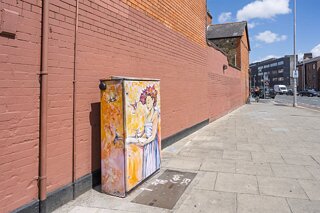
As you navigate the street towards the River Liffey, the historic fabric of Church Street meets modern urban expression through the Dublin Canvas initiative. This project commissions local artists to turn dull, grey traffic light utility control boxes into vibrant public art. Two standout boxes on this street showcase how Dublin’s folklore and revolutionary history continue to inhabit the modern streetscape.
1. "Billy in the Bowl" (The River End of Church Street)
Located near the southern, river terminus of the street, a highly popular Paint-A-Box installation pays homage to one of 18th-century Dublin’s most notorious folk characters: Billy in the Bowl (Billy Davis).
The Artist: This box was illustrated by the late, immensely talented Japanese street artist and comic creator Shota Kotake (commissioned in September 2017). Kotake’s distinct, illustrative line style brought historic Dublin characters to life across the city before his untimely passing, leaving a lasting mark on the Irish arts scene.
The History: Billy Davis was an infamous 1780s beggar born without legs who propelled himself through the unpaved streets of Stoneybatter, Grangegorman, and Oxmantown in a large, custom-made iron bowl fitted with wheels. Remarkably handsome and endowed with immense upper-body strength, Billy was initially a favourite of local servant girls who plied him with alms. However, he weaponised his disability to become a prolific thief and strangler, hiding in roadside bushes to lure unsuspecting passersby with groans of distress before dragging them down. Known as the "Stoneybatter Strangler," his criminal career ended in 1786 when two women successfully fought him off, leading to his capture and a sentence of life at hard labour.
2. "The Sheares Brothers" (The Corner of Church Street and Mary's Lane)
Further up the street, at the busy junction where Church Street meets Mary's Lane, another compelling piece of Dublin Canvas street art explicitly bridges the built environment with the subterranean history of St. Michan’s crypt.
The Artist: This traffic box was designed and executed by the brilliant Dublin comic book artist, illustrator, and street muralist Hugh Madden. Madden is widely celebrated for his graphic, narrative-driven public art that heavily incorporates elements of classical Irish folklore, history, and sequential art into the urban landscape.
The History: Madden's piece depicts Henry and John Sheares, the wealthy Cork-born lawyers who became prominent leaders in the Society of United Irishmen. Having witnessed the French Revolution firsthand, they helped orchestrate the Dublin element of the 1798 Rebellion. Betrayed by an informant just days before the planned uprising, they were tried for high treason and executed outside Newgate Gaol. Their remains were interred directly down the street in the unique limestone vaults of St. Michan’s, where their naturally mummified bodies became an object of quiet reverence for generations of Dubliners. Madden’s street art effectively pulls their memory out from the underground vaults and positions it back onto the physical corner of the modern street they fought to liberate.
Church Street is one of Dublin’s oldest and most historically layered thoroughfares, serving as a vital artery on the city’s northside for over a millennium. Steeped in Norse, medieval, and revolutionary history, it encapsulates Dublin's evolution from an early Christian settlement into a dense Victorian industrial core, and eventually into the modern inner-city landscape we see today.
The Ancient Highway: Origins and Earlier Names
Long before it was known as Church Street, this route was part of the Slí Mór (the Great Highway), one of Ireland’s five ancient royal roads that intersected at the historic ford across the River Liffey.
When the Vikings established their walled settlement on the south side of the river, the north side evolved into an area known as Oxmantown (a corruption of "Ostmentown," or the town of the Eastmen/Norsemen). Church Street became the central spine of this northern suburb.
While it has been recorded as Church Street for centuries—named after the prominent presence of St. Michan’s Church—older historical maps and deeds from the medieval period occasionally refer to parts of this layout simply as the "road to Oxmantown Green" or "The Pill" near its southern terminus, referencing an old water inlet of the Liffey that once ran close by.
St. Michan’s and the Capuchin Friary
The spiritual heart of the street is anchored by two massive ecclesiastical landmarks:
St. Michan's Church (Church of Ireland): Originally founded by the Norse-Vikings in 1095, the current structure dates largely from a 17th-century rebuild. It is globally renowned for its subterranean vaults, where unique atmospheric conditions created by the surrounding limestone naturally mummified centuries-old remains. Among those interred are the Sheares brothers, executed after the 1798 Rebellion.
A Tragic Loss: Regrettably, much of what was preserved in the vaults suffered catastrophic, irreparable damage as a result of a deliberate arson attack. While the fire itself charred several of the priceless mummies—including the famous 800-year-old "Crusader"—much of the widespread destruction to the historic contents was caused by the thousands of gallons of water used by the fire crews to douse the flames, which pooled over a foot deep and instantly ruined the hyper-specific dry atmosphere required to preserve the remains.
St. Mary of the Angels (Capuchin Friary): Built in the late 19th century, this striking Gothic Revival church represents a massive chapter in the Catholic history of the area, serving the dense, working-class communities of the north inner city.
Security Gates and Contemporary Realities
For a street photographer documenting the built environment, the exterior of St. Mary of the Angels offers a stark visual story of how Dublin's historic streetscapes adapt to modern urban realities. The presence of locked metal security gates in front of the main doors at the Capuchin Friary (St. Mary of the Angels) on Church Street is a measure implemented across various urban parishes in Dublin city centre.
While there is rarely a single, definitive public declaration for these structural additions, the installation of recent security gates with decorative finials across the recessed door arches stems from a combination of practical and operational factors:
Securing Deep, Recessed Porches: The Gothic Revival facade of the church features deeply recessed portal entries with fine stone carvings, steps, and polished red granite columns. In city-centre environments, these sheltered, unmonitored alcoves are highly susceptible to anti-social behaviour, vandalism, and overnight loitering when the main building is closed.
Restricted Operating and Mass Hours: Unlike historical periods when urban churches remained unlocked from dawn until dusk, contemporary staffing, maintenance constraints, and security requirements mean the main body of the church is only accessible during specific windows. Currently, regular public access is aligned closely with scheduled services (such as morning and evening weekday Masses, and specific confession times). The metal gates allow the inner wooden doors to remain open for ventilation or aesthetic purposes during operational hours while physically securing the boundary immediately after services conclude.
Proximity to High-Demand Services: The Capuchin Friary is intrinsically linked to the Capuchin Day Centre for Homeless People, which operates just behind the main church building on Bow Street. While the Capuchins provide extensive, vital frontline services (including meals, medical clinics, and daytime amenities), the sheer volume of daily visitors to the immediate vicinity necessitates strict boundary management for the historic church fabric itself. This ensures that the sacred space, detailed architectural features, and entryways are protected when staff or volunteers are not actively on-site to monitor them.
These architectural interventions form part of the evolving, modern narrative of Dublin's historic streetscapes—where 19th-century ecclesiastical architecture, home to The Irish Centre for Padre Pio, is adapted with contemporary physical security to manage the realities of an active inner-city core.
The "Collapsed Houses" Tragedy of 1913
Directly across the street from the Friary, inside the railed enclosure of Father Mathew Square, lies a sobering pocket park that commemorates one of the darkest days in Dublin’s social history. By the early 20th century, the Georgian grandeur of Dublin had decayed into horrific, overcrowded tenement slums, and Church Street was at the very epicentre of this humanitarian
On the evening of 2nd September 1913, numbers 66 and 67 Church Street—two structurally compromised, severely overcrowded tenement buildings—spontaneously collapsed inward.
The disaster claimed the lives of seven residents, including young children, and injured dozens more. This tragedy occurred right at the onset of the 1913 Dublin Lockout, a massive industrial dispute led by Jim Larkin. The collapse shocked the public consciousness, exposing the wretched housing conditions of the Dublin working class and forcing a subsequent housing inquiry that eventually triggered the slow clearance of the inner-city tenements.
The site is formally marked by a beautiful, highly ornate historic street lamp standing amidst the greenery. Mounted alongside it is an all-metal memorial plaque that explicitly names the victims—including Margaret Rourke (55), Hugh Sammon (17), and Nicholas FitzPatrick (40)—ensuring that the human cost of Dublin's dark tenement era is never forgotten.
The ornate street lamp featured in my photographs is a historic Dublin Corporation gas lamp, dating back to the late Victorian or early Edwardian era. While the individual foundry artisan who hand-cast this specific iron pillar remains anonymous in civic records, its placement inside Father Mathew Square forms part of a broader artistic and architectural legacy on Church Street.
When the local authority cleared the ruins of the collapsed tenements and redeveloped the area into Dublin’s first major public housing scheme, the project was spearheaded by City Architect Charles J. McCarthy. To elevate the area, McCarthy worked closely with one of Ireland’s most prominent artistic dynasties: The Broe Family of Sculptors, specifically Leo Broe.
The Artist: Leo Broe and the Broe Dynasty
Leo Broe (and later his son, Desmond Broe) operated a renowned sculpture and monumental studio based nearby on Harold’s Cross Road. The family became the definitive artisans of ecclesiastical and public sculpture in mid-20th-century Dublin, heavily shaping the visual fabric of Church Street itself.
The Church Street Connection: If you look directly across the road from the memorial lamp to the facade of St. Mary of the Angels, the spectacular exterior sculptures—the large canopied statue of the Virgin Mary and the accompanying figures of Saint Francis and Saint Clare—were all hand-sculpted by Leo Broe.
Their Style and Career: Broe’s work seamlessly bridged classic 19th-century academic realism with the simpler, more solemn forms of early 20th-century Irish naturalism. The Broe studio was highly sought after following the founding of the Irish Free State, commissioned to create numerous republican war memorials, intricate Celtic Revival headstones, and Catholic public art across the country.
The Art: The Decorative Cast-Iron Tradition
The street lamp itself represents the height of Dublin’s historic industrial iron art. During the late 1800s, Dublin Corporation commissioned exceptionally intricate, gothic, and naturalistic designs for its city centre street furniture.
Design Motifs: As captured in my photographs , the pillar features a highly textured, twisted foliate design—mimicking climbing ivy or vines—terminating in a stylised basket that cradles the glass globe.
The Transformation: Originally manufactured as a gas lamp to illuminate the dark, unlit streets of the north inner city (the lack of light famously hindered the 1913 rescue efforts), it was later preserved, converted to electricity, and integrated into the pocket park.
Today, the lamp stands not just as a piece of functional infrastructure, but as a striking piece of street art, working in tandem with the all-metal plaque to casting a permanent, symbolic light over the names of the victims.
Modern Street Art: The Dublin Canvas "Paint-A-Box" Project
As you navigate the street towards the River Liffey, the historic fabric of Church Street meets modern urban expression through the Dublin Canvas initiative. This project commissions local artists to turn dull, grey traffic light utility control boxes into vibrant public art. Two standout boxes on this street showcase how Dublin’s folklore and revolutionary history continue to inhabit the modern streetscape.
1. "Billy in the Bowl" (The River End of Church Street)
Located near the southern, river terminus of the street, a highly popular Paint-A-Box installation pays homage to one of 18th-century Dublin’s most notorious folk characters: Billy in the Bowl (Billy Davis).
The Artist: This box was illustrated by the late, immensely talented Japanese street artist and comic creator Shota Kotake (commissioned in September 2017). Kotake’s distinct, illustrative line style brought historic Dublin characters to life across the city before his untimely passing, leaving a lasting mark on the Irish arts scene.
The History: Billy Davis was an infamous 1780s beggar born without legs who propelled himself through the unpaved streets of Stoneybatter, Grangegorman, and Oxmantown in a large, custom-made iron bowl fitted with wheels. Remarkably handsome and endowed with immense upper-body strength, Billy was initially a favourite of local servant girls who plied him with alms. However, he weaponised his disability to become a prolific thief and strangler, hiding in roadside bushes to lure unsuspecting passersby with groans of distress before dragging them down. Known as the "Stoneybatter Strangler," his criminal career ended in 1786 when two women successfully fought him off, leading to his capture and a sentence of life at hard labour.
2. "The Sheares Brothers" (The Corner of Church Street and Mary's Lane)
Further up the street, at the busy junction where Church Street meets Mary's Lane, another compelling piece of Dublin Canvas street art explicitly bridges the built environment with the subterranean history of St. Michan’s crypt.
The Artist: This traffic box was designed and executed by the brilliant Dublin comic book artist, illustrator, and street muralist Hugh Madden. Madden is widely celebrated for his graphic, narrative-driven public art that heavily incorporates elements of classical Irish folklore, history, and sequential art into the urban landscape.
The History: Madden's piece depicts Henry and John Sheares, the wealthy Cork-born lawyers who became prominent leaders in the Society of United Irishmen. Having witnessed the French Revolution firsthand, they helped orchestrate the Dublin element of the 1798 Rebellion. Betrayed by an informant just days before the planned uprising, they were tried for high treason and executed outside Newgate Gaol. Their remains were interred directly down the street in the unique limestone vaults of St. Michan’s, where their naturally mummified bodies became an object of quiet reverence for generations of Dubliners. Madden’s street art effectively pulls their memory out from the underground vaults and positions it back onto the physical corner of the modern street they fought to liberate.
CHURCH STREET JUNE 2026