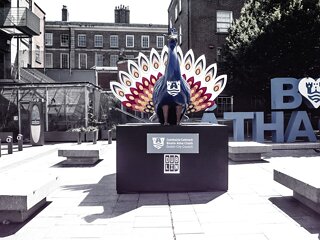
I USED A FUJIFILM GFX100RF ON THE FIRST DAY AND LEICA Q3 THE NEXT DAY
BARNADO SQUARE IN CONTEXT JUNE 2026 [TWO SESSIONS TWO DIFFERENT CAMERAS]
On the 26th June I used a Fujifilm GFX100RF and it overheated and when I returned the images were totally black but i managed to recover some but all have a purple tint. The next day I used a Leica Q3 which has given me many problems since I got it in May 2025 however the most recent firmware update appears to have resolved most ongoing issues. In general i have been somewhat disappointed by both cameras but while I favoured the Fuji I am beginning to feel more confident about the Q3 performance.
The Vanishing Oasis: A Tale of Two Dublin Disappointments
The space adjacent to Dublin City Hall and Palace Street, now officially designated as Barnardo Square, serves as a stark example of the erosion of Dublin’s public realm.
Once a sanctuary featuring a central pond and a trio of significant sculptures, the site has been transformed into a bleak, paved thoroughfare. This redevelopment, largely synonymous with the construction of the adjacent office block—frequently derided by critics such as Frank McDonald and Paul Clerkin as an architectural affront to Dame Street—has stripped the area of its human scale.
What was once an intimate urban garden is now a sterile plaza, an environment that prioritises rigid, austere geometry over the needs of the city's inhabitants.
The history of the three statues formerly housed in the square’s pond adds a layer of cultural tragedy to this decline. These figures, crafted for the 1872 Great Industrial Exhibition at Earlsfort Terrace, represent the pinnacle of Irish manufacturing in wood, metal, and stone. They were not mere garden ornaments; they were emblems of a Victorian-era pride in domestic industry and craftsmanship. Their removal from the Dame Street site was a severance of the city’s tangible link to its industrial heritage.
The narrative continues to King’s Inns Park, which serves as the final, ignoble resting place for these artefacts. Following the destruction of the local statue known as "Truth" (or "Henrietta")—a casualty of a reversing truck—the authorities attempted to compensate for the loss. Instead of providing the exhibition statues with the dignity their provenance demands, the city opted for a utilitarian approach, mounting them upon an unsightly concrete plinth. This choice effectively decontextualises the sculptures, rendering them visually indistinguishable from temporary "film props" or discarded decorative remnants.
This pairing of sites illustrates a systemic failure in Dublin’s urban curation. In both instances, historical significance has been sacrificed for the sake of maintenance and ease of movement. The public is left with a sense of lingering disappointment: a square on Dame Street that feels devoid of soul, and a collection of historic treasures at King’s Inns that are treated as afterthoughts. Ultimately, both locations stand as monuments to a city that has lost the ability to value, integrate, and properly honour the remnants of its past.
On the 26th June I used a Fujifilm GFX100RF and it overheated and when I returned the images were totally black but i managed to recover some but all have a purple tint. The next day I used a Leica Q3 which has given me many problems since I got it in May 2025 however the most recent firmware update appears to have resolved most ongoing issues. In general i have been somewhat disappointed by both cameras but while I favoured the Fuji I am beginning to feel more confident about the Q3 performance.
The Vanishing Oasis: A Tale of Two Dublin Disappointments
The space adjacent to Dublin City Hall and Palace Street, now officially designated as Barnardo Square, serves as a stark example of the erosion of Dublin’s public realm.
Once a sanctuary featuring a central pond and a trio of significant sculptures, the site has been transformed into a bleak, paved thoroughfare. This redevelopment, largely synonymous with the construction of the adjacent office block—frequently derided by critics such as Frank McDonald and Paul Clerkin as an architectural affront to Dame Street—has stripped the area of its human scale.
What was once an intimate urban garden is now a sterile plaza, an environment that prioritises rigid, austere geometry over the needs of the city's inhabitants.
The history of the three statues formerly housed in the square’s pond adds a layer of cultural tragedy to this decline. These figures, crafted for the 1872 Great Industrial Exhibition at Earlsfort Terrace, represent the pinnacle of Irish manufacturing in wood, metal, and stone. They were not mere garden ornaments; they were emblems of a Victorian-era pride in domestic industry and craftsmanship. Their removal from the Dame Street site was a severance of the city’s tangible link to its industrial heritage.
The narrative continues to King’s Inns Park, which serves as the final, ignoble resting place for these artefacts. Following the destruction of the local statue known as "Truth" (or "Henrietta")—a casualty of a reversing truck—the authorities attempted to compensate for the loss. Instead of providing the exhibition statues with the dignity their provenance demands, the city opted for a utilitarian approach, mounting them upon an unsightly concrete plinth. This choice effectively decontextualises the sculptures, rendering them visually indistinguishable from temporary "film props" or discarded decorative remnants.
This pairing of sites illustrates a systemic failure in Dublin’s urban curation. In both instances, historical significance has been sacrificed for the sake of maintenance and ease of movement. The public is left with a sense of lingering disappointment: a square on Dame Street that feels devoid of soul, and a collection of historic treasures at King’s Inns that are treated as afterthoughts. Ultimately, both locations stand as monuments to a city that has lost the ability to value, integrate, and properly honour the remnants of its past.
BARNARDO SQUARE IN CONTEXT