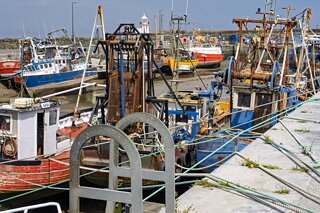
BALLBRIGAN HARBOUR PHOTOGRAPHED ON A VERY HOT DAY IN JUNE 2026
BALBRIGGAN IS WHAT IS KNOWN AS A DRYING HARBOUR [PHOTOGRAPHED 23 JUNE 2026]
Balbriggan Is One The Drying Harbours Of North County Dublin
Balbriggan Harbour has long served as a classic example of the "drying harbour" architecture found along the Irish coastline. As an engineer and someone who spends a significant amount of time documenting the built environment, I find the mechanics of these tidal spaces fascinating.
The Engineering of "Taking to the Hard"
In a drying harbour like Balbriggan, the harbour floor is essentially the resting place for the local fleet twice a day. As the tide recedes, the water level drops, leaving vessels to settle into the mud and sand.
For the modern fishing vessels designed to operate in this specific environment, this is a routine, non-damaging procedure. These boats are constructed with the necessary hull strength to manage the stress of settling on the harbour floor. However, it serves as a stark reminder of the constraints of tidal engineering: the window for movement is narrow, and the harbour itself is entirely dictated by the lunar cycle.
A Chapter Closed: The HMS Portisham
For many years, the visual identity of Balbriggan was inextricably linked to the HMS Portisham. A former Ham-class inshore minesweeper, this 100-tonne vessel was, for its owner, a long-term project in maritime conversion. For the local council, it was a persistent planning and aesthetic challenge.
I have followed this story for years—not just as a photographer, but as someone interested in the intersection of property law and maritime heritage. The case became a landmark legal saga, with the Supreme Court eventually ruling against Fingal County Council’s initial attempts to label the vessel a nuisance.
During my recent visits to the area to document the ongoing "Our Balbriggan" rejuvenation works, it became clear that the harbour is entering a new phase. With the extensive redevelopment of the public realm, plazas, and tourist infrastructure, the space previously occupied by the Portisham has been reclaimed. The vessel is no longer a fixture of the quay, marking the end of a long, controversial chapter in the harbour’s industrial timeline.
Current Location: Following the legal and maintenance issues in Balbriggan, the vessel was relocated further south and was towed into Arklow Harbour in late 2024. According to locals the owner ran into difficulties while relocating to Arklow and began to take on water. After being towed into the harbour the boat was seized and destroyed - apparently this is nothing more than a local legend,
Balbriggan continues to evolve, shedding its more complex, static remnants in favour of a design-forward, accessible public waterfront. It is a transition worth documenting for anyone tracking the shifting landscape of Dublin’s northern coastline.
SEO Extract
Balbriggan Is One The Drying Harbours Of North County Dublin
Balbriggan Harbour has long served as a classic example of the "drying harbour" architecture found along the Irish coastline. As an engineer and someone who spends a significant amount of time documenting the built environment, I find the mechanics of these tidal spaces fascinating.
The Engineering of "Taking to the Hard"
In a drying harbour like Balbriggan, the harbour floor is essentially the resting place for the local fleet twice a day. As the tide recedes, the water level drops, leaving vessels to settle into the mud and sand.
For the modern fishing vessels designed to operate in this specific environment, this is a routine, non-damaging procedure. These boats are constructed with the necessary hull strength to manage the stress of settling on the harbour floor. However, it serves as a stark reminder of the constraints of tidal engineering: the window for movement is narrow, and the harbour itself is entirely dictated by the lunar cycle.
A Chapter Closed: The HMS Portisham
For many years, the visual identity of Balbriggan was inextricably linked to the HMS Portisham. A former Ham-class inshore minesweeper, this 100-tonne vessel was, for its owner, a long-term project in maritime conversion. For the local council, it was a persistent planning and aesthetic challenge.
I have followed this story for years—not just as a photographer, but as someone interested in the intersection of property law and maritime heritage. The case became a landmark legal saga, with the Supreme Court eventually ruling against Fingal County Council’s initial attempts to label the vessel a nuisance.
During my recent visits to the area to document the ongoing "Our Balbriggan" rejuvenation works, it became clear that the harbour is entering a new phase. With the extensive redevelopment of the public realm, plazas, and tourist infrastructure, the space previously occupied by the Portisham has been reclaimed. The vessel is no longer a fixture of the quay, marking the end of a long, controversial chapter in the harbour’s industrial timeline.
Current Location: Following the legal and maintenance issues in Balbriggan, the vessel was relocated further south and was towed into Arklow Harbour in late 2024. According to locals the owner ran into difficulties while relocating to Arklow and began to take on water. After being towed into the harbour the boat was seized and destroyed - apparently this is nothing more than a local legend,
Balbriggan continues to evolve, shedding its more complex, static remnants in favour of a design-forward, accessible public waterfront. It is a transition worth documenting for anyone tracking the shifting landscape of Dublin’s northern coastline.
SEO Extract
BALBRIGGAN DRYING HARBOUR