I LIKE THIS LENS BUT IT IS NOT EASY TO USE
The Voigtländer 15mm f/4.5 Super Wide Heliar III: Embracing Distortion in Dublin’s Temple Bar
Rediscovering the Manual Prime: Voigtländer’s Heritage
There is a distinct phase in every photographer’s journey where the allure of lightning-fast autofocus and corporate lens ecosystems dominates the kit bag. For years, my native Sony G and GM lenses, alongside a full suite of Zeiss Batis primes, filled that role perfectly. But a funny thing happens when you pair classic manual glass with high-resolution sensors.
Reviewing older manual lenses on a high-resolving sensor is an eye-opening experience. Lenses that once seemed frustrating on older bodies are suddenly showing their true capabilities. The Voigtländer primes—specifically the 15mm, 40mm, and 65mm—are not just holding their own; they are outperforming some of my favourite AF glass, demonstrating an organic micro-contrast and edge-to-edge rendering that is hard to match.
With a photography trip to Belfast on the horizon, the Voigtländer 15mm f/4.5 Super Wide Heliar III E-mount has officially earned its place in my travel kit. But before heading north, I took it out for a raw, unfiltered test run through the South Inner City of Dublin.
The Temple Bar Experiment: Learning Through Randomness
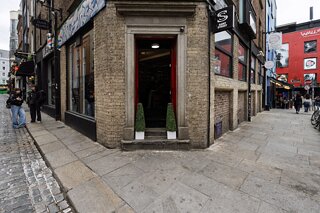
To truly understand the 110-degree field of view, I wandered through Temple Bar, photographing completely at random. I wanted to see how the lens behaved in a fluid, unpredictable environment, so I made a conscious decision to publish the resulting images exactly as they were shot, with absolutely no digital correction for perspective or distortion.
This exercise became an immediate lesson in the mechanics of ultra-wide-angle photography:
The Accidental Thumb: One crucial ergonomic detail I had forgotten about this ultra-compact lens is just how easily it likes to photograph my left thumb if my grip strays too far forward on the barrel.
Managing the Frame: I quickly discovered that having anyone walking directly beside me was a mistake, as the extreme peripheral perspective stretched them aggressively.
Proximity is Key: To make the wide-angle distortion work to my advantage, I learned it is best to get as close to the subject as humanly possible—unless, of course, the frame includes a crowd of people, where the edge distortion can become overly chaotic.
Technical Review: Voigtländer 15mm f/4.5 Super Wide Heliar III (E-Mount)
A Brief History: From Vienna to Nagano
The Voigtländer name carries massive historical weight, being one of the oldest names in optics. Founded by Johann Christoph Voigtländer in Vienna in 1756, the company created the world’s first mathematically calculated photographic lens (designed by Josef Petzval) in 1840.
[1756: Founded in Vienna]
[1840: First Petzval Lens]
[1999: Cosina Revitalisation]
While the name evokes classic European optical heritage, modern Voigtländer lenses are purely Japanese precision instruments. In 1999, the rights were acquired by Cosina, a highly respected optical manufacturer based in Nagano, Japan. Cosina preserved the classic naming conventions—like Heliar, Skopar, and Nokton—but combined them with state-of-the-art glass manufacturing and native electronic integrations.
The Version III of this 15mm lens was a complete ground-up optical redesign. While Versions I and II were legendary on film rangefinders, adapting them to digital sensors caused severe smearing and heavy magenta colour-casts in the corners. Version III completely rectifies this by altering the angle at which light strikes the sensor.
Build and Handling
True to Cosina's standards, the lens is an all-metal, beautifully engineered block of glass and steel. The manual focus ring is perfectly damped, offering exactly the right resistance for precise hyperfocal adjustments. For urban documentation, you can set the aperture to f/8 or f/11, dial in the hyperfocal distance, and shoot dynamically without ever worrying about focus delay. The integrated electronic contacts pass full EXIF data to the camera and trigger the body's 5-axis image stabilisation.
Optical Performance
Sharpness: In the centre, sharpness is outstanding from wide open at f/4.5. On demanding modern sensors, mid-frame details hold up remarkably well. The extreme corners display minor softness wide open but sharpen up beautifully when stopped down to f/8 or f/11.
Distortion & Sunstars: Straight lines stay impressively straight when leveled. For architectural and interior work, the inherent optical distortion is exceptionally low for such a wide view. Furthermore, the 10-blade straight aperture design produces the signature, razor-sharp 10-pointed "Voigtländer sunstars" from points of light.
Flare Resistance: The coating handles direct, harsh sunlight extremely well. Ghosting is minimal, and contrast remains incredibly high even when shooting directly into the sun.
Vignetting: Due to its ultra-compact design, peripheral light fall-off is heavy wide open (sometimes exceeding 2 to 3 stops in the absolute corners). While software profiles fix this easily, lifting the exposure in the corners can introduce noise in low-light environments.
The Fixed Hood Advantage vs. The Batis Ecosystem
Online forums occasionally debate the lens's permanently attached, petal-shaped metal hood—particularly landscape shooters looking to mount large, square filter systems. However, for active street and urban documentation, this fixed design is a massive practical asset.
My personal shooting philosophy is to never use filters or lens covers. It keeps the camera instantly responsive and ensures the unadulterated optical rendering of the prime isn't compromised. Because the front element is completely exposed, the hood must function as a structural shield.
This design was proven in the most brutal way during a previous trip to Belfast city centre. A heavy fall resulted in me crashing to the ground directly on top of my Sony body and the 15mm prime. While the fixed metal hood took a distinct dent, it fully absorbed the kinetic energy and completely saved the glass.
Losing two Batis hoods to busy city traffic because they simply won't stay clicked into place is an incredibly frustrating design flaw. It highlights a massive contrast in engineering philosophies between the two brands. While the Zeiss Batis line delivers lovely optical performance, those smooth, plastic, bayonet-mount hoods rely on a relatively weak friction click. When moving dynamically through a city, brushing against a jacket or a camera strap is often all it takes to unintentionally twist the hood right off its mount, leaving the front element completely vulnerable.
Rediscovering the Manual Prime: Voigtländer’s Heritage
There is a distinct phase in every photographer’s journey where the allure of lightning-fast autofocus and corporate lens ecosystems dominates the kit bag. For years, my native Sony G and GM lenses, alongside a full suite of Zeiss Batis primes, filled that role perfectly. But a funny thing happens when you pair classic manual glass with high-resolution sensors.
Reviewing older manual lenses on a high-resolving sensor is an eye-opening experience. Lenses that once seemed frustrating on older bodies are suddenly showing their true capabilities. The Voigtländer primes—specifically the 15mm, 40mm, and 65mm—are not just holding their own; they are outperforming some of my favourite AF glass, demonstrating an organic micro-contrast and edge-to-edge rendering that is hard to match.
With a photography trip to Belfast on the horizon, the Voigtländer 15mm f/4.5 Super Wide Heliar III E-mount has officially earned its place in my travel kit. But before heading north, I took it out for a raw, unfiltered test run through the South Inner City of Dublin.
The Temple Bar Experiment: Learning Through Randomness
To truly understand the 110-degree field of view, I wandered through Temple Bar, photographing completely at random. I wanted to see how the lens behaved in a fluid, unpredictable environment, so I made a conscious decision to publish the resulting images exactly as they were shot, with absolutely no digital correction for perspective or distortion.
This exercise became an immediate lesson in the mechanics of ultra-wide-angle photography:
The Accidental Thumb: One crucial ergonomic detail I had forgotten about this ultra-compact lens is just how easily it likes to photograph my left thumb if my grip strays too far forward on the barrel.
Managing the Frame: I quickly discovered that having anyone walking directly beside me was a mistake, as the extreme peripheral perspective stretched them aggressively.
Proximity is Key: To make the wide-angle distortion work to my advantage, I learned it is best to get as close to the subject as humanly possible—unless, of course, the frame includes a crowd of people, where the edge distortion can become overly chaotic.
Technical Review: Voigtländer 15mm f/4.5 Super Wide Heliar III (E-Mount)
A Brief History: From Vienna to Nagano
The Voigtländer name carries massive historical weight, being one of the oldest names in optics. Founded by Johann Christoph Voigtländer in Vienna in 1756, the company created the world’s first mathematically calculated photographic lens (designed by Josef Petzval) in 1840.
[1756: Founded in Vienna]
[1840: First Petzval Lens]
[1999: Cosina Revitalisation]
While the name evokes classic European optical heritage, modern Voigtländer lenses are purely Japanese precision instruments. In 1999, the rights were acquired by Cosina, a highly respected optical manufacturer based in Nagano, Japan. Cosina preserved the classic naming conventions—like Heliar, Skopar, and Nokton—but combined them with state-of-the-art glass manufacturing and native electronic integrations.
The Version III of this 15mm lens was a complete ground-up optical redesign. While Versions I and II were legendary on film rangefinders, adapting them to digital sensors caused severe smearing and heavy magenta colour-casts in the corners. Version III completely rectifies this by altering the angle at which light strikes the sensor.
Build and Handling
True to Cosina's standards, the lens is an all-metal, beautifully engineered block of glass and steel. The manual focus ring is perfectly damped, offering exactly the right resistance for precise hyperfocal adjustments. For urban documentation, you can set the aperture to f/8 or f/11, dial in the hyperfocal distance, and shoot dynamically without ever worrying about focus delay. The integrated electronic contacts pass full EXIF data to the camera and trigger the body's 5-axis image stabilisation.
Optical Performance
Sharpness: In the centre, sharpness is outstanding from wide open at f/4.5. On demanding modern sensors, mid-frame details hold up remarkably well. The extreme corners display minor softness wide open but sharpen up beautifully when stopped down to f/8 or f/11.
Distortion & Sunstars: Straight lines stay impressively straight when leveled. For architectural and interior work, the inherent optical distortion is exceptionally low for such a wide view. Furthermore, the 10-blade straight aperture design produces the signature, razor-sharp 10-pointed "Voigtländer sunstars" from points of light.
Flare Resistance: The coating handles direct, harsh sunlight extremely well. Ghosting is minimal, and contrast remains incredibly high even when shooting directly into the sun.
Vignetting: Due to its ultra-compact design, peripheral light fall-off is heavy wide open (sometimes exceeding 2 to 3 stops in the absolute corners). While software profiles fix this easily, lifting the exposure in the corners can introduce noise in low-light environments.
The Fixed Hood Advantage vs. The Batis Ecosystem
Online forums occasionally debate the lens's permanently attached, petal-shaped metal hood—particularly landscape shooters looking to mount large, square filter systems. However, for active street and urban documentation, this fixed design is a massive practical asset.
My personal shooting philosophy is to never use filters or lens covers. It keeps the camera instantly responsive and ensures the unadulterated optical rendering of the prime isn't compromised. Because the front element is completely exposed, the hood must function as a structural shield.
This design was proven in the most brutal way during a previous trip to Belfast city centre. A heavy fall resulted in me crashing to the ground directly on top of my Sony body and the 15mm prime. While the fixed metal hood took a distinct dent, it fully absorbed the kinetic energy and completely saved the glass.
Losing two Batis hoods to busy city traffic because they simply won't stay clicked into place is an incredibly frustrating design flaw. It highlights a massive contrast in engineering philosophies between the two brands. While the Zeiss Batis line delivers lovely optical performance, those smooth, plastic, bayonet-mount hoods rely on a relatively weak friction click. When moving dynamically through a city, brushing against a jacket or a camera strap is often all it takes to unintentionally twist the hood right off its mount, leaving the front element completely vulnerable.
VOIGTLANDER 15MM