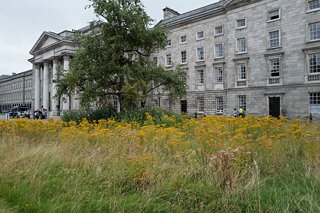
TODAY WHEN I VISITED TRINITY CAMPUS I HOPED TO FIND AND PHOTOGRAPH ST PATRICK'S WELL - WELL I FAILED
Hidden Hydrology and Wild Meadows: The Curious Paradoxes of Trinity College Dublin
A visit to the historic grounds of Trinity College Dublin often yields unexpected discoveries. Founded in 1592, this ancient institution attracts millions of visitors annually through its iconic Front Gate. Most come to walk the historic cobbles, admire the 18th-century Old Library, and view the priceless 9th-century Book of Kells.
Yet beyond the famous attractions lies a fascinating landscape of ecological experiments, curious tourist misconceptions, and centuries-old hidden history.
The Great "Wilding" Experiment
For decades, first-time visitors arrived expecting a carbon copy of an Oxbridge courtyard, complete with pristine, emerald-green manicured lawns. Aside from the obvious geographic detail that Dublin is the capital of Ireland rather than England, modern visitors are often caught completely off guard by the sight framing the statues of Edmund Burke and Oliver Goldsmith: a sprawling, intentionally overgrown wildflower meadow.
What initially resembles neglected turf is actually a deliberate rewilding initiative. Following a 2020 vote where 90 per cent of students and staff supported the project, Trinity College replaced its bowling-green style lawns at Front Gate with urban biodiversity spaces.
Instead of heavily fertilised, tightly cropped grass requiring chemical pesticides and constant upkeep, the ground was handed back to nature. Native clover, knapweed, buttercups, and rare orchids now flourish in the centre of bustling city traffic.
"Must Have Been Defunded!"
Not everyone grasps the ecological intent immediately. Standing near Front Square on a warm afternoon, overheard remarks frequently reveal hilarious misunderstandings.
One dismayed visitor was recently overheard telling their partner in all seriousness that the university must have suffered severe funding cuts, as it clearly could no longer afford to maintain the grounds or purchase a lawnmower.
In reality, cultivating a rewilded meadow requires far more deliberate ecological planning than routine mowing. What some mistake for a depleted budget is a world-class university making a direct statement about biodiversity and urban conservation.
High-Tech Pitch Maintenance and the Paradox of the Well
The theory of a cash-strapped university becomes even more amusing just a short stroll away. While the Front Gate lawns are left to bloom wildly for pollinators, autonomous robotic lawnmowers quietly whir across the college grounds, precision-grooming the cricket pitches and rugby fields.
During dry spells, sprinklers actively irrigate these sports grounds alongside official signs reassuring passers-by that the turf is being watered using an on-site subterranean well. The university balances two distinct operational choices: strict water sustainability initiatives alongside automated pitch maintenance, directly adjacent to an intentional urban wilderness.
Seeking the Lost Saint Patrick’s Well
This modern reliance on groundwater creates a striking historical parallel with a search across campus for Dublin's legendary Saint Patrick’s Well (Sráid Thobar Phádraig).
The historical well remains hidden along the southern boundary of the campus inside the Provost’s Garden, adjacent to the path leading to the Provost's House Stables. It sits inside a narrow subterranean brick vault. While the locked access point sits within the Trinity garden perimeter near the Arts Building, the underground chamber extends beneath the Nassau Street footpath near the Dawson Street junction.
Historical clues mark its presence:
Street Names: For generations, the official Irish street sign for Nassau Street read Sráid Thobar Phádraig—translating directly to "Street of Saint Patrick's Well".
Viking Earthworks: Medieval lore suggests Saint Patrick used the natural spring to baptise early Dublin converts. Originally an open spring over 40 feet deep, it was enclosed in the 17th century when earth from the nearby dismantled Thingmote (Dublin's Viking assembly mound) was scattered along the lane, creating the vault and reducing its depth.
The spring famously ran dry in 1729, likely due to local quarrying or foundation work severing the underground water vein. The event sparked immediate folklore, prompting Dean Jonathan Swift to write a satirical poem lightheartedly accusing thirsty Trinity students of drinking the holy well dry during an extended bender.
The Ultimate Campus Contrast
Though the historic bricked-over vault of Saint Patrick's Well remains out of sight beneath Nassau Street, the campus hydrologic story continues.
AboutTrinityCollege