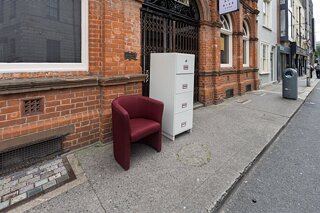
ABANDONED FURNITURE NEAR THE FOUR COURTS
AN EXAMPLE OF BEING REPLACED BY AI [IT WOULD APPEAR THAT THE CHAIR AND CABINET WERE ABANDONED]
TheTakeSeatIncident4July2026
Would You Take This Seat
IS THIS AN EXAMPLE OF BEING REPLACED BY AI [IT WOULD APPEAR THAT THE CHAIR AND CABINET WERE ABANDONED]
Many years ago I had a summer job with a large company and ended up saying, to what I thought was a visitor, "take a seat". Later in the day we discovered that it was missing. The person in question made a living by removing old pallets from outside warehouses and in general no one bothered to prevent him. To be fair office chair was outside the building.
The Narrative: The Curated Eviction
Take a seat, here we are treated to a classic slice of street-level theatre right outside the old Medical Mission building and the All Rise Cafe. The scene captures a profound corporate existential crisis spilled out onto the public pavement: a deep burgundy tub chair paired with a stark, institutional four-drawer filing cabinet.
There is a brilliant, unspoken comedy in the hesitation I observed from passersby. Placed squarely on the concrete, the furniture exists in a liminal zone. It lacks the universal "FREE TO A GOOD HOME" cardboard sign, creating a hilarious psychological barrier for the public. Without that explicit permission, an urban passerby faces a paralysing dilemma: Is this a generous act of neighbourhood recycling, or did an administrative assistant just step inside for a moment, leaving me seconds away from accidentally stealing an active reception desk? The chair looks entirely too comfortable and well-kept to be junk, which ironically makes it suspicious. My old anecdote about someone taking "take a seat" literally is the exact energy this setup radiates—it invites a playful misunderstanding.
The Legalities: "Free to a Good Home" vs. The Law
While the cultural tradition of leaving unwanted but functional items on the pavement is a time-honoured method of urban redistribution, the legal reality in Ireland is much more rigid.
Litter Pollution Act 1997: Under Irish law, placing, leaving, or throwing any material that is unsightly or deleterious on a public place constitutes an offence. Legally, leaving a filing cabinet and an armchair on the footpath is classified as fly-tipping or illegal dumping, regardless of whether the owner intends for them to be rescued and recycled.
Public Safety and Liability: Local authorities (like Dublin City Council) view items left on footpaths as structural hazards. They obstruct pedestrian traffic, present a significant tripping hazard, and block access for individuals with visual impairments or mobility aids. If someone were to trip over that burgundy chair, liability could fall heavily on whoever placed it there.
The Urban Exception: In practice, local enforcement often operates on a ticking clock. If items are left out and vanish within an hour into the back of a passing estate car, the "crime" solves itself before a litter warden can issue a fine. But if it sits long enough to brave a Dublin downpour, it quickly transitions from a tempting freebie to an expensive headache for the council's waste management team.
It seems, in this instance, the chair's mystery was its best protection—until someone finally gathered the courage to take my advice, and the seat itself, literally.
TheTakeSeatIncident4July2026
Would You Take This Seat
IS THIS AN EXAMPLE OF BEING REPLACED BY AI [IT WOULD APPEAR THAT THE CHAIR AND CABINET WERE ABANDONED]
Many years ago I had a summer job with a large company and ended up saying, to what I thought was a visitor, "take a seat". Later in the day we discovered that it was missing. The person in question made a living by removing old pallets from outside warehouses and in general no one bothered to prevent him. To be fair office chair was outside the building.
The Narrative: The Curated Eviction
Take a seat, here we are treated to a classic slice of street-level theatre right outside the old Medical Mission building and the All Rise Cafe. The scene captures a profound corporate existential crisis spilled out onto the public pavement: a deep burgundy tub chair paired with a stark, institutional four-drawer filing cabinet.
There is a brilliant, unspoken comedy in the hesitation I observed from passersby. Placed squarely on the concrete, the furniture exists in a liminal zone. It lacks the universal "FREE TO A GOOD HOME" cardboard sign, creating a hilarious psychological barrier for the public. Without that explicit permission, an urban passerby faces a paralysing dilemma: Is this a generous act of neighbourhood recycling, or did an administrative assistant just step inside for a moment, leaving me seconds away from accidentally stealing an active reception desk? The chair looks entirely too comfortable and well-kept to be junk, which ironically makes it suspicious. My old anecdote about someone taking "take a seat" literally is the exact energy this setup radiates—it invites a playful misunderstanding.
The Legalities: "Free to a Good Home" vs. The Law
While the cultural tradition of leaving unwanted but functional items on the pavement is a time-honoured method of urban redistribution, the legal reality in Ireland is much more rigid.
Litter Pollution Act 1997: Under Irish law, placing, leaving, or throwing any material that is unsightly or deleterious on a public place constitutes an offence. Legally, leaving a filing cabinet and an armchair on the footpath is classified as fly-tipping or illegal dumping, regardless of whether the owner intends for them to be rescued and recycled.
Public Safety and Liability: Local authorities (like Dublin City Council) view items left on footpaths as structural hazards. They obstruct pedestrian traffic, present a significant tripping hazard, and block access for individuals with visual impairments or mobility aids. If someone were to trip over that burgundy chair, liability could fall heavily on whoever placed it there.
The Urban Exception: In practice, local enforcement often operates on a ticking clock. If items are left out and vanish within an hour into the back of a passing estate car, the "crime" solves itself before a litter warden can issue a fine. But if it sits long enough to brave a Dublin downpour, it quickly transitions from a tempting freebie to an expensive headache for the council's waste management team.
It seems, in this instance, the chair's mystery was its best protection—until someone finally gathered the courage to take my advice, and the seat itself, literally.
OFFICE FURNITURE ON THE STREET