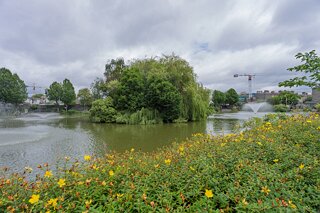
TODAY I USED A VOIGTLANDER 15mm LENS
BLESSINGTON STREET BASIN PUBLIC PARK [THERE IS A PLAQUE INDICATING THAT IRIS MURDOCh WAS BORN HERE]
Tucked away at the end of a residential street in Phibsborough, Dublin 7, lies the Blessington Street Basin (commonly known to Dubliners simply as "the Basin"). Dubbed the city's "secret garden," this walled urban oasis has transitioned from a vital piece of 19th-century industrial infrastructure into one of the capital's most tranquil public parks.
History of the Basin
The Blessington Street Basin was originally constructed by the Dublin Corporation between 1803 and 1810 to serve as a drinking water reservoir for the rapidly expanding Northside of the city.
The Royal Connection: Opened officially as the Royal George Reservoir in honour of King George III, the name was largely ignored by locals who preferred "the Basin".
The Engineering: It holds roughly 15 million litres (4 million gallons) of water. The supply was fed from Lough Owel in County Westmeath via a branch line of the Royal Canal, running through a two-mile pipe into the site.
The Whiskey Era: By the late 1860s, the domestic water needs of the city outgrew the Basin, and the cleaner Vartry Reservoir system in County Wicklow took over. However, the Basin found a second purpose: supplying water exclusively to the iconic Jameson Distillery (Bow Street) and Powers Distillery (John’s Lane) until the mid-1970s.
Current Status
After the distilleries stopped using the water in the 1970s, the site fell into severe neglect and stagnation. However, a massive refurbishment by Dublin City Council in 1993–1994 completely rejuvenated the area.
Today, the Basin is a beautifully preserved, high-walled public park. The deep rectangular reservoir covers about 80% of the site and features a linear series of fountains to oxygenate the water, running alongside an artificial wooded island that serves as a protected sanctuary for wild fowl (including swans, tufted ducks, and mallards). A picturesque 5-metre-wide perimeter pathway, bordered by historic calp limestone walls, mature trees, and a beautifully restored 1811 Tudor-style gate lodge, makes it a popular sanctuary for locals.
The Connection to Iris Murdoch
While exploring the perimeter, you will encounter a commemorative plaque dedicated to one of the 20th century's most brilliant literary and philosophical minds: Dame Iris Murdoch.
Murdoch was born just outside the park gates at 59 Blessington Street on 15 July 1919. Though her family moved to London when she was a baby, she remained fiercely proud of her Irish roots throughout her life, famously noting, "I'm profoundly Irish and I've been conscious of this all my life."
Life and Cultural Importance
Iris Murdoch was a towering figure in post-war British and Irish culture, breaking barriers as both a vanguard academic philosopher and a wildly successful novelist.
The Oxford Quartet: Alongside contemporaries like Elizabeth Anscombe and Philippa Foot, Murdoch belonged to a remarkable wartime cohort of female philosophers at Oxford who challenged the dominant, sterile Western views of human nature, advocating instead for an ethics centred on love, virtue, and looking at reality without the bias of the "fat relentless ego."
Literary Titan: She wrote 26 novels, renowned for their intricate psychological plots, dark humour, and intense moral dilemmas. Her mastery of the form earned her six Booker Prize nominations, winning it in 1978 for The Sea, the Sea.
Her Legacy: Murdoch's later life became a poignant public touchstone for Alzheimer's awareness. Her battle with the disease was chronicled by her husband, John Bayley, in memoirs that were later adapted into the Oscar-winning 2001 biographical film Iris. The plaque near her birthplace honours her enduring intellectual rigour, her contribution to late 20th-century literature, and her philosophical exploration of goodness.
Tucked away at the end of a residential street in Phibsborough, Dublin 7, lies the Blessington Street Basin (commonly known to Dubliners simply as "the Basin"). Dubbed the city's "secret garden," this walled urban oasis has transitioned from a vital piece of 19th-century industrial infrastructure into one of the capital's most tranquil public parks.
History of the Basin
The Blessington Street Basin was originally constructed by the Dublin Corporation between 1803 and 1810 to serve as a drinking water reservoir for the rapidly expanding Northside of the city.
The Royal Connection: Opened officially as the Royal George Reservoir in honour of King George III, the name was largely ignored by locals who preferred "the Basin".
The Engineering: It holds roughly 15 million litres (4 million gallons) of water. The supply was fed from Lough Owel in County Westmeath via a branch line of the Royal Canal, running through a two-mile pipe into the site.
The Whiskey Era: By the late 1860s, the domestic water needs of the city outgrew the Basin, and the cleaner Vartry Reservoir system in County Wicklow took over. However, the Basin found a second purpose: supplying water exclusively to the iconic Jameson Distillery (Bow Street) and Powers Distillery (John’s Lane) until the mid-1970s.
Current Status
After the distilleries stopped using the water in the 1970s, the site fell into severe neglect and stagnation. However, a massive refurbishment by Dublin City Council in 1993–1994 completely rejuvenated the area.
Today, the Basin is a beautifully preserved, high-walled public park. The deep rectangular reservoir covers about 80% of the site and features a linear series of fountains to oxygenate the water, running alongside an artificial wooded island that serves as a protected sanctuary for wild fowl (including swans, tufted ducks, and mallards). A picturesque 5-metre-wide perimeter pathway, bordered by historic calp limestone walls, mature trees, and a beautifully restored 1811 Tudor-style gate lodge, makes it a popular sanctuary for locals.
The Connection to Iris Murdoch
While exploring the perimeter, you will encounter a commemorative plaque dedicated to one of the 20th century's most brilliant literary and philosophical minds: Dame Iris Murdoch.
Murdoch was born just outside the park gates at 59 Blessington Street on 15 July 1919. Though her family moved to London when she was a baby, she remained fiercely proud of her Irish roots throughout her life, famously noting, "I'm profoundly Irish and I've been conscious of this all my life."
Life and Cultural Importance
Iris Murdoch was a towering figure in post-war British and Irish culture, breaking barriers as both a vanguard academic philosopher and a wildly successful novelist.
The Oxford Quartet: Alongside contemporaries like Elizabeth Anscombe and Philippa Foot, Murdoch belonged to a remarkable wartime cohort of female philosophers at Oxford who challenged the dominant, sterile Western views of human nature, advocating instead for an ethics centred on love, virtue, and looking at reality without the bias of the "fat relentless ego."
Literary Titan: She wrote 26 novels, renowned for their intricate psychological plots, dark humour, and intense moral dilemmas. Her mastery of the form earned her six Booker Prize nominations, winning it in 1978 for The Sea, the Sea.
Her Legacy: Murdoch's later life became a poignant public touchstone for Alzheimer's awareness. Her battle with the disease was chronicled by her husband, John Bayley, in memoirs that were later adapted into the Oscar-winning 2001 biographical film Iris. The plaque near her birthplace honours her enduring intellectual rigour, her contribution to late 20th-century literature, and her philosophical exploration of goodness.
BLESSINGTON STREET BASIN