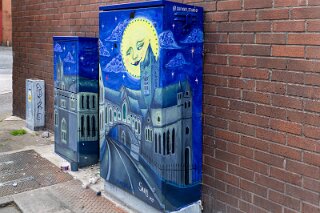
THIS EXAMPLE OF PAINT-A-BOX IS LOCATED NEAR CHRIST CHURCH CATHEDRAL
FULL MOON AT CHRIST CHURCH COOK STREET - WINETAVERN STREET [PAINT-A-BOX STREET ART BY SARA MANEIRO REY]
Moonlight at the Crossroads: Sara Maneiro Rey’s ‘Full Moon’
A new celestial glow has descended upon the historic heart of Dublin 8. Located at the bustling junction where The Liberties meets the medieval city, the artwork ‘Full Moon’ (Ref: 249567) has transformed a standard utility box into a portal of magical realism. Commissioned through the Dublin Canvas "Paint-a-Box" initiative, this piece by Spanish artist and designer Sara Maneiro Rey—known professionally as Sarosky Studio—brings a touch of cosmic wonder to one of the city's most architecturally significant corners.
The Artist: Sara Maneiro Rey
Sara Maneiro Rey is a visionary whose work frequently bridges the gap between graphic design and fine art. Her style is defined by:
Celestial Themes: A fascination with the moon, stars, and the nocturnal sky.
Vibrant Palettes: The use of deep blues and luminous highlights that provide a sharp, modern contrast to Dublin’s traditional grey stone.
Urban Renewal: Her contribution to the Dublin Canvas project serves to humanise functional city infrastructure, inviting passers-by to pause and reflect amidst the urban rush.
A Geographical Curiositiy: The "Split" Street
The location of the artwork at the intersection of Winetavern Street, Cook Street, and St. Michael’s Hill is more than just a busy corner; it is a fascinating "glitch" in Dublin’s street mapping.
If you stand at this junction, you will notice a peculiar complication: the single stretch of road running alongside Christ Church Cathedral effectively has a split personality. On the western side, it is Winetavern Street, while the eastern side (adjacent to the Cathedral and the Synod Hall) is signed as St. Michael’s Hill.
The Historical Seams:
St. Michael’s Hill: Named after the ancient St. Michael’s Church (the tower of which remains as part of Dublinia), this side of the road represents the ecclesiastical and administrative peak of the medieval city.
Winetavern Street: This side marks the start of the steep descent toward the River Liffey. In the 11th century, this was the commercial hub for wine importers and tavern keepers, serving as the "drinking quarter" of Viking and Norman Dublin.
Cook Street: Perpendicular to this line, Cook Street was the domain of the Guild of Cooks. Bakers and cooks were clustered here behind the city walls to contain the ever-present risk of fire from their ovens.
By placing ‘Full Moon’ at this precise intersection, Rey has marked a spot where Dublin’s layers of history overlap. The artwork sits at the threshold where the sacred (St. Michael’s Hill), the commercial (Winetavern Street), and the industrial (Cook Street) all converge under the silent gaze of the moon.
Moonlight at the Crossroads: Sara Maneiro Rey’s ‘Full Moon’
A new celestial glow has descended upon the historic heart of Dublin 8. Located at the bustling junction where The Liberties meets the medieval city, the artwork ‘Full Moon’ (Ref: 249567) has transformed a standard utility box into a portal of magical realism. Commissioned through the Dublin Canvas "Paint-a-Box" initiative, this piece by Spanish artist and designer Sara Maneiro Rey—known professionally as Sarosky Studio—brings a touch of cosmic wonder to one of the city's most architecturally significant corners.
The Artist: Sara Maneiro Rey
Sara Maneiro Rey is a visionary whose work frequently bridges the gap between graphic design and fine art. Her style is defined by:
Celestial Themes: A fascination with the moon, stars, and the nocturnal sky.
Vibrant Palettes: The use of deep blues and luminous highlights that provide a sharp, modern contrast to Dublin’s traditional grey stone.
Urban Renewal: Her contribution to the Dublin Canvas project serves to humanise functional city infrastructure, inviting passers-by to pause and reflect amidst the urban rush.
A Geographical Curiositiy: The "Split" Street
The location of the artwork at the intersection of Winetavern Street, Cook Street, and St. Michael’s Hill is more than just a busy corner; it is a fascinating "glitch" in Dublin’s street mapping.
If you stand at this junction, you will notice a peculiar complication: the single stretch of road running alongside Christ Church Cathedral effectively has a split personality. On the western side, it is Winetavern Street, while the eastern side (adjacent to the Cathedral and the Synod Hall) is signed as St. Michael’s Hill.
The Historical Seams:
St. Michael’s Hill: Named after the ancient St. Michael’s Church (the tower of which remains as part of Dublinia), this side of the road represents the ecclesiastical and administrative peak of the medieval city.
Winetavern Street: This side marks the start of the steep descent toward the River Liffey. In the 11th century, this was the commercial hub for wine importers and tavern keepers, serving as the "drinking quarter" of Viking and Norman Dublin.
Cook Street: Perpendicular to this line, Cook Street was the domain of the Guild of Cooks. Bakers and cooks were clustered here behind the city walls to contain the ever-present risk of fire from their ovens.
By placing ‘Full Moon’ at this precise intersection, Rey has marked a spot where Dublin’s layers of history overlap. The artwork sits at the threshold where the sacred (St. Michael’s Hill), the commercial (Winetavern Street), and the industrial (Cook Street) all converge under the silent gaze of the moon.
THE ART AND THE ARTIST