LOCATED ON UPPER RATHMINES ROAD
THE THOMAS O'LEARY MEMORIAL [UPPER RATHMINES ROAD]
Step onto Upper Rathmines Road, directly opposite Rathmines Close, and you will find a quiet piece of Dublin’s revolutionary history embedded straight into a roadside wall. For eighty-five years, a modest, deeply weathered 1933 stone monument marked the exact spot where a grim chapter of the Irish Civil War concluded.
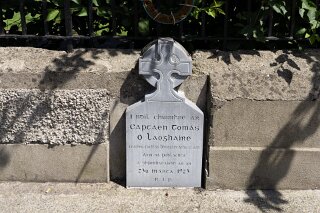
Set into the boundary wall of the former Tranquilla Convent grounds, the original marker had suffered terribly from decades of dampness, overhanging foliage, and roadside pollution, leaving the stone blackened and the delicate inscription nearly illegible. However, on 24 March 2018—the weekend of the 95th anniversary of his death—the original marker was completely replaced with the pristine limestone monument we see today in my set of photographs.
The Tragedy of March 1923
The monument is dedicated to Captain Thomas O’Leary (Tomás Ó Laoghaire), a 22-year-old Dubliner raised in nearby Harold’s Cross. O’Leary was an officer in the 4th Battalion, Dublin Brigade of the anti-Treaty IRA.
By March 1923, the Civil War had entered a bitter, clandestine guerrilla phase. On the night of 23 March, O’Leary was intercepted by Free State forces. His body was later recovered at this exact spot outside the convent gates, bearing twenty-two bullet wounds—a tragic synchronicity with his age. His death belonged to a dark period of summary executions and roadside killings that marked the final, brutal months of the conflict.
The 2018 Restoration: Faithful Preservation
The 2018 replacement is a masterclass in faithful preservation. Looking closely at "Memorial-269630.jpg", the stonemason took immense care to replicate the traditional Gaelic script (Cló Gaelach) of the 1933 original, maintaining the classic overdots (buailte) for aspiration rather than shifting to modern spellings.
The crisp relief of the Celtic cross and the sharp, re-carved text ensure that O’Leary’s name and the actions of 23 March 1923 remain vividly legible to passersby, preserving a profound piece of neighbourhood memory right on the old convent wall.
Dublin history, Irish Civil War, Thomas O'Leary, Upper Rathmines Road, Dublin street photography, anti-Treaty IRA, Cló Gaelach, Dublin monuments, local history, Irish revolutionary period
Step onto Upper Rathmines Road, directly opposite Rathmines Close, and you will find a quiet piece of Dublin’s revolutionary history embedded straight into a roadside wall. For eighty-five years, a modest, deeply weathered 1933 stone monument marked the exact spot where a grim chapter of the Irish Civil War concluded.
Set into the boundary wall of the former Tranquilla Convent grounds, the original marker had suffered terribly from decades of dampness, overhanging foliage, and roadside pollution, leaving the stone blackened and the delicate inscription nearly illegible. However, on 24 March 2018—the weekend of the 95th anniversary of his death—the original marker was completely replaced with the pristine limestone monument we see today in my set of photographs.
The Tragedy of March 1923
The monument is dedicated to Captain Thomas O’Leary (Tomás Ó Laoghaire), a 22-year-old Dubliner raised in nearby Harold’s Cross. O’Leary was an officer in the 4th Battalion, Dublin Brigade of the anti-Treaty IRA.
By March 1923, the Civil War had entered a bitter, clandestine guerrilla phase. On the night of 23 March, O’Leary was intercepted by Free State forces. His body was later recovered at this exact spot outside the convent gates, bearing twenty-two bullet wounds—a tragic synchronicity with his age. His death belonged to a dark period of summary executions and roadside killings that marked the final, brutal months of the conflict.
The 2018 Restoration: Faithful Preservation
The 2018 replacement is a masterclass in faithful preservation. Looking closely at "Memorial-269630.jpg", the stonemason took immense care to replicate the traditional Gaelic script (Cló Gaelach) of the 1933 original, maintaining the classic overdots (buailte) for aspiration rather than shifting to modern spellings.
The crisp relief of the Celtic cross and the sharp, re-carved text ensure that O’Leary’s name and the actions of 23 March 1923 remain vividly legible to passersby, preserving a profound piece of neighbourhood memory right on the old convent wall.
Dublin history, Irish Civil War, Thomas O'Leary, Upper Rathmines Road, Dublin street photography, anti-Treaty IRA, Cló Gaelach, Dublin monuments, local history, Irish revolutionary period

CAPTAIN THOMAS O'LEARY