A QUICK VISIT TO PALMERSTOWN VILLAGE AND MILL LANE
The Leica Q3 Gremlins And A Frustrating Session At Mill Lane
Today, I headed to Mill Lane in Palmerstown, Leica Q3 in hand, seeking to recover from a disappointing session with my Fujifilm GFX100RF twenty four hours earlier. Note - I am trying to decide if I should bring the Fujifilm GFX100RF or the Leica Q3 when I visit Galway next week.
Instead of the smooth, tactile joy Leica usually promises, I was met with a litany of digital protests. It began with the camera refusing to recognise its own battery—the very one it shipped with—as "genuine." After a quick swap, the Q3 took to freezing randomly and declaring my SD card faulty. To top it off, the Leica FOTOS app staged a silent protest, refusing to sync GPS data. I abandoned the session, only to discover later that, miraculously, most images had been geotagged anyway.
A Hidden Gem: The Mill Lane Green Space
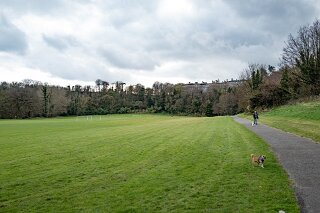
Nestled in the valley of the River Liffey, the parkland at Mill Lane is one of Palmerstown’s most serene escapes. While many know it for its proximity to the historic Waterstown Park, the specific area occupied by the local football pitch offers a unique blend of community spirit and rugged natural beauty.
The History of the Space
The history of this land is deeply tied to the industrial heritage of the Liffey. Mill Lane, as the name suggests, was once a bustling artery for the mills that powered the local economy in the 18th and 19th centuries. The green space we see today sits on what was once the periphery of these industrial works, eventually transitioning from utilitarian land to a vital recreational hub for Palmerstown residents.
Why It’s Worth the Visit
The Atmosphere: There is a wonderful contrast between the neatly maintained football pitch and the wilder, riverside trails that branch off from it.
The Light: For those (unlike me) whose cameras are behaving, the way the low sun filters through the trees lining the Liffey creates a spectacular bokeh effect.
The Solitude: Even during a busy match day, the surrounding trails offer a sense of isolation that feels miles away from the Dublin suburbs.
Precision or Performance? The Leica Q3 Geotagging Dilemma
The promise of the Leica Q3 was simple: world-class optics paired with modern, seamless connectivity. However, a recent outing to the historic green spaces of Mill Lane in Palmerstown revealed that "seamless" is perhaps the last word applicable to the current state of the Q3’s geotagging system.
While Firmware 4.0.0 was touted as a major leap forward—unifying the UI with the SL3 and improving autofocus—it has introduced a "ghost in the machine" regarding location data. For photographers requiring pinpoint accuracy, the current behaviour is more than a minor bug; it is a significant reliability issue.
The Invisible Buffer: Why Playback Lies
The most disconcerting aspect of the new firmware is the delay in metadata injection. During a session at the Mill Lane football pitch, photographs were taken and immediately reviewed on the playback screen, yet no GPS information was visible. On almost any other system, this would be a clear signal to stop and troubleshoot the connection.
However, it appears the Q3 is now caching GPS data in a temporary buffer. The coordinates are not written to the file header until a later stage—often during a background "cleanup" cycle or when the camera is powered down. While this keeps the camera "snappy" and ready for the next shot, it robs the photographer of real-time confirmation. One is essentially shooting blind, hoping the handshake between the iPhone and the camera remains steady.
The Accuracy Compromise
This buffering method raises a critical question: How accurate is the data? If the camera is not polling the iPhone for a fresh coordinate at the exact millisecond the shutter fires, it may be "batch-tagging" images with the last known successful location. Moving 100 yards down the Liffey between shots could result in metadata that is fundamentally incorrect. For those documenting specific heritage sites or nature trails, a "close enough" coordinate from several minutes prior is simply not sufficient.
Community Feedback and Known Bugs
The Leica community has been vocal about the quirks of version 4.0.0. Alongside the geotagging lag, frequent reports include:
The "Non-Genuine" Battery Bug: An overly sensitive check that flags official Leica BP-SCL6 batteries as third-party.
SD Card Freezing: Random "faulty card" errors that often require a hard power cycle.
The FOTOS Handshake: A requirement to "forget and re-pair" the Bluetooth connection entirely after the update to ensure any communication at all.
Today, I headed to Mill Lane in Palmerstown, Leica Q3 in hand, seeking to recover from a disappointing session with my Fujifilm GFX100RF twenty four hours earlier. Note - I am trying to decide if I should bring the Fujifilm GFX100RF or the Leica Q3 when I visit Galway next week.
Instead of the smooth, tactile joy Leica usually promises, I was met with a litany of digital protests. It began with the camera refusing to recognise its own battery—the very one it shipped with—as "genuine." After a quick swap, the Q3 took to freezing randomly and declaring my SD card faulty. To top it off, the Leica FOTOS app staged a silent protest, refusing to sync GPS data. I abandoned the session, only to discover later that, miraculously, most images had been geotagged anyway.
A Hidden Gem: The Mill Lane Green Space
Nestled in the valley of the River Liffey, the parkland at Mill Lane is one of Palmerstown’s most serene escapes. While many know it for its proximity to the historic Waterstown Park, the specific area occupied by the local football pitch offers a unique blend of community spirit and rugged natural beauty.
The History of the Space
The history of this land is deeply tied to the industrial heritage of the Liffey. Mill Lane, as the name suggests, was once a bustling artery for the mills that powered the local economy in the 18th and 19th centuries. The green space we see today sits on what was once the periphery of these industrial works, eventually transitioning from utilitarian land to a vital recreational hub for Palmerstown residents.
Why It’s Worth the Visit
The Atmosphere: There is a wonderful contrast between the neatly maintained football pitch and the wilder, riverside trails that branch off from it.
The Light: For those (unlike me) whose cameras are behaving, the way the low sun filters through the trees lining the Liffey creates a spectacular bokeh effect.
The Solitude: Even during a busy match day, the surrounding trails offer a sense of isolation that feels miles away from the Dublin suburbs.
Precision or Performance? The Leica Q3 Geotagging Dilemma
The promise of the Leica Q3 was simple: world-class optics paired with modern, seamless connectivity. However, a recent outing to the historic green spaces of Mill Lane in Palmerstown revealed that "seamless" is perhaps the last word applicable to the current state of the Q3’s geotagging system.
While Firmware 4.0.0 was touted as a major leap forward—unifying the UI with the SL3 and improving autofocus—it has introduced a "ghost in the machine" regarding location data. For photographers requiring pinpoint accuracy, the current behaviour is more than a minor bug; it is a significant reliability issue.
The Invisible Buffer: Why Playback Lies
The most disconcerting aspect of the new firmware is the delay in metadata injection. During a session at the Mill Lane football pitch, photographs were taken and immediately reviewed on the playback screen, yet no GPS information was visible. On almost any other system, this would be a clear signal to stop and troubleshoot the connection.
However, it appears the Q3 is now caching GPS data in a temporary buffer. The coordinates are not written to the file header until a later stage—often during a background "cleanup" cycle or when the camera is powered down. While this keeps the camera "snappy" and ready for the next shot, it robs the photographer of real-time confirmation. One is essentially shooting blind, hoping the handshake between the iPhone and the camera remains steady.
The Accuracy Compromise
This buffering method raises a critical question: How accurate is the data? If the camera is not polling the iPhone for a fresh coordinate at the exact millisecond the shutter fires, it may be "batch-tagging" images with the last known successful location. Moving 100 yards down the Liffey between shots could result in metadata that is fundamentally incorrect. For those documenting specific heritage sites or nature trails, a "close enough" coordinate from several minutes prior is simply not sufficient.
Community Feedback and Known Bugs
The Leica community has been vocal about the quirks of version 4.0.0. Alongside the geotagging lag, frequent reports include:
The "Non-Genuine" Battery Bug: An overly sensitive check that flags official Leica BP-SCL6 batteries as third-party.
SD Card Freezing: Random "faulty card" errors that often require a hard power cycle.
The FOTOS Handshake: A requirement to "forget and re-pair" the Bluetooth connection entirely after the update to ensure any communication at all.


MILL LANE