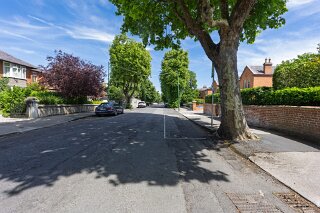
I USED A SONY A7RVI WITH A 16-35MM LENS
The Origin and History of Cowper Road
To understand Cowper Road, one must look at the names stamped across the local geography: Palmerston, Temple, and Cowper.
In the 18th and 19th centuries, much of the land in this part of Rathmines belonged to the Temple family. Henry John Temple, better known as the British Prime Minister Lord Palmerston, owned vast estates here. When his stepson, William Cowper (a prominent British Liberal politician), inherited the properties in 1869, he amended his surname to William Cowper-Temple (later 1st Baron Mount Temple). It is from him that Cowper Road takes its name.
The road was developed during the late-Victorian boom of the Rathmines Township (an independent local government district from 1847 to 1930). Wealthy Dublin merchants, professionals, and high-ranking civil servants fled the decaying inner city to build substantial, redbrick semi-detached and detached homes here.
Notable Highlights and Items of Interest
1. The Cowper Tram Stop / Luas Station
The walk begins at a site deeply rooted in Dublin's transport history. Long before the modern Luas tram system opened in 2004, this exact line was the Harcourt Street Railway Line, opened by the Dublin, Wicklow and Wexford Railway in 1854. Cowper station itself was added later, in 1897, specifically to serve the rapidly expanding, affluent Victorian suburb.
2. "The Bloody Fields" and the Battle of Rathmines
The peaceful, affluent lawns of Cowper Road mask a violent past. The entire area surrounding Cowper Road, Palmerston Park, and south toward the River Dodder was historically known as The Bloody Fields.
On 2 August 1649, during the English Civil War, the Battle of Rathmines raged across these lands. The Parliamentarian forces (Roundheads), led by Colonel Michael Jones, launched a surprise attack on the Royalist and Irish Confederate encampments led by the Duke of Ormonde. It resulted in a slaughter, with an estimated 2,000 to 5,000 men killed. Many of the dead are believed to be buried in mass graves directly beneath the foundations of the houses and roads in the area.
3. The Mageough Home (37–39 Cowper Road)
Perhaps the most striking architectural landmark on the road is the Mageough Home. Built in 1878, this beautiful redbrick complex features 39 Gothic Revival cottages, an infirmary, and its own central Church of Ireland chapel surrounding a manicured green.
The complex was funded by a massive bequest from Miss Elizabeth Mageough, who died in 1869. She left the modern equivalent of millions of euros to create a protected sanctuary for "aged females professing the Protestant faith." The land was purchased directly from William Cowper-Temple, and the complex remains an active, charming residential community today.
4. Famous Residents
The grand houses of Cowper Road have hosted many prominent figures over the decades, including leading academics from Trinity College Dublin, legal minds, and prominent diplomats. Notably, Elizabeth Mageough herself lived at Richview House (1 Cowper Road) prior to her death.
Detailing the Roads Off Cowper Road
Moving westward toward Upper Rathmines Road, several distinct side streets branch off Cowper Road, each with its own character:
Cowper Downs: A much more modern, quiet residential cul-de-sac winding away from the main thoroughfare. It features mid-to-late 20th-century developments that contrast with the Victorian redbricks, yet seamlessly blend into the mature greenery of the area.
Mageough Chapel Approach / Central Green: While not a public through-road, the internal avenues of the Mageough Home create a distinct, peaceful branch off the northern side of Cowper Road.
Palmerston Road: Intersecting near the western end, this is one of Dublin’s grandest Victorian avenues. The junction offers views of sweeping, highly decorated redbrick properties featuring distinct iron railings and immaculate granite steps.
Current Status
Today, Cowper Road is one of the most exclusive and expensive residential addresses in Dublin. Individual Victorian homes along the road routinely command prices between €1.5 million and upwards of €5 million.
The road has successfully maintained its architectural integrity, with the vast majority of its original Victorian facades, decorative brickwork, timber sash windows, and granite boundary walls strictly protected under Dublin City Council's Protected Structures legislation. It remains a tranquil, leafy canopy that bridges the quietude of high-end suburbia with the urban energy of Upper Rathmines Road.
To understand Cowper Road, one must look at the names stamped across the local geography: Palmerston, Temple, and Cowper.
In the 18th and 19th centuries, much of the land in this part of Rathmines belonged to the Temple family. Henry John Temple, better known as the British Prime Minister Lord Palmerston, owned vast estates here. When his stepson, William Cowper (a prominent British Liberal politician), inherited the properties in 1869, he amended his surname to William Cowper-Temple (later 1st Baron Mount Temple). It is from him that Cowper Road takes its name.
The road was developed during the late-Victorian boom of the Rathmines Township (an independent local government district from 1847 to 1930). Wealthy Dublin merchants, professionals, and high-ranking civil servants fled the decaying inner city to build substantial, redbrick semi-detached and detached homes here.
Notable Highlights and Items of Interest
1. The Cowper Tram Stop / Luas Station
The walk begins at a site deeply rooted in Dublin's transport history. Long before the modern Luas tram system opened in 2004, this exact line was the Harcourt Street Railway Line, opened by the Dublin, Wicklow and Wexford Railway in 1854. Cowper station itself was added later, in 1897, specifically to serve the rapidly expanding, affluent Victorian suburb.
2. "The Bloody Fields" and the Battle of Rathmines
The peaceful, affluent lawns of Cowper Road mask a violent past. The entire area surrounding Cowper Road, Palmerston Park, and south toward the River Dodder was historically known as The Bloody Fields.
On 2 August 1649, during the English Civil War, the Battle of Rathmines raged across these lands. The Parliamentarian forces (Roundheads), led by Colonel Michael Jones, launched a surprise attack on the Royalist and Irish Confederate encampments led by the Duke of Ormonde. It resulted in a slaughter, with an estimated 2,000 to 5,000 men killed. Many of the dead are believed to be buried in mass graves directly beneath the foundations of the houses and roads in the area.
3. The Mageough Home (37–39 Cowper Road)
Perhaps the most striking architectural landmark on the road is the Mageough Home. Built in 1878, this beautiful redbrick complex features 39 Gothic Revival cottages, an infirmary, and its own central Church of Ireland chapel surrounding a manicured green.
The complex was funded by a massive bequest from Miss Elizabeth Mageough, who died in 1869. She left the modern equivalent of millions of euros to create a protected sanctuary for "aged females professing the Protestant faith." The land was purchased directly from William Cowper-Temple, and the complex remains an active, charming residential community today.
4. Famous Residents
The grand houses of Cowper Road have hosted many prominent figures over the decades, including leading academics from Trinity College Dublin, legal minds, and prominent diplomats. Notably, Elizabeth Mageough herself lived at Richview House (1 Cowper Road) prior to her death.
Detailing the Roads Off Cowper Road
Moving westward toward Upper Rathmines Road, several distinct side streets branch off Cowper Road, each with its own character:
Cowper Downs: A much more modern, quiet residential cul-de-sac winding away from the main thoroughfare. It features mid-to-late 20th-century developments that contrast with the Victorian redbricks, yet seamlessly blend into the mature greenery of the area.
Mageough Chapel Approach / Central Green: While not a public through-road, the internal avenues of the Mageough Home create a distinct, peaceful branch off the northern side of Cowper Road.
Palmerston Road: Intersecting near the western end, this is one of Dublin’s grandest Victorian avenues. The junction offers views of sweeping, highly decorated redbrick properties featuring distinct iron railings and immaculate granite steps.
Current Status
Today, Cowper Road is one of the most exclusive and expensive residential addresses in Dublin. Individual Victorian homes along the road routinely command prices between €1.5 million and upwards of €5 million.
The road has successfully maintained its architectural integrity, with the vast majority of its original Victorian facades, decorative brickwork, timber sash windows, and granite boundary walls strictly protected under Dublin City Council's Protected Structures legislation. It remains a tranquil, leafy canopy that bridges the quietude of high-end suburbia with the urban energy of Upper Rathmines Road.


COWPER ROAD 21 JUNE 2026