ON THE WAY TO BECOMING A PUBLIC PARK
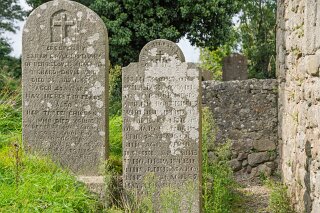
TULLY CHURCHYARD ON LEHAUNSTOWN LANE FROM RUIN TO PUBLIC PARK [PHOTOGRAPHED 25 SEPTEMBER 2023]
My first time to explore the area surrounding the old Tully Church and Graveyard was in 2011 not long after the tram service became operational nothing really changed and then in 2020 I began to notice some minor signs of anti-social activity and began to be concerned about the long term future of the site and the two associated historic high crosses. In 2023 I did not notice anything to be concerned about but I now visit every three or four months to check .
A Changing Landscape: The Future of Tully Church & Graveyard
For anyone who has photographed the quiet, overgrown beauty of Tully Church and its graveyard over the years, the recent changes are impossible to miss. What was once a hidden spot, a secluded piece of history protected by its own remoteness, has been transformed.
Observations of "wear-and-tear" since 2023 are accurate. This is the story of that transformation—a deliberate, planned shift from a passively protected ruin to the actively managed centrepiece of a major new public park.
The 'Before': An Era of Passive Protection
Until recently, Tully Church was a "hidden spot" in the truest sense. Descriptions from as recently as 2011 note the site was located "down a narrow lane" and was "quite overgrown." Visitors were advised to "step carefully" due to "loose rocks lurking in the undergrowth," and access itself required climbing over a "solidly built stone stile in the wall."
This inaccessibility, while perhaps frustrating for heritage enthusiasts, acted as a de facto conservation strategy. The site was protected from high-volume footfall and incidental damage precisely because it was unknown to most and difficult to access.
The 'After': A New Era of Active Management
The "massive redevelopment" that has reshaped the area is the Cherrywood Strategic Development Zone (SDZ), one of the largest urban developments in the state, which will eventually house over 26,000 people.
The influx of visitors seen since 2023 is the direct and intended consequence of the official opening of three new flagship parks—Tully, Beckett, and Ticknick—on May 31, 2023.
Tully Church is no longer a secluded ruin. It has been intentionally repurposed as the central feature and primary historical asset of Tully Park, a 9-hectare "flagship Class 1 Park." The park's entire design is "centred on the national monument of Tully Church and Graveyard." The former "builder's access" is now a permanent network of pedestrian walkways and cycleways designed to connect the new communities directly to the churchyard.
The observed damage is, therefore, the predictable result of a policy decision to transform the site into a highly accessible public amenity. But was this done without care? The records show the opposite.
🧐 Who is Responsible? The 'Triple-Lock' Protecting Tully Church
Far from being overlooked, the Tully Church complex is one of the most highly protected heritage sites in Dún Laoghaire-Rathdown. Its protection is governed by a clear, three-part hierarchy of responsibility.
1. National Monument in State Care (No. 225)
Legal Basis: National Monuments Acts 1930-2014.
What it means: This is the highest level of protection.
Responsible Agencies:
The National Monuments Service (NMS): The ultimate regulator that must approve any and all works.
The Office of Public Works (OPW): The state agency with direct, long-term responsibility for the physical preservation and maintenance of the ruins.
2. Record of Protected Structures (RPS)
Legal Basis: Planning & Development Act 2000.
What it means: This legally protects the structure, its interior, the graveyard (its "curtilage"), and all boundary walls from inappropriate development.
Responsible Agency: Dún Laoghaire-Rathdown County Council (DLRCoCo).
3. Record of Monuments and Places (RMP)
Legal Basis: National Monuments (Amendment) Act 1994.
What it means: This designation legally establishes a "Zone of Archaeological Potential" around the monument. It was this status that legally triggered mandatory archaeological assessments before any development could begin.
Responsible Agencies: NMS and DLRCoCo.
📜 Was This Always the Plan? Heritage in the Masterplan
The perception that heritage was secondary to construction is contradicted by the foundational planning documents. The area's rich archaeology was identified from the outset as a core asset that shaped the masterplan.
The Cherrywood Planning Scheme (2014) contained legally binding heritage objectives that all developers had to follow. This forced them to centre the park's design around the monuments rather than walling them off.
This triggered extensive archaeological investigation before the park was designed. This work included:
Geophysical surveys, which identified the subsurface remains of the early medieval monastic enclosure surrounding the church (invisible on the surface).
Archaeological test trenching and monitoring.
Excavation of other nearby sites, including prehistoric features and remnants of the 18th-century Laughanstown military camp.
This body of work allowed the park to be designed around sensitive archaeology. In essence, the development didn't ignore the heritage; it funded its investigation and, in doing so, created a public management framework for it.
The specific plan for the park (Planning Ref: DZ15A/0813) detailed a core objective: "To create a heritage zone, a biodiversity zone, a play zone and a passive zone."
Crucially, the planning permission contains legally binding conditions, including:
"The development of Tully Park shall be appropriate to the tranquil character and setting of the cluster of national monuments at its centre."
"The mature trees in the vicinity of the Tully Church complex shall be retained in so far as possible."
The plan also included provisions for public lighting and CCTV as an active mitigation against anti-social behaviour.
🗓️ Key Moments: A Timeline of Change
1989: The OPW removes three vulnerable Rathdown-type grave-slabs from the church for their protection, setting a precedent for active conservation.
2014: The Cherrywood SDZ Planning Scheme is adopted, legally mandating that heritage objectives must be met.
2015-2016: The planning application (DZ15A/0813) for Tully Park is submitted, supported by detailed archaeological assessments.
July 2020: Prompted by local concerns over the impending development, TD Cormac Devlin raises parliamentary questions about who is responsible for the church's upkeep.
July 2020: In response, the OPW formally confirms that the site "is included as part of the regular maintenance program," closing a dangerous gap in responsibility.
Oct 2021: An Taisce (The National Trust for Ireland) issues a public statement warning that the site's "historic relationship" with the wider landscape must be respected by developers.
2021-2022: As part of the park's construction, conservation services are engaged to "stabilise" parts of the church's structure.
May 31, 2023: Tully Park officially opens to the public. The era of "passive protection" ends, and the era of "active management" begins.
🙋♀️ Have Concerns Been Raised Before? Yes.
The concerns many of us feel are not new. They have been shared at the highest levels by Ireland's national heritage body and by elected representatives in the Dáil.
In 2021, Dr. Mark Clinton of An Taisce issued a formal statement warning that the historic link between Tully Church and nearby Lehaunstown Castle "should be fully respected in the projected ongoing development." This placed direct, public pressure on the developers.
Even more critically, in July 2020, local TD Cormac Devlin raised the issue in parliament. His questions were prompted by a terrifying discovery: the Minister for the OPW had initially stated the OPW had no records for Tully Church.
Deputy Devlin's intervention forced a re-examination. The OPW subsequently issued a formal correction, stating the site "was excluded in error" from its lists and confirming unequivocally that its "regular maintenance program" was in place. This intervention was instrumental in securing the site's future before the park gates opened.
📸 Our Role Now: From Passive Observers to Active Monitors
Extensive consideration has been given to Tully Church's protection. The site has moved from a model of benign neglect to one of active public management.
This new model requires data and monitoring to be effective. For photographers and local observers, our role is now more critical than ever. Your photographic documentation of "wear-and-tear" is a valuable data set for the site's managing authorities.
If you see something, here is how you can formally channel your observations to the correct authorities.
What You Can Do
1. For Immediate, Non-Structural Issues (e.g., litter, graffiti, anti-social behaviour)
Who: Dún Laoghaire-Rathdown County Council, Parks Department.
Why: They are the "front-line" operator of Tully Park, responsible for daily maintenance, security, and the operation of the CCTV.
How: Contact [email protected] or use the Council's "Report a Problem" online portal.
2. For Structural "Wear-and-Tear" or Damage to Monuments (e.g., stone erosion, damage to church walls, dislodged stones, damage to grave slabs)
Who: DLRCoCo Heritage Officer (Deirdre Black) AND the Office of Public Works (OPW), National Monuments Division.
Why: This dual approach is essential. The Heritage Officer is responsible for the County Heritage Plan, while the OPW runs the "regular maintenance program" for the monument itself.
How: Send dated photographic evidence to both agencies to ensure the local operator and the state guardian are informed.
3. For Persistent Anti-Social Activity or Breaches of the Park's Character
Who: DLRCoCo, Planning Enforcement Department.
Why: If the site's "tranquil character and setting" is being persistently violated, this may be a breach of the legally binding conditions of Planning Reference DZ15A/0813.
How: A formal complaint citing this specific planning reference provides a legal basis for the Council to review its management and security for the park.
My first time to explore the area surrounding the old Tully Church and Graveyard was in 2011 not long after the tram service became operational nothing really changed and then in 2020 I began to notice some minor signs of anti-social activity and began to be concerned about the long term future of the site and the two associated historic high crosses. In 2023 I did not notice anything to be concerned about but I now visit every three or four months to check .
A Changing Landscape: The Future of Tully Church & Graveyard
For anyone who has photographed the quiet, overgrown beauty of Tully Church and its graveyard over the years, the recent changes are impossible to miss. What was once a hidden spot, a secluded piece of history protected by its own remoteness, has been transformed.
Observations of "wear-and-tear" since 2023 are accurate. This is the story of that transformation—a deliberate, planned shift from a passively protected ruin to the actively managed centrepiece of a major new public park.
The 'Before': An Era of Passive Protection
Until recently, Tully Church was a "hidden spot" in the truest sense. Descriptions from as recently as 2011 note the site was located "down a narrow lane" and was "quite overgrown." Visitors were advised to "step carefully" due to "loose rocks lurking in the undergrowth," and access itself required climbing over a "solidly built stone stile in the wall."
This inaccessibility, while perhaps frustrating for heritage enthusiasts, acted as a de facto conservation strategy. The site was protected from high-volume footfall and incidental damage precisely because it was unknown to most and difficult to access.
The 'After': A New Era of Active Management
The "massive redevelopment" that has reshaped the area is the Cherrywood Strategic Development Zone (SDZ), one of the largest urban developments in the state, which will eventually house over 26,000 people.
The influx of visitors seen since 2023 is the direct and intended consequence of the official opening of three new flagship parks—Tully, Beckett, and Ticknick—on May 31, 2023.
Tully Church is no longer a secluded ruin. It has been intentionally repurposed as the central feature and primary historical asset of Tully Park, a 9-hectare "flagship Class 1 Park." The park's entire design is "centred on the national monument of Tully Church and Graveyard." The former "builder's access" is now a permanent network of pedestrian walkways and cycleways designed to connect the new communities directly to the churchyard.
The observed damage is, therefore, the predictable result of a policy decision to transform the site into a highly accessible public amenity. But was this done without care? The records show the opposite.
🧐 Who is Responsible? The 'Triple-Lock' Protecting Tully Church
Far from being overlooked, the Tully Church complex is one of the most highly protected heritage sites in Dún Laoghaire-Rathdown. Its protection is governed by a clear, three-part hierarchy of responsibility.
1. National Monument in State Care (No. 225)
Legal Basis: National Monuments Acts 1930-2014.
What it means: This is the highest level of protection.
Responsible Agencies:
The National Monuments Service (NMS): The ultimate regulator that must approve any and all works.
The Office of Public Works (OPW): The state agency with direct, long-term responsibility for the physical preservation and maintenance of the ruins.
2. Record of Protected Structures (RPS)
Legal Basis: Planning & Development Act 2000.
What it means: This legally protects the structure, its interior, the graveyard (its "curtilage"), and all boundary walls from inappropriate development.
Responsible Agency: Dún Laoghaire-Rathdown County Council (DLRCoCo).
3. Record of Monuments and Places (RMP)
Legal Basis: National Monuments (Amendment) Act 1994.
What it means: This designation legally establishes a "Zone of Archaeological Potential" around the monument. It was this status that legally triggered mandatory archaeological assessments before any development could begin.
Responsible Agencies: NMS and DLRCoCo.
📜 Was This Always the Plan? Heritage in the Masterplan
The perception that heritage was secondary to construction is contradicted by the foundational planning documents. The area's rich archaeology was identified from the outset as a core asset that shaped the masterplan.
The Cherrywood Planning Scheme (2014) contained legally binding heritage objectives that all developers had to follow. This forced them to centre the park's design around the monuments rather than walling them off.
This triggered extensive archaeological investigation before the park was designed. This work included:
Geophysical surveys, which identified the subsurface remains of the early medieval monastic enclosure surrounding the church (invisible on the surface).
Archaeological test trenching and monitoring.
Excavation of other nearby sites, including prehistoric features and remnants of the 18th-century Laughanstown military camp.
This body of work allowed the park to be designed around sensitive archaeology. In essence, the development didn't ignore the heritage; it funded its investigation and, in doing so, created a public management framework for it.
The specific plan for the park (Planning Ref: DZ15A/0813) detailed a core objective: "To create a heritage zone, a biodiversity zone, a play zone and a passive zone."
Crucially, the planning permission contains legally binding conditions, including:
"The development of Tully Park shall be appropriate to the tranquil character and setting of the cluster of national monuments at its centre."
"The mature trees in the vicinity of the Tully Church complex shall be retained in so far as possible."
The plan also included provisions for public lighting and CCTV as an active mitigation against anti-social behaviour.
🗓️ Key Moments: A Timeline of Change
1989: The OPW removes three vulnerable Rathdown-type grave-slabs from the church for their protection, setting a precedent for active conservation.
2014: The Cherrywood SDZ Planning Scheme is adopted, legally mandating that heritage objectives must be met.
2015-2016: The planning application (DZ15A/0813) for Tully Park is submitted, supported by detailed archaeological assessments.
July 2020: Prompted by local concerns over the impending development, TD Cormac Devlin raises parliamentary questions about who is responsible for the church's upkeep.
July 2020: In response, the OPW formally confirms that the site "is included as part of the regular maintenance program," closing a dangerous gap in responsibility.
Oct 2021: An Taisce (The National Trust for Ireland) issues a public statement warning that the site's "historic relationship" with the wider landscape must be respected by developers.
2021-2022: As part of the park's construction, conservation services are engaged to "stabilise" parts of the church's structure.
May 31, 2023: Tully Park officially opens to the public. The era of "passive protection" ends, and the era of "active management" begins.
🙋♀️ Have Concerns Been Raised Before? Yes.
The concerns many of us feel are not new. They have been shared at the highest levels by Ireland's national heritage body and by elected representatives in the Dáil.
In 2021, Dr. Mark Clinton of An Taisce issued a formal statement warning that the historic link between Tully Church and nearby Lehaunstown Castle "should be fully respected in the projected ongoing development." This placed direct, public pressure on the developers.
Even more critically, in July 2020, local TD Cormac Devlin raised the issue in parliament. His questions were prompted by a terrifying discovery: the Minister for the OPW had initially stated the OPW had no records for Tully Church.
Deputy Devlin's intervention forced a re-examination. The OPW subsequently issued a formal correction, stating the site "was excluded in error" from its lists and confirming unequivocally that its "regular maintenance program" was in place. This intervention was instrumental in securing the site's future before the park gates opened.
📸 Our Role Now: From Passive Observers to Active Monitors
Extensive consideration has been given to Tully Church's protection. The site has moved from a model of benign neglect to one of active public management.
This new model requires data and monitoring to be effective. For photographers and local observers, our role is now more critical than ever. Your photographic documentation of "wear-and-tear" is a valuable data set for the site's managing authorities.
If you see something, here is how you can formally channel your observations to the correct authorities.
What You Can Do
1. For Immediate, Non-Structural Issues (e.g., litter, graffiti, anti-social behaviour)
Who: Dún Laoghaire-Rathdown County Council, Parks Department.
Why: They are the "front-line" operator of Tully Park, responsible for daily maintenance, security, and the operation of the CCTV.
How: Contact [email protected] or use the Council's "Report a Problem" online portal.
2. For Structural "Wear-and-Tear" or Damage to Monuments (e.g., stone erosion, damage to church walls, dislodged stones, damage to grave slabs)
Who: DLRCoCo Heritage Officer (Deirdre Black) AND the Office of Public Works (OPW), National Monuments Division.
Why: This dual approach is essential. The Heritage Officer is responsible for the County Heritage Plan, while the OPW runs the "regular maintenance program" for the monument itself.
How: Send dated photographic evidence to both agencies to ensure the local operator and the state guardian are informed.
3. For Persistent Anti-Social Activity or Breaches of the Park's Character
Who: DLRCoCo, Planning Enforcement Department.
Why: If the site's "tranquil character and setting" is being persistently violated, this may be a breach of the legally binding conditions of Planning Reference DZ15A/0813.
How: A formal complaint citing this specific planning reference provides a legal basis for the Council to review its management and security for the park.


ONGOING CHANGES