TULLY CHURCH AND THE TWO HIGH CROSSES
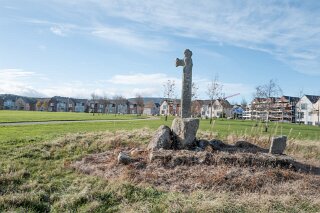
THE LAUGHANSTOWN CROSSES NEAR TULLY CHURCH [PHOTOGRAPHED USING A LEICA Q3 - 2 NOVEMBER 2025]
⛪ Tully Church and High Crosses, Laughanstown
Located in Laughanstown, near Cabinteely, County Dublin, this important historical site contains the ruins of the medieval Tully Church, an ancient graveyard, and two significant granite high crosses.
History and Architecture
The site's ecclesiastical importance dates back to the 1st Millennium AD, as recorded in early literature by its Irish name, Tulach na nEpscop, which translates to 'the Hill of the Bishops'. This name strongly suggests it was a major diocesan or monastic centre, possibly a place for synods. The church is reputedly dedicated to St. Bridget.
Following the Anglo-Norman invasion, the lands were granted to Christ Church Cathedral in Dublin around 1180 by Sitric Mac Torcaill, a local Hiberno-Norse chieftain. The church remained an active place of worship until the early 17th century, likely falling into disuse during the turmoil of the Reformation.
The remaining ruins consist of a nave and chancel. The nave belongs to an earlier structure, possibly dating to the 9th century. A chancel was added in the late 12th or early 13th century, featuring two notable elements:
A fine, well-preserved Romanesque chancel arch separates it from the nave.
The chancel itself is unusually wider than the nave, a rare architectural feature.
The High Crosses
Two distinct high crosses are found at the site, representing different periods of craftsmanship.
The Roadside Cross
Standing along the laneway just northwest of the church, this is a 10th-century granite ringed cross. It is set upon a tall, massive stone plinth, which is its most memorable feature.
Local history records that this cross was rescued in the late 19th century (c. 1897) by a local farmer, James Crehan (or Grehan). During a project to lower the level of the road, Crehan built the plinth to ensure the cross remained at its original height, saving it from being discarded. Its most distinctive features are its plain, uncarved ring and the unusual gabled capstone, which resembles a small roof.
The 'Bishop's' Field Cross
The second, larger cross stands in a field to the northwest of the church ruins, which is now part of the public Tully Park.
This is a 12th-century granite high cross, measuring approximately 2.2 metres in height. It is in a heavily weathered and damaged condition, and is notably incomplete, with one of its arms missing.
The east face bears the faint, badly-worn carving of an ecclesiastical figure in a full-length garment, holding what appears to be a crozier. Due to the severe weathering, the figure's identity is a subject of debate: while some interpret it as a bishop (aligning with the 'Hill of the Bishops' name), others suggest the slender figure may be female, possibly representing St. Bridget. The cross is outlined by strong, raised mouldings, and the west face features a very worn carving of a face or mask at the intersection of the arms.
The Site Today
The graveyard surrounding the ruins is itself historic, containing headstones dating up to the late 19th century. From its elevated position, the site offers visitors wonderful views of the surrounding area, including Killiney Hill, the Irish Sea, and the Dublin Mountains.
⛪ Tully Church and High Crosses, Laughanstown
Located in Laughanstown, near Cabinteely, County Dublin, this important historical site contains the ruins of the medieval Tully Church, an ancient graveyard, and two significant granite high crosses.
History and Architecture
The site's ecclesiastical importance dates back to the 1st Millennium AD, as recorded in early literature by its Irish name, Tulach na nEpscop, which translates to 'the Hill of the Bishops'. This name strongly suggests it was a major diocesan or monastic centre, possibly a place for synods. The church is reputedly dedicated to St. Bridget.
Following the Anglo-Norman invasion, the lands were granted to Christ Church Cathedral in Dublin around 1180 by Sitric Mac Torcaill, a local Hiberno-Norse chieftain. The church remained an active place of worship until the early 17th century, likely falling into disuse during the turmoil of the Reformation.
The remaining ruins consist of a nave and chancel. The nave belongs to an earlier structure, possibly dating to the 9th century. A chancel was added in the late 12th or early 13th century, featuring two notable elements:
A fine, well-preserved Romanesque chancel arch separates it from the nave.
The chancel itself is unusually wider than the nave, a rare architectural feature.
The High Crosses
Two distinct high crosses are found at the site, representing different periods of craftsmanship.
The Roadside Cross
Standing along the laneway just northwest of the church, this is a 10th-century granite ringed cross. It is set upon a tall, massive stone plinth, which is its most memorable feature.
Local history records that this cross was rescued in the late 19th century (c. 1897) by a local farmer, James Crehan (or Grehan). During a project to lower the level of the road, Crehan built the plinth to ensure the cross remained at its original height, saving it from being discarded. Its most distinctive features are its plain, uncarved ring and the unusual gabled capstone, which resembles a small roof.
The 'Bishop's' Field Cross
The second, larger cross stands in a field to the northwest of the church ruins, which is now part of the public Tully Park.
This is a 12th-century granite high cross, measuring approximately 2.2 metres in height. It is in a heavily weathered and damaged condition, and is notably incomplete, with one of its arms missing.
The east face bears the faint, badly-worn carving of an ecclesiastical figure in a full-length garment, holding what appears to be a crozier. Due to the severe weathering, the figure's identity is a subject of debate: while some interpret it as a bishop (aligning with the 'Hill of the Bishops' name), others suggest the slender figure may be female, possibly representing St. Bridget. The cross is outlined by strong, raised mouldings, and the west face features a very worn carving of a face or mask at the intersection of the arms.
The Site Today
The graveyard surrounding the ruins is itself historic, containing headstones dating up to the late 19th century. From its elevated position, the site offers visitors wonderful views of the surrounding area, including Killiney Hill, the Irish Sea, and the Dublin Mountains.


TULLY CHURCH AND CROSSES