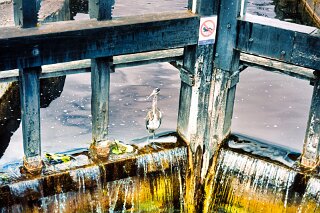
THIS HERON ATTRACTED A LOT OF ATTENTION
THE WISE FISHER OF CROSS GUNS BRIDGE [A LESSON IN RESPECTING THE WATER]
I really need a different lens as I was too far away to get a good show but here in Ireland there is an old saying - "the best lens is the one that you have with you"
The Wise Fisher of Cross Guns Bridge - A Lesson in Respecting the Water
If you have taken a stroll along Dublin’s Royal Canal recently, you may have spotted this majestic local resident keeping watch. Perched elegantly on the lock gate at Cross Guns Bridge, this is indeed a Grey Heron (Ardea cinerea).
While it looks like a living statue waiting patiently for its next meal, it also happens to be positioned right next to a very clear "No Swimming" sign. It seems our feathered friend has perfect compliance—a stark contrast to the human behaviour often witnessed along our inland waterways when temperatures begin to soar.
Why Grey Herons are Thriving in Dublin
Grey Herons are an increasingly familiar sight across Dublin and the wider Irish landscape. Recent data from BirdWatch Ireland shows their populations are stable and growing, particularly in urban areas.
There are a few reasons why they have become such a beloved fixture of our city canals:
The Ultimate Urban Adaptability: While naturally drawn to rural wetlands and estuaries, herons have realised that city canals and parks offer a reliable, year-round buffet of fish, frogs, and small mammals.
Charismatic Solitude: People love them because they bring a touch of the wild into the concrete jungle. Watching a heron stand completely motionless before striking with lightning speed is a mesmerizing daily spectacle for commuters and walkers.
Prehistoric Elegance: With their massive wingspans and slow, powerful wingbeats, they look delightfully prehistoric when taking flight, adding a sense of ancient grace to Dublin's modern waterways.
A Serious Message: The Danger of the Invite
While the heron wisely uses the lock gate purely as a fishing platform, the "No Swimming" sign behind it carries a vital warning that is too often ignored, particularly during summer heatwaves.
When temperatures break records across Ireland and the UK, inviting bodies of water like canals, rivers, and quarries become incredibly tempting to young people looking to cool off.
Tragically, these spells of hot weather consistently bring a spike in accidental drownings.
The danger rarely stems from a person's swimming ability, but rather from a physiological phenomenon known as Cold Water Shock:
The 15°C Threshold: Even when the air temperature hits 30°C, the water in Irish canals and rivers remains deceptively cold—often well below 15°C.
The Reflex Response: Jumping suddenly into water this cold triggers an involuntary gasp reflex. If your head is underwater, you immediately inhale water into the lungs.
Physical Incapacitation: The sudden plunge causes blood vessels to constrict rapidly, spiking blood pressure and causing immediate hyperventilation and panic. Even the strongest, fittest swimmers can find themselves completely incapacitated within seconds.
Hidden Hazards: Beyond the temperature, urban canals hide dangerous undercurrents near lock gates, sudden depth changes, and submerged machinery or debris that can trap a jumper.
As the summer months bring warmer days, we can learn a lot from the Grey Heron at Cross Guns Bridge. Enjoy the beauty of the canal from the bank, leave the water to the wildlife, and always respect the signs put there to save lives.
I really need a different lens as I was too far away to get a good show but here in Ireland there is an old saying - "the best lens is the one that you have with you"
The Wise Fisher of Cross Guns Bridge - A Lesson in Respecting the Water
If you have taken a stroll along Dublin’s Royal Canal recently, you may have spotted this majestic local resident keeping watch. Perched elegantly on the lock gate at Cross Guns Bridge, this is indeed a Grey Heron (Ardea cinerea).
While it looks like a living statue waiting patiently for its next meal, it also happens to be positioned right next to a very clear "No Swimming" sign. It seems our feathered friend has perfect compliance—a stark contrast to the human behaviour often witnessed along our inland waterways when temperatures begin to soar.
Why Grey Herons are Thriving in Dublin
Grey Herons are an increasingly familiar sight across Dublin and the wider Irish landscape. Recent data from BirdWatch Ireland shows their populations are stable and growing, particularly in urban areas.
There are a few reasons why they have become such a beloved fixture of our city canals:
The Ultimate Urban Adaptability: While naturally drawn to rural wetlands and estuaries, herons have realised that city canals and parks offer a reliable, year-round buffet of fish, frogs, and small mammals.
Charismatic Solitude: People love them because they bring a touch of the wild into the concrete jungle. Watching a heron stand completely motionless before striking with lightning speed is a mesmerizing daily spectacle for commuters and walkers.
Prehistoric Elegance: With their massive wingspans and slow, powerful wingbeats, they look delightfully prehistoric when taking flight, adding a sense of ancient grace to Dublin's modern waterways.
A Serious Message: The Danger of the Invite
While the heron wisely uses the lock gate purely as a fishing platform, the "No Swimming" sign behind it carries a vital warning that is too often ignored, particularly during summer heatwaves.
When temperatures break records across Ireland and the UK, inviting bodies of water like canals, rivers, and quarries become incredibly tempting to young people looking to cool off.
Tragically, these spells of hot weather consistently bring a spike in accidental drownings.
The danger rarely stems from a person's swimming ability, but rather from a physiological phenomenon known as Cold Water Shock:
The 15°C Threshold: Even when the air temperature hits 30°C, the water in Irish canals and rivers remains deceptively cold—often well below 15°C.
The Reflex Response: Jumping suddenly into water this cold triggers an involuntary gasp reflex. If your head is underwater, you immediately inhale water into the lungs.
Physical Incapacitation: The sudden plunge causes blood vessels to constrict rapidly, spiking blood pressure and causing immediate hyperventilation and panic. Even the strongest, fittest swimmers can find themselves completely incapacitated within seconds.
Hidden Hazards: Beyond the temperature, urban canals hide dangerous undercurrents near lock gates, sudden depth changes, and submerged machinery or debris that can trap a jumper.
As the summer months bring warmer days, we can learn a lot from the Grey Heron at Cross Guns Bridge. Enjoy the beauty of the canal from the bank, leave the water to the wildlife, and always respect the signs put there to save lives.
GREY HERON AT CROSS GUNS BRIDGE