I USED A VOIGTLANDER 65MM LENS
INSIDE CABRA'S NEW WILD PARK [THIS IS LOCATED AT THE CABRA TRAM STOP]
From Toxic Brownfield to Dog Walker’s Paradise: Inside Cabra’s New "Wild" Park Extension
An exciting urban transformation has taken place directly adjacent to the Cabra Luas (tram) stop in Dublin 7. The major expansion of Mount Bernard Park, which sits tucked just beside the light-rail line, represents a unique shift in Irish urban planning.
For years, Mount Bernard Park was a relatively compact community green space, well-known locally for its tennis courts and sports pitches. However, the park has recently grown by over 50% in size by reclaiming a historical, disused industrial brownfield site extending northwards toward the Royal Canal.
The Industrial Legacy and the "Wild" Approach
The newly annexed lands were once owned by CIÉ (Ireland’s national transport operator) and were historically associated with old railway infrastructure and industrial yards. Left abandoned for decades, the soil beneath the surface carried industrial contamination—making it a classic urban brownfield site.
When the Luas Cross City tram line was built through the old Broadstone railway cutting, these adjacent lands remained closed off. They effectively acted as an accidental sanctuary where nature took back control behind locked gates, slowly developing a thick, untamed ecosystem.
Instead of executing a traditional, aggressive brownfield remediation—which would involve heavy excavation, turning over contaminated soil, and destroying the mature vegetation—Dublin City Council’s Parks Services, funded by the National Transport Authority, took a highly sustainable, low-intervention approach:
Preserving Biodiversity: Because digging into the ground risked disturbing the locked-in pollutants, the council opted for minimal excavation. The vast majority of the "wild" volunteer vegetation, brambles, and self-seeded saplings have been left entirely intact.
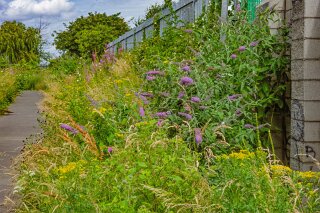
Light-Touch Infrastructure: Regeneration works focused on clearing just enough shrubbery to weave a dedicated, universal-access tarmac pathway around the perimeter of the extension.
The Paradox of the "Green Desert"
If you visit the new extension, you will immediately notice a striking paradox: it looks incredibly wild and overgrown, yet it is eerily quiet. On a recent walk - 3 July 2026, there was a distinct lack of visible wildlife. No obvious birds, bees, or insects, and not a single butterfly in sight.
Why hasn't the wildlife caught up with the vegetation?
1. The Pioneer Plant Monoculture
While the site has plenty of green cover, much of what grew during its decades of abandonment consists of highly aggressive "pioneer" species. Brambles, ivy, and self-seeded trees like sycamore or buddleia excel at taking over derelict concrete.
However, a dense thicket of brambles lacks the diverse hierarchy of wildflowers needed to support a continuous life cycle for insects. Without specific host plants for caterpillars or a steady succession of different blooming flowers from spring through autumn, butterflies and bees simply move on to more varied gardens nearby.
2. Low Insect Biomass Cascades Up the Chain
Insects are highly sensitive to micro-habitats. Because the council left the existing volunteer scrub mostly as it was to avoid disturbing the soil, the site lacks open, sun-drenched patches of bare earth or diverse wild grasses. Because the insect biomass is low, local birds have very little reason to forage there yet. Birds may nest in the thick cover, but they fly elsewhere to feed.
3. The Shock of Public Access
The transition from a completely locked brownfield to a public park involves a major shock to the local ecosystem. Heavy machinery clearing paths, the installation of the tarmac perimeter loop, and the sudden introduction of human foot traffic will temporarily drive away what little wildlife did call the area home.
A Hit with Local Dog Walkers
While the insects and birds are taking their time to return, the human and canine residents of Cabra have claimed the space wholeheartedly. The extension has quickly become a massive hit with local dog walkers.
Interestingly, dogs seem highly inclined to keep strictly to the new tarmac pathways. The dense, thorny nature of the unedited undergrowth—filled with decades of thick brambles and rough, industrial volunteer scrub—acts as a natural barrier. It keeps the dogs safely on the path, allowing them to enjoy the sights and smells of a wild woodland trail without disappearing into the dangerous undergrowth.
True ecological restoration on a brownfield takes years. As the site settles down and more diverse flora takes root over the coming seasons, those missing bees and butterflies should slowly begin to filter back in from the banks of the nearby Royal Canal.
From Toxic Brownfield to Dog Walker’s Paradise: Inside Cabra’s New "Wild" Park Extension
An exciting urban transformation has taken place directly adjacent to the Cabra Luas (tram) stop in Dublin 7. The major expansion of Mount Bernard Park, which sits tucked just beside the light-rail line, represents a unique shift in Irish urban planning.
For years, Mount Bernard Park was a relatively compact community green space, well-known locally for its tennis courts and sports pitches. However, the park has recently grown by over 50% in size by reclaiming a historical, disused industrial brownfield site extending northwards toward the Royal Canal.
The Industrial Legacy and the "Wild" Approach
The newly annexed lands were once owned by CIÉ (Ireland’s national transport operator) and were historically associated with old railway infrastructure and industrial yards. Left abandoned for decades, the soil beneath the surface carried industrial contamination—making it a classic urban brownfield site.
When the Luas Cross City tram line was built through the old Broadstone railway cutting, these adjacent lands remained closed off. They effectively acted as an accidental sanctuary where nature took back control behind locked gates, slowly developing a thick, untamed ecosystem.
Instead of executing a traditional, aggressive brownfield remediation—which would involve heavy excavation, turning over contaminated soil, and destroying the mature vegetation—Dublin City Council’s Parks Services, funded by the National Transport Authority, took a highly sustainable, low-intervention approach:
Preserving Biodiversity: Because digging into the ground risked disturbing the locked-in pollutants, the council opted for minimal excavation. The vast majority of the "wild" volunteer vegetation, brambles, and self-seeded saplings have been left entirely intact.
Light-Touch Infrastructure: Regeneration works focused on clearing just enough shrubbery to weave a dedicated, universal-access tarmac pathway around the perimeter of the extension.
The Paradox of the "Green Desert"
If you visit the new extension, you will immediately notice a striking paradox: it looks incredibly wild and overgrown, yet it is eerily quiet. On a recent walk - 3 July 2026, there was a distinct lack of visible wildlife. No obvious birds, bees, or insects, and not a single butterfly in sight.
Why hasn't the wildlife caught up with the vegetation?
1. The Pioneer Plant Monoculture
While the site has plenty of green cover, much of what grew during its decades of abandonment consists of highly aggressive "pioneer" species. Brambles, ivy, and self-seeded trees like sycamore or buddleia excel at taking over derelict concrete.
However, a dense thicket of brambles lacks the diverse hierarchy of wildflowers needed to support a continuous life cycle for insects. Without specific host plants for caterpillars or a steady succession of different blooming flowers from spring through autumn, butterflies and bees simply move on to more varied gardens nearby.
2. Low Insect Biomass Cascades Up the Chain
Insects are highly sensitive to micro-habitats. Because the council left the existing volunteer scrub mostly as it was to avoid disturbing the soil, the site lacks open, sun-drenched patches of bare earth or diverse wild grasses. Because the insect biomass is low, local birds have very little reason to forage there yet. Birds may nest in the thick cover, but they fly elsewhere to feed.
3. The Shock of Public Access
The transition from a completely locked brownfield to a public park involves a major shock to the local ecosystem. Heavy machinery clearing paths, the installation of the tarmac perimeter loop, and the sudden introduction of human foot traffic will temporarily drive away what little wildlife did call the area home.
A Hit with Local Dog Walkers
While the insects and birds are taking their time to return, the human and canine residents of Cabra have claimed the space wholeheartedly. The extension has quickly become a massive hit with local dog walkers.
Interestingly, dogs seem highly inclined to keep strictly to the new tarmac pathways. The dense, thorny nature of the unedited undergrowth—filled with decades of thick brambles and rough, industrial volunteer scrub—acts as a natural barrier. It keeps the dogs safely on the path, allowing them to enjoy the sights and smells of a wild woodland trail without disappearing into the dangerous undergrowth.
True ecological restoration on a brownfield takes years. As the site settles down and more diverse flora takes root over the coming seasons, those missing bees and butterflies should slowly begin to filter back in from the banks of the nearby Royal Canal.
CABRA'S NEW WILD PARK