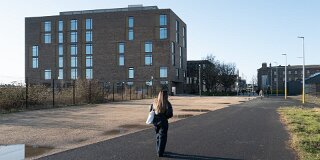
THE GRANGEGORMAN UNIVERSITY CAMPUS JANUARY 2026
From Asylum to Academy: The Rise of Dublin's New Education Giant
I should mention that I have a vested interest as I live at edge of the Grangegorman Campus and my front door faces Bolton Street College. I studied Electronics/Telecommunications at Kevin Street College and also more recently attended DCU and NCI.
If you’ve walked through Dublin 7 lately, you might have noticed something massive rising from the historic grounds near Stoneybatter. It is not just a new building; it is an entire new urban quarter. The TU Dublin Grangegorman campus is one of the most significant urban regeneration projects in Dublin's history, and the scale of what is happening there is quietly staggering.
The "Queens" Comparison: A Campus Rivalling a Capital's University
Here is a fact that puts the scale of this project into perspective: Eventually, this single campus in Grangegorman will host almost the same number of students as the entirety of Queen's University in Belfast. Let that sink in. Queen's University Belfast (QUB) is a massive, historic institution with a total student population of approximately 24,000 to 25,000. I mention Queens because I photograph Queens Quarter on a regular basis and have noticed some negative impacts that the University has had on the area.
When the Grangegorman Masterplan is fully realised, this specific campus is projected to accommodate over 20,000 students and staff. To put that in a local context, that is roughly the same size as Dublin City University (DCU), which has approximately 20,000 students across its multiple campuses.
Essentially, TU Dublin is building a facility the size of DCU inside a single historic site in the city centre.
The Dublin "University League"
To understand just how dominant this new quarter will be, we have to look at the broader landscape of higher education in Dublin. The city is already home to major players like DCU in the north suburbs and the specialist, city-integrated National College of Ireland (NCI) in the IFSC.
While UCD remains the "giant" of the sector (approx. 35,000 students) and Trinity holds the historic crown, TU Dublin is creating something unique. While NCI successfully modelled how a college can anchor a business district (the Docklands), Grangegorman is doing something similar but on a much vaster scale for the creative and technical heart of Dublin 7.
A Dark Past, A Permeable Future
The development of this site is fascinating because of the stark contrast between its history and its current design. For over two centuries, this walled-off section of Dublin was synonymous with incarceration and institutional care—first as the Richmond Lunatic Asylum (1814), then the Richmond General Penitentiary, and later St. Brendan's Hospital.
For generations, the site was defined by high walls and locked gates. Today, the design philosophy is the exact opposite. Unlike Trinity College, which has formal gates and guards, or UCD, which sits somewhat apart from its immediate suburbs, Grangegorman is designed as a permeable urban quarter. There are no access restrictions for pedestrians; it is a public amenity as much as a university.
The Elephant in the Room: The "Factory" Trap
However, while the architecture is world-class, the biggest challenge for TU Dublin will be its soul.
Many students who have passed through Dublin's newer institutions—such as DCU or NCI—have often critiqued them for feeling like "factories." Unlike the established confidence of Trinity or UCD, newer universities often suffer from an institutional inferiority complex.
In a bid to prove they are "real" universities, these institutions can sometimes fall into the trap of rigid bureaucracy and grading on a bell curve. This practice artificially suppresses grades to appear "rigorous," treating students as statistics rather than fostering genuine intellectual exploration. The danger is that TU Dublin imports this anxiety into its new home. If the administration focuses too much on metrics to prove itself against Trinity, it risks becoming just another shiny educational factory.
The Tale of Two Campuses: A Twist of Fate
The migration to this new campus tells two very different stories, involving a stubborn building on Bolton Street and a financial disaster on Kevin Street.
1. The "Last Mohican": Bolton Street's Heavy Metal For locals living on Bolton Street, the view hasn't changed quite as much—yet. Bolton Street College is the "Last Mohican" of the city centre campuses, and its history is as heavy as its machinery.
Interestingly, the Bolton Street building was once the European Hotel. Its conversion to a technical college involved embedding heavy industrial turning equipment and machinery deep into the concrete of the basements.
This infrastructure is the primary reason Bolton Street is still open. That equipment is incredibly expensive and difficult to move, making the building a hard sell to developers compared to the open sites of other colleges. TU Dublin cannot simply move these heavy workshops to the pristine classrooms of the Central Quad.
The solution is a split strategy. The "heavy" trades will eventually move to a new purpose-built Design and Construct Centre at Broombridge (Cabra), while the academic side (Architecture, Civil Engineering) will move to the future West Quad in Grangegorman. Until then, Bolton Street remains a bustling, gritty outpost of the old world.
2. The Kevin Street Twist: Irony on Wood Quay The story of the Kevin Street campus is even more dramatic. The site (famous for Electronics and Telecommunications) was sold to a developer, but the story didn't end there.
The Crash: The developer who bought the site became insolvent, leaving the ambitious "Camden Yard" project stalled with an incomplete building on the site.
The Buyer: In a fascinating twist, Dublin City Council (DCC) has decided to step in and purchase the site "as is" for a knock-down price.
The Irony: DCC intends to use this site to relocate their headquarters away from the controversial Civic Offices at Wood Quay (the "Bunkers").
This is a delicious historical irony. In the late 1970s, thousands of Dubliners—including massive contingents of students from Bolton Street and Kevin Street—marched in protest against the destruction of the Viking site at Wood Quay to build those very bunkers.
Now, fifty years later, the Council is abandoning the bunkers that the students tried to stop, only to move their headquarters onto the very site where those students used to study. The "Save Wood Quay" protesters may have lost the battle in 1978, but they seem to have won the war of attrition.
Why It Matters
This development isn't just about student numbers. It is re-orienting the centre of gravity in Dublin. The influx of 20,000 people daily is transforming Stoneybatter, Smithfield, and Phibsborough.
It is a rare example of a university not just building a new wing, but building a new future on the footprint of a difficult past—let’s just hope the teaching philosophy matches the architectural ambition.
I should mention that I have a vested interest as I live at edge of the Grangegorman Campus and my front door faces Bolton Street College. I studied Electronics/Telecommunications at Kevin Street College and also more recently attended DCU and NCI.
If you’ve walked through Dublin 7 lately, you might have noticed something massive rising from the historic grounds near Stoneybatter. It is not just a new building; it is an entire new urban quarter. The TU Dublin Grangegorman campus is one of the most significant urban regeneration projects in Dublin's history, and the scale of what is happening there is quietly staggering.
The "Queens" Comparison: A Campus Rivalling a Capital's University
Here is a fact that puts the scale of this project into perspective: Eventually, this single campus in Grangegorman will host almost the same number of students as the entirety of Queen's University in Belfast. Let that sink in. Queen's University Belfast (QUB) is a massive, historic institution with a total student population of approximately 24,000 to 25,000. I mention Queens because I photograph Queens Quarter on a regular basis and have noticed some negative impacts that the University has had on the area.
When the Grangegorman Masterplan is fully realised, this specific campus is projected to accommodate over 20,000 students and staff. To put that in a local context, that is roughly the same size as Dublin City University (DCU), which has approximately 20,000 students across its multiple campuses.
Essentially, TU Dublin is building a facility the size of DCU inside a single historic site in the city centre.
The Dublin "University League"
To understand just how dominant this new quarter will be, we have to look at the broader landscape of higher education in Dublin. The city is already home to major players like DCU in the north suburbs and the specialist, city-integrated National College of Ireland (NCI) in the IFSC.
While UCD remains the "giant" of the sector (approx. 35,000 students) and Trinity holds the historic crown, TU Dublin is creating something unique. While NCI successfully modelled how a college can anchor a business district (the Docklands), Grangegorman is doing something similar but on a much vaster scale for the creative and technical heart of Dublin 7.
A Dark Past, A Permeable Future
The development of this site is fascinating because of the stark contrast between its history and its current design. For over two centuries, this walled-off section of Dublin was synonymous with incarceration and institutional care—first as the Richmond Lunatic Asylum (1814), then the Richmond General Penitentiary, and later St. Brendan's Hospital.
For generations, the site was defined by high walls and locked gates. Today, the design philosophy is the exact opposite. Unlike Trinity College, which has formal gates and guards, or UCD, which sits somewhat apart from its immediate suburbs, Grangegorman is designed as a permeable urban quarter. There are no access restrictions for pedestrians; it is a public amenity as much as a university.
The Elephant in the Room: The "Factory" Trap
However, while the architecture is world-class, the biggest challenge for TU Dublin will be its soul.
Many students who have passed through Dublin's newer institutions—such as DCU or NCI—have often critiqued them for feeling like "factories." Unlike the established confidence of Trinity or UCD, newer universities often suffer from an institutional inferiority complex.
In a bid to prove they are "real" universities, these institutions can sometimes fall into the trap of rigid bureaucracy and grading on a bell curve. This practice artificially suppresses grades to appear "rigorous," treating students as statistics rather than fostering genuine intellectual exploration. The danger is that TU Dublin imports this anxiety into its new home. If the administration focuses too much on metrics to prove itself against Trinity, it risks becoming just another shiny educational factory.
The Tale of Two Campuses: A Twist of Fate
The migration to this new campus tells two very different stories, involving a stubborn building on Bolton Street and a financial disaster on Kevin Street.
1. The "Last Mohican": Bolton Street's Heavy Metal For locals living on Bolton Street, the view hasn't changed quite as much—yet. Bolton Street College is the "Last Mohican" of the city centre campuses, and its history is as heavy as its machinery.
Interestingly, the Bolton Street building was once the European Hotel. Its conversion to a technical college involved embedding heavy industrial turning equipment and machinery deep into the concrete of the basements.
This infrastructure is the primary reason Bolton Street is still open. That equipment is incredibly expensive and difficult to move, making the building a hard sell to developers compared to the open sites of other colleges. TU Dublin cannot simply move these heavy workshops to the pristine classrooms of the Central Quad.
The solution is a split strategy. The "heavy" trades will eventually move to a new purpose-built Design and Construct Centre at Broombridge (Cabra), while the academic side (Architecture, Civil Engineering) will move to the future West Quad in Grangegorman. Until then, Bolton Street remains a bustling, gritty outpost of the old world.
2. The Kevin Street Twist: Irony on Wood Quay The story of the Kevin Street campus is even more dramatic. The site (famous for Electronics and Telecommunications) was sold to a developer, but the story didn't end there.
The Crash: The developer who bought the site became insolvent, leaving the ambitious "Camden Yard" project stalled with an incomplete building on the site.
The Buyer: In a fascinating twist, Dublin City Council (DCC) has decided to step in and purchase the site "as is" for a knock-down price.
The Irony: DCC intends to use this site to relocate their headquarters away from the controversial Civic Offices at Wood Quay (the "Bunkers").
This is a delicious historical irony. In the late 1970s, thousands of Dubliners—including massive contingents of students from Bolton Street and Kevin Street—marched in protest against the destruction of the Viking site at Wood Quay to build those very bunkers.
Now, fifty years later, the Council is abandoning the bunkers that the students tried to stop, only to move their headquarters onto the very site where those students used to study. The "Save Wood Quay" protesters may have lost the battle in 1978, but they seem to have won the war of attrition.
Why It Matters
This development isn't just about student numbers. It is re-orienting the centre of gravity in Dublin. The influx of 20,000 people daily is transforming Stoneybatter, Smithfield, and Phibsborough.
It is a rare example of a university not just building a new wing, but building a new future on the footprint of a difficult past—let’s just hope the teaching philosophy matches the architectural ambition.
GRANGEGORMAN CAMPUS