I WAS TOLD THAT THERE WAS A TYPEWRITER MUSEUM ON BOTANIC ROAD
I WAS TOLD THAT THERE WAS A TYPEWRITER MUSEUM ON BOTANIC ROAD [BOTANIC OFFICE EQUIPMENT]
Dublin's Accidental Museum: The Story of Botanic Office Equipment
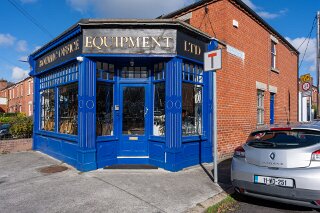
On a corner of Botanic Avenue in the Dublin suburb of Drumcondra, a shopfront with big gold letters spelling out "Botanic Office Equipment LTD" offers the first clue to a business that has become a local landmark. For the casual observer, the business at 63 Botanic Avenue presents a puzzle. The name suggests a supplier of modern office consumables—printer ink, notepads, or pens. The reality, however, is a portal to a bygone era of commerce.
Many locals and passers-by often mistake it for a "typewriter museum," a perceptive but slightly misidentified observation. The interior of Botanic Office Equipment is not a curated public exhibit, but it is unequivocally a museum. As journalistic accounts confirm, the shop "could be mistaken for a cash-register museum."
A 100-Year History of Cash Registers
Inside, the collection spans the full technological history of the cash register. Visitors can see "small brass vintage machines, large silver cash registers and matt black touch screens." This collection, which represents "More than 100 years of cash registers, arranged chronologically," is not a deliberate pivot into heritage tourism.
Rather, it is the physical artefact of a multi-generational family business that has specialised in this single piece of technology since 1970. The chronological arrangement isn't for an audience; it's the evolution of the company's own product line, from ornate, mechanical devices to the digital point-of-sale systems sold today.
This duality—part functional business, part historical archive—is a fact the proprietors are well aware of. The current owner, Padraic Bolger, has acknowledged the public's confusion: "People can misunderstand the shop... You get some people coming in thinking we sell printer ink and stuff like that." What they find instead is a tangible link to the history of retail itself, managed by the family that has serviced it for over half a century.
How a 2-Person Shop Survives the "Throwaway Culture"
The business remains, at its core, a family enterprise, just "as it was when it started." It is currently run by the founder's sons, Padraic Bolger and Ciarán Bolger. Shareholder data confirms this structure, listing Padraic Bolger as the majority owner, with Ciarán holding the remaining shares.
While the company is active, its operational scale has been significantly altered by technology. In the past 20 years, the firm "has dwindled from eight members of staff to just two" (Padraic and Ciarán). This reduction isn't a sign of failure but of a fundamental shift in its business model, driven by the very technology it sells.
The original, larger staff was necessary for a business built on the service and repair of complex, mechanical machines. Today, that model is largely obsolete. As Padraic Bolger notes, they "mainly sell machines now." The reason for this pivot is that modern electronic components are difficult or impossible to replace, a stark contrast to the serviceable machines of the past.
The company has survived this "throwaway culture" by inverting its value proposition. Its modern unique selling point is no longer its technical repair skill but its human-scale service. Padraic Bolger recounts how one client, a charity shop, left for a larger cash register company but "came back." The reason: "They want the personal touch... People like that they can call us up and know the person on the other end of the phone."
In this way, Botanic Office Equipment survives as a direct antithesis to the anonymous, large-scale electronics suppliers that dominate the market. It's a living case study of a legacy business adapting to a digital world by leveraging its most analog asset: its personal history and service.
From Lighthouses to Typewriters: The Bolger Legacy 💡
The story of Botanic Office Equipment is inseparable from the biography of its founder, Gerry Bolger, and his family's deep-rooted expertise in servicing complex mechanical systems.
Gerry Bolger, described as being in his 80s with a "cheery voice," founded the shop in 1970. His background, however, was not in retail but in a demanding and highly technical field. "My father serviced lighthouses," Padraic Bolger explained. This was not a remote-service role; the family lived at the stations, including a "stint at Fanad Lighthouse in Donegal." This career demonstrates a foundational skill set in the maintenance and repair of high-stakes, precision analog systems.
This technical aptitude led Gerry Bolger to his next role, one which directly explains the "typewriter" connection. Before he ever opened his shop, Gerry was an apprentice for the globally recognized Underwood Typewriter Company. As part of his training "learning how to service and repair typewriters," he "travelled to England, Italy and Switzerland."
This background is crucial. It establishes that the Bolger family's expertise was not in one product (like cash registers) but in the transferable skill of analog-era engineering. Gerry Bolger's career path—from lighthouses to typewriters, and ultimately to cash registers—shows an entrepreneurial mind capable of applying a core technical competency to new and emerging markets.
That legacy of hands-on expertise continues today. The business is now managed by his sons, Padraic and Ciarán, who grew up in the trade. Padraic, described in a 2018 interview as being in his 50s and "behind the counter," is the public face of this generational continuity, fielding calls for service and managing the "accidental museum" his father built.
An Entrepreneurial Spark: Decimal Day
The founding of Botanic Office Equipment was not a gradual evolution but a brilliant and precisely timed entrepreneurial maneuver. Gerry Bolger's decision to pivot away from the typewriter industry and into the cash register business was a direct response to a massive, impending economic disruption in Ireland.
Corporate records show "Botanic Office Equipment Limited" was incorporated on 22 April 1985. However, journalistic accounts and interviews with the family state clearly that Gerry Bolger "set up shop in 1970." These two dates are not a contradiction; they chart the company's life cycle. It operated for 15 years as an entrepreneurial venture—likely a sole proprietorship—before formalizing its structure in 1985 as a mature, limited company.
The catalyst for its 1970 founding was Decimal Day. On 15 February 1971, Ireland, along with the UK, decimalised its currency. The old £sd system (pounds, shillings, and pence) was abolished and replaced by the new decimal system, where one pound was worth 100 new pence.
Gerry Bolger, with his technical background in office equipment, immediately understood the implications: every single cash register in the country would become obsolete overnight.
"Then with decimalisation, I saw a gap in the market," Gerry Bolger explained. "Businesses would need new cash registers. And I hopped on the bandwagon."
His timing was perfect. By opening his shop on Botanic Avenue in 1970, he established his business ahead of the 1971 changeover, positioning himself as a primary supplier for the inevitable wave of demand from every pub, grocer, and shop in Dublin. The company was, therefore, born from a moment of forced technological obsolescence—a government mandate that created an entirely new market. This origin story is deeply ironic, given that the company's modern-day challenge is surviving the cultural shift toward voluntary technological obsolescence.
Deconstructing the "Typewriter Museum" Myth
The common assumption that the shop is a "typewriter museum" is incorrect in its specific detail but remarkably accurate in its spirit. This misconception is not random; it's a logical conflation of at least four distinct, real-world factors.
The Founder's "Historical Echo" As established, the company's founder, Gerry Bolger, began his career as an apprentice for the Underwood Typewriter Company. He was a trained typewriter mechanic. This idea, therefore, is tapping into the genuine pre-history of the business itself. The "typewriter" connection is real, but it belongs to the founder's career before he established the 1970 cash register business.
Conflation with Another Dublin Business This "typewriter museum" idea is almost certainly a conflation of Botanic Office Equipment with another, very similar, business in Dublin: "The Typewriter Shop" on Dorset Street, in the same general area of North Dublin. That shop is "the last typewriter shop in Dublin," specializes in vintage typewriters, and is also a multi-generational family business. It's highly probable that these two distinct stories have been merged in the public's mind.
The "Botanic" Name The company's name is purely geographical, taken from its location on Botanic Avenue. This street is next to one of Dublin's most famous landmarks, the National Botanic Gardens in Glasnevin. The word "Botanic" is, for most people, associated with the gardens, which are themselves a "living museum." This semantic association likely reinforces the impression of the shop as a heritage site.
The "Museum" Instinct is Correct Finally, the core instinct behind this observation is correct. The shop is a museum, just not of typewriters. There is a documented and growing public interest in vintage office technology. People have correctly identified a "hidden museum" of 20th-century technology in Drumcondra but have simply misidentified the primary artifact.
A Legacy of Adaptation
Botanic Office Equipment remains an active, trading company, legally registered and operating from its historic 63 Botanic Avenue address. It is not a formal museum, but its interior serves as an "accidental museum" of cash register technology, a physical byproduct of its 50-plus-year history.
The company's story is one of profound adaptation. It was founded in 1970 by Gerry Bolger, a man whose technical skills were honed servicing lighthouses and Underwood typewriters. He launched the business not as a passion project, but as a savvy entrepreneurial response to Ireland's 1971 decimalisation, which created an instant, massive "gap in the market."
Today, the business, now run by his sons Padraic and Ciarán Bolger, faces the opposite challenge. It is no longer buoyed by obsolescence but threatened by it. The "throwaway culture" of modern electronics has decimated its original, service-oriented business model, reducing its staff from eight to two.
The company's survival demonstrates a second, more recent adaptation. It has transitioned from a business model based on technical service to one based on human service. It endures as a rare, independent supplier that offers a "personal touch," a direct line to an expert, and a human connection that its larger, anonymous competitors cannot. Botanic Office Equipment is a rare case study of a company that has survived the complete obsolescence of its founding premise by selling its own legacy, expertise, and personal connection as its primary, and most valuable, product.
Dublin's Accidental Museum: The Story of Botanic Office Equipment
On a corner of Botanic Avenue in the Dublin suburb of Drumcondra, a shopfront with big gold letters spelling out "Botanic Office Equipment LTD" offers the first clue to a business that has become a local landmark. For the casual observer, the business at 63 Botanic Avenue presents a puzzle. The name suggests a supplier of modern office consumables—printer ink, notepads, or pens. The reality, however, is a portal to a bygone era of commerce.
Many locals and passers-by often mistake it for a "typewriter museum," a perceptive but slightly misidentified observation. The interior of Botanic Office Equipment is not a curated public exhibit, but it is unequivocally a museum. As journalistic accounts confirm, the shop "could be mistaken for a cash-register museum."
A 100-Year History of Cash Registers
Inside, the collection spans the full technological history of the cash register. Visitors can see "small brass vintage machines, large silver cash registers and matt black touch screens." This collection, which represents "More than 100 years of cash registers, arranged chronologically," is not a deliberate pivot into heritage tourism.
Rather, it is the physical artefact of a multi-generational family business that has specialised in this single piece of technology since 1970. The chronological arrangement isn't for an audience; it's the evolution of the company's own product line, from ornate, mechanical devices to the digital point-of-sale systems sold today.
This duality—part functional business, part historical archive—is a fact the proprietors are well aware of. The current owner, Padraic Bolger, has acknowledged the public's confusion: "People can misunderstand the shop... You get some people coming in thinking we sell printer ink and stuff like that." What they find instead is a tangible link to the history of retail itself, managed by the family that has serviced it for over half a century.
How a 2-Person Shop Survives the "Throwaway Culture"
The business remains, at its core, a family enterprise, just "as it was when it started." It is currently run by the founder's sons, Padraic Bolger and Ciarán Bolger. Shareholder data confirms this structure, listing Padraic Bolger as the majority owner, with Ciarán holding the remaining shares.
While the company is active, its operational scale has been significantly altered by technology. In the past 20 years, the firm "has dwindled from eight members of staff to just two" (Padraic and Ciarán). This reduction isn't a sign of failure but of a fundamental shift in its business model, driven by the very technology it sells.
The original, larger staff was necessary for a business built on the service and repair of complex, mechanical machines. Today, that model is largely obsolete. As Padraic Bolger notes, they "mainly sell machines now." The reason for this pivot is that modern electronic components are difficult or impossible to replace, a stark contrast to the serviceable machines of the past.
The company has survived this "throwaway culture" by inverting its value proposition. Its modern unique selling point is no longer its technical repair skill but its human-scale service. Padraic Bolger recounts how one client, a charity shop, left for a larger cash register company but "came back." The reason: "They want the personal touch... People like that they can call us up and know the person on the other end of the phone."
In this way, Botanic Office Equipment survives as a direct antithesis to the anonymous, large-scale electronics suppliers that dominate the market. It's a living case study of a legacy business adapting to a digital world by leveraging its most analog asset: its personal history and service.
From Lighthouses to Typewriters: The Bolger Legacy 💡
The story of Botanic Office Equipment is inseparable from the biography of its founder, Gerry Bolger, and his family's deep-rooted expertise in servicing complex mechanical systems.
Gerry Bolger, described as being in his 80s with a "cheery voice," founded the shop in 1970. His background, however, was not in retail but in a demanding and highly technical field. "My father serviced lighthouses," Padraic Bolger explained. This was not a remote-service role; the family lived at the stations, including a "stint at Fanad Lighthouse in Donegal." This career demonstrates a foundational skill set in the maintenance and repair of high-stakes, precision analog systems.
This technical aptitude led Gerry Bolger to his next role, one which directly explains the "typewriter" connection. Before he ever opened his shop, Gerry was an apprentice for the globally recognized Underwood Typewriter Company. As part of his training "learning how to service and repair typewriters," he "travelled to England, Italy and Switzerland."
This background is crucial. It establishes that the Bolger family's expertise was not in one product (like cash registers) but in the transferable skill of analog-era engineering. Gerry Bolger's career path—from lighthouses to typewriters, and ultimately to cash registers—shows an entrepreneurial mind capable of applying a core technical competency to new and emerging markets.
That legacy of hands-on expertise continues today. The business is now managed by his sons, Padraic and Ciarán, who grew up in the trade. Padraic, described in a 2018 interview as being in his 50s and "behind the counter," is the public face of this generational continuity, fielding calls for service and managing the "accidental museum" his father built.
An Entrepreneurial Spark: Decimal Day
The founding of Botanic Office Equipment was not a gradual evolution but a brilliant and precisely timed entrepreneurial maneuver. Gerry Bolger's decision to pivot away from the typewriter industry and into the cash register business was a direct response to a massive, impending economic disruption in Ireland.
Corporate records show "Botanic Office Equipment Limited" was incorporated on 22 April 1985. However, journalistic accounts and interviews with the family state clearly that Gerry Bolger "set up shop in 1970." These two dates are not a contradiction; they chart the company's life cycle. It operated for 15 years as an entrepreneurial venture—likely a sole proprietorship—before formalizing its structure in 1985 as a mature, limited company.
The catalyst for its 1970 founding was Decimal Day. On 15 February 1971, Ireland, along with the UK, decimalised its currency. The old £sd system (pounds, shillings, and pence) was abolished and replaced by the new decimal system, where one pound was worth 100 new pence.
Gerry Bolger, with his technical background in office equipment, immediately understood the implications: every single cash register in the country would become obsolete overnight.
"Then with decimalisation, I saw a gap in the market," Gerry Bolger explained. "Businesses would need new cash registers. And I hopped on the bandwagon."
His timing was perfect. By opening his shop on Botanic Avenue in 1970, he established his business ahead of the 1971 changeover, positioning himself as a primary supplier for the inevitable wave of demand from every pub, grocer, and shop in Dublin. The company was, therefore, born from a moment of forced technological obsolescence—a government mandate that created an entirely new market. This origin story is deeply ironic, given that the company's modern-day challenge is surviving the cultural shift toward voluntary technological obsolescence.
Deconstructing the "Typewriter Museum" Myth
The common assumption that the shop is a "typewriter museum" is incorrect in its specific detail but remarkably accurate in its spirit. This misconception is not random; it's a logical conflation of at least four distinct, real-world factors.
The Founder's "Historical Echo" As established, the company's founder, Gerry Bolger, began his career as an apprentice for the Underwood Typewriter Company. He was a trained typewriter mechanic. This idea, therefore, is tapping into the genuine pre-history of the business itself. The "typewriter" connection is real, but it belongs to the founder's career before he established the 1970 cash register business.
Conflation with Another Dublin Business This "typewriter museum" idea is almost certainly a conflation of Botanic Office Equipment with another, very similar, business in Dublin: "The Typewriter Shop" on Dorset Street, in the same general area of North Dublin. That shop is "the last typewriter shop in Dublin," specializes in vintage typewriters, and is also a multi-generational family business. It's highly probable that these two distinct stories have been merged in the public's mind.
The "Botanic" Name The company's name is purely geographical, taken from its location on Botanic Avenue. This street is next to one of Dublin's most famous landmarks, the National Botanic Gardens in Glasnevin. The word "Botanic" is, for most people, associated with the gardens, which are themselves a "living museum." This semantic association likely reinforces the impression of the shop as a heritage site.
The "Museum" Instinct is Correct Finally, the core instinct behind this observation is correct. The shop is a museum, just not of typewriters. There is a documented and growing public interest in vintage office technology. People have correctly identified a "hidden museum" of 20th-century technology in Drumcondra but have simply misidentified the primary artifact.
A Legacy of Adaptation
Botanic Office Equipment remains an active, trading company, legally registered and operating from its historic 63 Botanic Avenue address. It is not a formal museum, but its interior serves as an "accidental museum" of cash register technology, a physical byproduct of its 50-plus-year history.
The company's story is one of profound adaptation. It was founded in 1970 by Gerry Bolger, a man whose technical skills were honed servicing lighthouses and Underwood typewriters. He launched the business not as a passion project, but as a savvy entrepreneurial response to Ireland's 1971 decimalisation, which created an instant, massive "gap in the market."
Today, the business, now run by his sons Padraic and Ciarán Bolger, faces the opposite challenge. It is no longer buoyed by obsolescence but threatened by it. The "throwaway culture" of modern electronics has decimated its original, service-oriented business model, reducing its staff from eight to two.
The company's survival demonstrates a second, more recent adaptation. It has transitioned from a business model based on technical service to one based on human service. It endures as a rare, independent supplier that offers a "personal touch," a direct line to an expert, and a human connection that its larger, anonymous competitors cannot. Botanic Office Equipment is a rare case study of a company that has survived the complete obsolescence of its founding premise by selling its own legacy, expertise, and personal connection as its primary, and most valuable, product.
THE BACKGROUND STORY