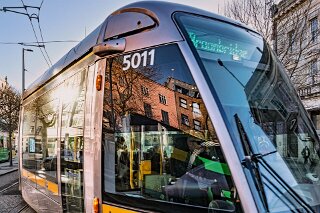
THIS IS THE MAIN STREET IN IRELAND
'CONNELL STREET IS THE MAIN STREET IN DUBLIN [PHOTOGRAPHED DURING JANUARY 2026]
O’Connell Street is the historic heart and main thoroughfare of Dublin, Ireland. Stretching from the River Liffey to Parnell Street, it is one of the widest streets in Europe, measuring approximately 49 metres in width. Its significance lies not just in its scale, but in its role as a witness to the most transformative events in Irish history.
Historical Significance
Originally known as Sackville Street, it was renamed in 1924 in honour of Daniel O’Connell, the "Liberator" who campaigned for Catholic Emancipation.
The street was the primary stage for the 1916 Easter Rising. The General Post Office (GPO), which still stands today as a working post office and museum, served as the headquarters for the rebel leaders. During the conflict, much of the street was reduced to rubble by British artillery, particularly from the gunboat Helga stationed on the Liffey.
Notable Landmarks and Monuments
O’Connell Street functions as an open-air gallery of Irish political history through its various statues and structures:
The Spire of Dublin: Officially titled the Monument of Light, this 120-metre stainless steel pin stands on the former site of Nelson’s Pillar (which was blown up in 1966). It represents the modernisation of the city.
The O’Connell Monument: Located at the southern end near O’Connell Bridge, this grand bronze statue commemorates Daniel O'Connell, surrounded by figures representing different elements of Irish society.
Statue of Jim Larkin: A dynamic monument to the labour leader, famous for his role in the 1913 Dublin Lockout.
The GPO: Beyond its historical weight, the building is a masterpiece of Greek Revival architecture, featuring iconic Ionic columns that still bear the scars of bullet holes from 1916.
Modern Character
Today, O’Connell Street is a bustling commercial and transport hub. While it has faced challenges regarding its retail mix in recent decades, it remains the focal point for national celebrations, most notably the St. Patrick’s Day Parade. It serves as a central artery for the Luas (tram) green and red lines, connecting the north and south sides of the city.
O’Connell Street is the historic heart and main thoroughfare of Dublin, Ireland. Stretching from the River Liffey to Parnell Street, it is one of the widest streets in Europe, measuring approximately 49 metres in width. Its significance lies not just in its scale, but in its role as a witness to the most transformative events in Irish history.
Historical Significance
Originally known as Sackville Street, it was renamed in 1924 in honour of Daniel O’Connell, the "Liberator" who campaigned for Catholic Emancipation.
The street was the primary stage for the 1916 Easter Rising. The General Post Office (GPO), which still stands today as a working post office and museum, served as the headquarters for the rebel leaders. During the conflict, much of the street was reduced to rubble by British artillery, particularly from the gunboat Helga stationed on the Liffey.
Notable Landmarks and Monuments
O’Connell Street functions as an open-air gallery of Irish political history through its various statues and structures:
The Spire of Dublin: Officially titled the Monument of Light, this 120-metre stainless steel pin stands on the former site of Nelson’s Pillar (which was blown up in 1966). It represents the modernisation of the city.
The O’Connell Monument: Located at the southern end near O’Connell Bridge, this grand bronze statue commemorates Daniel O'Connell, surrounded by figures representing different elements of Irish society.
Statue of Jim Larkin: A dynamic monument to the labour leader, famous for his role in the 1913 Dublin Lockout.
The GPO: Beyond its historical weight, the building is a masterpiece of Greek Revival architecture, featuring iconic Ionic columns that still bear the scars of bullet holes from 1916.
Modern Character
Today, O’Connell Street is a bustling commercial and transport hub. While it has faced challenges regarding its retail mix in recent decades, it remains the focal point for national celebrations, most notably the St. Patrick’s Day Parade. It serves as a central artery for the Luas (tram) green and red lines, connecting the north and south sides of the city.
O'CONNELL STREET