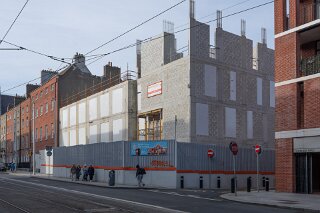
LOWER DOMINICK STREET AS IT WAS IN MARCH 2026
LOWER DOMINICK STREET [18 MARCH 2026]
Lower Dominick Street in Dublin 1 is currently a focal point for urban regeneration, representing a stark contrast between modern architectural "exemplars" and the decaying remains of mid-20th-century social housing. The street, once a premier Georgian address, has undergone significant transformation over the last decade, though progress on the western side remains frustratingly slow for many.
Completed Redevelopment: Dominick Hall (East Side)
The most significant milestone in the area's recent history is the completion of the Dominick Street Lower (East) Regeneration Project, often referred to as Dominick Hall.
Completion: The project was officially completed in late 2022, with residents moving in throughout 2023.
The Development: It comprises 72 new social housing units (67 apartments and 5 townhouses) built on a previously vacant site at the junction of Parnell Street and Dominick Street Lower.
Design Features: Designed as a modern take on the Georgian "street skin," the building uses high-quality brickwork and includes a community centre, retail spaces, and a raised private courtyard for residents.
Sustainability: The units are A-rated for energy efficiency, meeting Near Zero Energy Building (NZEB) standards, a far cry from the damp-prone flats they replaced.
Redevelopment Underway: Dominick Street West
With the east side finished, attention has shifted to Dominick Street West. This phase involves the redevelopment of the remaining 1960s flat blocks on the opposite side of the street.
Status: As of early 2026, the project is in the advanced design and procurement stages. Dublin City Council (DCC) has received budget approval to deliver approximately 75 new homes on this site.
Approach: Unlike previous total-demolition strategies, the council is exploring a "deep retrofit" and "enhanced works" model for some structures to maintain sustainability and reduce carbon costs, though significant new construction is also planned.
Timeline: Works were initially projected to commence on-site by mid-2025, with active construction and site preparation continuing through 2026.
The Derelict Blocks: Dormant and Fenced Off
Despite the shiny new facade of Dominick Hall, a significant portion of the street remains dominated by the original 1960s social housing blocks that are now vacant, fenced off, and dormant.
The "Decanted" Blocks: These flats were "decanted" (emptied of residents) over several years, with many former tenants moving into the new Dominick Hall across the road.
State of Dereliction: These blocks are currently behind heavy security fencing. To the casual observer, they appear as "ghost blocks"—grey, concrete skeletons that have become magnets for anti-social behaviour and tagging.
Why the Delay? The dormancy is primarily due to the complexity of the "Dominick Street West" planning process. Legal delays, changes in national funding models (moving from Public-Private Partnerships to direct state funding), and the requirement for extensive archaeological surveys—given the street's 18th-century foundations—have left these structures in limbo for years.
Public Sentiment: The sight of boarded-up homes in the midst of a national housing crisis remains a point of local contention, often cited by community advocates as a symbol of the "slow-motion" nature of Irish public housing delivery.
Lower Dominick Street in Dublin 1 is currently a focal point for urban regeneration, representing a stark contrast between modern architectural "exemplars" and the decaying remains of mid-20th-century social housing. The street, once a premier Georgian address, has undergone significant transformation over the last decade, though progress on the western side remains frustratingly slow for many.
Completed Redevelopment: Dominick Hall (East Side)
The most significant milestone in the area's recent history is the completion of the Dominick Street Lower (East) Regeneration Project, often referred to as Dominick Hall.
Completion: The project was officially completed in late 2022, with residents moving in throughout 2023.
The Development: It comprises 72 new social housing units (67 apartments and 5 townhouses) built on a previously vacant site at the junction of Parnell Street and Dominick Street Lower.
Design Features: Designed as a modern take on the Georgian "street skin," the building uses high-quality brickwork and includes a community centre, retail spaces, and a raised private courtyard for residents.
Sustainability: The units are A-rated for energy efficiency, meeting Near Zero Energy Building (NZEB) standards, a far cry from the damp-prone flats they replaced.
Redevelopment Underway: Dominick Street West
With the east side finished, attention has shifted to Dominick Street West. This phase involves the redevelopment of the remaining 1960s flat blocks on the opposite side of the street.
Status: As of early 2026, the project is in the advanced design and procurement stages. Dublin City Council (DCC) has received budget approval to deliver approximately 75 new homes on this site.
Approach: Unlike previous total-demolition strategies, the council is exploring a "deep retrofit" and "enhanced works" model for some structures to maintain sustainability and reduce carbon costs, though significant new construction is also planned.
Timeline: Works were initially projected to commence on-site by mid-2025, with active construction and site preparation continuing through 2026.
The Derelict Blocks: Dormant and Fenced Off
Despite the shiny new facade of Dominick Hall, a significant portion of the street remains dominated by the original 1960s social housing blocks that are now vacant, fenced off, and dormant.
The "Decanted" Blocks: These flats were "decanted" (emptied of residents) over several years, with many former tenants moving into the new Dominick Hall across the road.
State of Dereliction: These blocks are currently behind heavy security fencing. To the casual observer, they appear as "ghost blocks"—grey, concrete skeletons that have become magnets for anti-social behaviour and tagging.
Why the Delay? The dormancy is primarily due to the complexity of the "Dominick Street West" planning process. Legal delays, changes in national funding models (moving from Public-Private Partnerships to direct state funding), and the requirement for extensive archaeological surveys—given the street's 18th-century foundations—have left these structures in limbo for years.
Public Sentiment: The sight of boarded-up homes in the midst of a national housing crisis remains a point of local contention, often cited by community advocates as a symbol of the "slow-motion" nature of Irish public housing delivery.
LOWER DOMINICK STREET