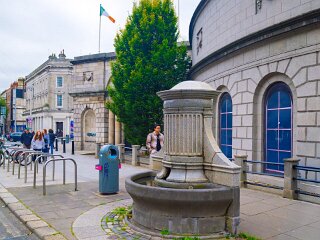
FOUNTAIN IN POOR CONDITION - DESIGNED BY JOHN ENSOR
FOUNTAIN IN POOR CONDITION AT THE AMBASSADOR THEATRE [DESIGNED BY JOHN ENSOR]
The fountain in question is situated at a key location in Dublin's urban landscape: the northern apex of Parnell Square, where it meets the top of O'Connell Street. Unfortunately, like many public fountains in Dublin, it is not maintained and remains in a visibly poor, non-operational condition.
Its prominent position, adjacent to both the Ambassador and Gate Theatres, has also made it vulnerable. During the extensive construction of the LUAS Cross City tram line, its proximity to the major engineering works was a significant cause for concern regarding potential damage.
Was it Always in this Specific Location?
Many have noteed its apparent isolation from other buildings, but this placement is entirely deliberate and part of its original 18th-century design.
It was not only always in this specific location, but the location was designed for it.
The fountain sits at the terminus of the vista looking north up O'Connell Street (formerly Sackville Street). In 18th-century urban planning, such focal points were crucial. The fountain and the sweeping, curved façades of the Ambassador and Gate Theatres behind it were all designed as a single, magnificent architectural set piece.
Its purpose was to create a grand, formal conclusion to Dublin's primary thoroughfare before the street opens into Parnell Square (then Rutland Square). Therefore, while it may seem "isolated" today, it was conceived as the central jewel of this entire architectural composition.
The Ambassador and Rotunda Complex
The fountain's location is intrinsically linked to the complex it serves. The Ambassador Theatre is a substantial structure and, as you noted, forms part of a larger, attached group of buildings.
This complex began with the Rotunda Hospital, designed by Richard Castle and completed in 1757. To attract funding for this maternity hospital (the first of its kind), the hospital's governors commissioned an entertainment complex to be built alongside it.
This is where John Ensor comes in. In the 1780s, he designed and executed the "Assembly Rooms" (now the Gate Theatre) and the "Round Room" (now the Ambassador Theatre). These new structures, with their numerous decorative features and contrasting wall treatments, were designed to flow from Castle's original hospital, creating the unified arcade and curved entrance we see today.
The theatre complex was, therefore, not only a notable structure in its own right but also a vital fundraising component for the hospital. This entire assembly—hospital, theatres, and fountain—continues to act as one of the most important cultural and social hubs on the north side of Dublin City.
The fountain in question is situated at a key location in Dublin's urban landscape: the northern apex of Parnell Square, where it meets the top of O'Connell Street. Unfortunately, like many public fountains in Dublin, it is not maintained and remains in a visibly poor, non-operational condition.
Its prominent position, adjacent to both the Ambassador and Gate Theatres, has also made it vulnerable. During the extensive construction of the LUAS Cross City tram line, its proximity to the major engineering works was a significant cause for concern regarding potential damage.
Was it Always in this Specific Location?
Many have noteed its apparent isolation from other buildings, but this placement is entirely deliberate and part of its original 18th-century design.
It was not only always in this specific location, but the location was designed for it.
The fountain sits at the terminus of the vista looking north up O'Connell Street (formerly Sackville Street). In 18th-century urban planning, such focal points were crucial. The fountain and the sweeping, curved façades of the Ambassador and Gate Theatres behind it were all designed as a single, magnificent architectural set piece.
Its purpose was to create a grand, formal conclusion to Dublin's primary thoroughfare before the street opens into Parnell Square (then Rutland Square). Therefore, while it may seem "isolated" today, it was conceived as the central jewel of this entire architectural composition.
The Ambassador and Rotunda Complex
The fountain's location is intrinsically linked to the complex it serves. The Ambassador Theatre is a substantial structure and, as you noted, forms part of a larger, attached group of buildings.
This complex began with the Rotunda Hospital, designed by Richard Castle and completed in 1757. To attract funding for this maternity hospital (the first of its kind), the hospital's governors commissioned an entertainment complex to be built alongside it.
This is where John Ensor comes in. In the 1780s, he designed and executed the "Assembly Rooms" (now the Gate Theatre) and the "Round Room" (now the Ambassador Theatre). These new structures, with their numerous decorative features and contrasting wall treatments, were designed to flow from Castle's original hospital, creating the unified arcade and curved entrance we see today.
The theatre complex was, therefore, not only a notable structure in its own right but also a vital fundraising component for the hospital. This entire assembly—hospital, theatres, and fountain—continues to act as one of the most important cultural and social hubs on the north side of Dublin City.
FOUNTAIN IN POOR CONDITION - DESIGNED BY JOHN ENSOR