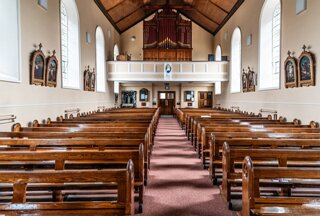
MY FIRST TIME TO PHOTOGRAPH THIS OLD CHURCH AND GRAVEYARD
JULY 2018 WAS MY FIRST TIME TO VISIT BALLYBRICKEN CHURCH AND GRAVEYARD [SONY A7RIII AND FE 24-70 F2.8 GM LENS]
A Journey Through Ballybricken: The Church of the Most Holy Trinity Without
My first introduction to Waterford was on 25 May 2016, during a stay at the Waterford Marina Hotel. I returned the following year in late August, opting for the Fitzwilton Hotel, a choice I repeated in July 2018.
Reflecting on that July visit, I initially wondered why I had chosen that specific time; usually, my primary motivation was to photograph the vibrant new murals created each August during the Waterford Walls festival. However, by 2018, my stays had become longer and my explorations more extensive. This gave me the freedom to wander beyond the street art and discover historical gems like the church at Ballybricken.
History and Architecture
The Catholic Church of the Most Holy Trinity Without and its adjoining graveyard offer a poignant look into Waterford’s social and religious evolution.
Strategic Origins: The current structure dates to circa 1810, replacing an 18th-century thatched chapel. Its distinctive name, "Without," denotes its historical position outside the ancient city walls, distinguishing it from the "Within" cathedral.
Pre-Emancipation Design: Built before the Catholic Emancipation Act of 1829, the church is a quintessential "barn chapel." Its cruciform plan reflects the modest budgets and architectural restrictions imposed on Catholic houses of worship during the Penal Law era.
Noble Simplicity: The building is unpretentious yet dignified. A notable feature is the west tower, though its original pinnacles were later removed. Inside, the galleries in the nave and transepts serve as a reminder of historical social hierarchies, where the "better sorts" sat above while the poor stood below.
The Legacy of "Little Nellie of Holy God"
Perhaps the most moving connection to the church is the story of Nellie Organ (1903–1908).
Born in Waterford and baptised at Ballybricken in August 1903, Nellie became known for her extraordinary spiritual precocity. Despite her young age and failing health, she displayed a profound understanding of the Eucharist. Her life and devotion are credited with influencing Pope Pius X to lower the age of Holy Communion from twelve to approximately seven years old. Today, visitors can still see the original font used for her baptism, marked by a commemorative plaque.
Why Visit Ballybricken?
For those exploring Ireland’s Ancient East, this site provides a layer of history often missed by the casual tourist:
Genealogical Heritage: The parish registers date back to the late 1700s, making the church and its weathered headstones a vital resource for those tracing Irish ancestry.
A Place of Pilgrimage: The story of Little Nellie draws visitors from across the globe, linking this local parish to a major shift in universal Catholic practice.
The Green and the Fair: The church overlooks Ballybricken Green, which served for centuries as the vital junction between city and country life, hosting a famous livestock fair until the mid-20th century.
Atmosphere: Despite its proximity to the bustling city centre, the grounds remain a sanctuary of "noble simplicity"—a serene, tranquil space perfect for quiet reflection.
Fact-Check & Technical Notes
Historical Accuracy: The distinction between "Within" and "Without" is historically accurate for Waterford's parochial system. The influence of Nellie Organ on the decree Quam Singulari (1910) is well-documented in ecclesiastical history.
A Journey Through Ballybricken: The Church of the Most Holy Trinity Without
My first introduction to Waterford was on 25 May 2016, during a stay at the Waterford Marina Hotel. I returned the following year in late August, opting for the Fitzwilton Hotel, a choice I repeated in July 2018.
Reflecting on that July visit, I initially wondered why I had chosen that specific time; usually, my primary motivation was to photograph the vibrant new murals created each August during the Waterford Walls festival. However, by 2018, my stays had become longer and my explorations more extensive. This gave me the freedom to wander beyond the street art and discover historical gems like the church at Ballybricken.
History and Architecture
The Catholic Church of the Most Holy Trinity Without and its adjoining graveyard offer a poignant look into Waterford’s social and religious evolution.
Strategic Origins: The current structure dates to circa 1810, replacing an 18th-century thatched chapel. Its distinctive name, "Without," denotes its historical position outside the ancient city walls, distinguishing it from the "Within" cathedral.
Pre-Emancipation Design: Built before the Catholic Emancipation Act of 1829, the church is a quintessential "barn chapel." Its cruciform plan reflects the modest budgets and architectural restrictions imposed on Catholic houses of worship during the Penal Law era.
Noble Simplicity: The building is unpretentious yet dignified. A notable feature is the west tower, though its original pinnacles were later removed. Inside, the galleries in the nave and transepts serve as a reminder of historical social hierarchies, where the "better sorts" sat above while the poor stood below.
The Legacy of "Little Nellie of Holy God"
Perhaps the most moving connection to the church is the story of Nellie Organ (1903–1908).
Born in Waterford and baptised at Ballybricken in August 1903, Nellie became known for her extraordinary spiritual precocity. Despite her young age and failing health, she displayed a profound understanding of the Eucharist. Her life and devotion are credited with influencing Pope Pius X to lower the age of Holy Communion from twelve to approximately seven years old. Today, visitors can still see the original font used for her baptism, marked by a commemorative plaque.
Why Visit Ballybricken?
For those exploring Ireland’s Ancient East, this site provides a layer of history often missed by the casual tourist:
Genealogical Heritage: The parish registers date back to the late 1700s, making the church and its weathered headstones a vital resource for those tracing Irish ancestry.
A Place of Pilgrimage: The story of Little Nellie draws visitors from across the globe, linking this local parish to a major shift in universal Catholic practice.
The Green and the Fair: The church overlooks Ballybricken Green, which served for centuries as the vital junction between city and country life, hosting a famous livestock fair until the mid-20th century.
Atmosphere: Despite its proximity to the bustling city centre, the grounds remain a sanctuary of "noble simplicity"—a serene, tranquil space perfect for quiet reflection.
Fact-Check & Technical Notes
Historical Accuracy: The distinction between "Within" and "Without" is historically accurate for Waterford's parochial system. The influence of Nellie Organ on the decree Quam Singulari (1910) is well-documented in ecclesiastical history.
BALLYBRICKEN CHURCHYARD