THE SO CALLED CATHOLIC CEMETERY IN DOUGLAS COUNTY CORK
THE DOUGLAS MUNICIPAL CEMETERY [OFTEN REFERRED TO AS THE CATHOLIC CEMETERY]
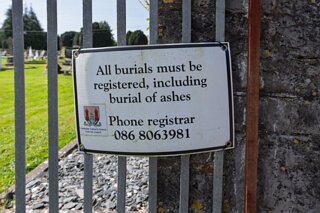
The "Catholic" cemetery in Douglas, Cork—officially known as Douglas Graveyard—is a site where modern administrative warnings and centuries of Irish history collide. To understand why a small notice about the registration of ashes holds such weight, one must look at the physical and legal fractures that created this unique burial ground.
The Warning: Why Registration Matters
A prominent notice at the entrance states: "All burials must be registered, including burial of ashes." To the casual visitor, this may seem like routine bureaucracy, but in an ancient graveyard, it usually signals a response to "wildcat" or "guerrilla" interments.
Legal Continuity: In an overcrowded, historical site, the "Right of Burial" is a precious legal asset. When families bury ashes privately without notice, they break the "Chain of Title." If the Council cannot verify who was last interred, they cannot legally permit future burials in that plot.
Structural Integrity: Douglas Graveyard is a dense patchwork of 19th-century masonry. Private, unrecorded digging for urns can undermine the foundations of adjacent, often leaning, Victorian headstones or damage the roots of protected trees.
The "Full" Status: The cemetery is officially closed to new plot sales. Registration ensures that the only burials taking place are within established family rights, preventing the site from being over-taxed beyond its capacity.
Development and the "Great Divide"
The cemetery is often called "Catholic," yet it is not, and never has been, owned by the Catholic Church. Its development is the result of a physical and legislative split from the neighbouring St Luke’s Church of Ireland.
The Roadway Split: Originally, the land was a contiguous part of St Luke’s burial ground. In the 1870s, during the rebuilding of the church, Churchyard Lane was formalised, physically severing the eastern portion of the graveyard from the church building.
The Disestablishment Act (1869): Following the disestablishment of the Church of Ireland, any burial ground separated from a church by a public highway was transferred to the local civil authorities (the Poor Law Guardians).
The Transition to "Catholic": Because the local authority—not the Anglican Church—now managed the section across the road, it became the natural choice for the Catholic population of Douglas. While Catholics had historically been buried in the "old yard," the new management solidified its status as a public, de facto Catholic cemetery.
People of Note and Local History
The cemetery serves as a silent ledger of Douglas’s social strata. While the "great and good" (like the philanthropist Sir John Arnott) are mostly within the gated grounds of St Luke’s, the public cemetery holds equally significant figures:
Commonwealth War Graves: The site contains 17 casualties from World War I and two from World War II. These men, such as Private Denis Murphy and Corporal M. O’Riordan, reflect Cork’s long tradition of service in the British Army.
Merchant Families: Notable names from the village's commercial history, such as the O’Sullivan publican family, are found here.
The Workhouse Dead: From 1881, the cemetery was the primary site for those who died in the Union Workhouse on Douglas Road (now St Finbarr’s Hospital) but could not afford a private burial at the more distant Carr's Hill.
Tales from the Graveyard
The Watch-House: In the eastern end of the graveyard once stood a "watch-house." These were common in the early 19th century to protect fresh graves from resurrectionists (body snatchers) who would steal corpses to sell to medical schools for dissection.
Famine Overcrowding: During the Great Famine (1845–1852), the cemetery became so dangerously overcrowded that it led to local protests. This forced the opening of the grim "pauper pits" at nearby Carr’s Hill, highlighting the desperate pressure on Douglas’s burial spaces during Ireland's darkest years.
The "Catholic" cemetery in Douglas, Cork—officially known as Douglas Graveyard—is a site where modern administrative warnings and centuries of Irish history collide. To understand why a small notice about the registration of ashes holds such weight, one must look at the physical and legal fractures that created this unique burial ground.
The Warning: Why Registration Matters
A prominent notice at the entrance states: "All burials must be registered, including burial of ashes." To the casual visitor, this may seem like routine bureaucracy, but in an ancient graveyard, it usually signals a response to "wildcat" or "guerrilla" interments.
Legal Continuity: In an overcrowded, historical site, the "Right of Burial" is a precious legal asset. When families bury ashes privately without notice, they break the "Chain of Title." If the Council cannot verify who was last interred, they cannot legally permit future burials in that plot.
Structural Integrity: Douglas Graveyard is a dense patchwork of 19th-century masonry. Private, unrecorded digging for urns can undermine the foundations of adjacent, often leaning, Victorian headstones or damage the roots of protected trees.
The "Full" Status: The cemetery is officially closed to new plot sales. Registration ensures that the only burials taking place are within established family rights, preventing the site from being over-taxed beyond its capacity.
Development and the "Great Divide"
The cemetery is often called "Catholic," yet it is not, and never has been, owned by the Catholic Church. Its development is the result of a physical and legislative split from the neighbouring St Luke’s Church of Ireland.
The Roadway Split: Originally, the land was a contiguous part of St Luke’s burial ground. In the 1870s, during the rebuilding of the church, Churchyard Lane was formalised, physically severing the eastern portion of the graveyard from the church building.
The Disestablishment Act (1869): Following the disestablishment of the Church of Ireland, any burial ground separated from a church by a public highway was transferred to the local civil authorities (the Poor Law Guardians).
The Transition to "Catholic": Because the local authority—not the Anglican Church—now managed the section across the road, it became the natural choice for the Catholic population of Douglas. While Catholics had historically been buried in the "old yard," the new management solidified its status as a public, de facto Catholic cemetery.
People of Note and Local History
The cemetery serves as a silent ledger of Douglas’s social strata. While the "great and good" (like the philanthropist Sir John Arnott) are mostly within the gated grounds of St Luke’s, the public cemetery holds equally significant figures:
Commonwealth War Graves: The site contains 17 casualties from World War I and two from World War II. These men, such as Private Denis Murphy and Corporal M. O’Riordan, reflect Cork’s long tradition of service in the British Army.
Merchant Families: Notable names from the village's commercial history, such as the O’Sullivan publican family, are found here.
The Workhouse Dead: From 1881, the cemetery was the primary site for those who died in the Union Workhouse on Douglas Road (now St Finbarr’s Hospital) but could not afford a private burial at the more distant Carr's Hill.
Tales from the Graveyard
The Watch-House: In the eastern end of the graveyard once stood a "watch-house." These were common in the early 19th century to protect fresh graves from resurrectionists (body snatchers) who would steal corpses to sell to medical schools for dissection.
Famine Overcrowding: During the Great Famine (1845–1852), the cemetery became so dangerously overcrowded that it led to local protests. This forced the opening of the grim "pauper pits" at nearby Carr’s Hill, highlighting the desperate pressure on Douglas’s burial spaces during Ireland's darkest years.
THE CATHOLIC CEMETERY