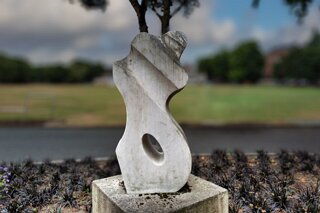
SCULPTURE BY GERDA FROMEL AT TRINITY COLLEGE
Modernist Form in College Park: Gerda Frömel at Trinity College Dublin
For years, the identity of the artist behind this subtle campus landmark remained a mystery to me. The breakthrough came quite by chance today. While out with my Leica Q3, I struck up a conversation with a visitor from Germany who spotted the camera. As luck would have it, he had traveled to Trinity specifically to photograph this piece, finally giving a name to a sculpture I had passed so many times.
Bordering the perimeter path of College Park—where the lawns of the cricket pitch open out towards the Pavilion and the Victorian facade of the Museum Building—stands an elegant, abstract carved stone sculpture by the German-Irish modernist sculptor Gerda Frömel (1931–1975).
Frömel’s sculptural output is celebrated for its understated refinement, technical precision, and organic geometry. Born in Czechoslovakia and trained in Stuttgart, Darmstadt, and Munich before settling in Ireland in the mid-1950s, she brought a distinct European sensibility to Irish modernism.
Frömel developed a distinctive language of abstraction influenced by European contemporaries such as Barbara Hepworth and Alberto Giacometti.
Visual and Material Analysis
The piece featured here exemplifies Frömel's mastery of relief and negative space:
Form and Contour: Carved from pale stone, the upright, torso-like silhouette features a swept, biomorphic contour that captures ambient light along its softly rounded edges.
Diagonals and Striations: A bold diagonal groove cuts across the upper section of the form, creating a rhythmic play of shadow and highlight that changes dynamically depending on the angle of daylight.
The Void: Near the base of the sculpture, a smooth oval aperture penetrates through the stone. This central void acts as a visual focal point, framing the surrounding greenery and inviting the viewer's eye through the artwork into the landscape beyond.
Set atop a low concrete pedestal amongst dark foliage, the sculpture offers a quiet, contemplative presence against the open backdrop of the university sports grounds.
The Artist And Her Career And Work
Born in Czechoslovakia to German parents, Gerda Frömel grew up in Germany and trained in sculpture and metalwork in Stuttgart, Darmstadt, and Munich. In 1955, while studying in Munich, she married the sculptor Werner Schürmann. The couple moved to Ireland the following year, settling in Woodtown Park near Rathfarnham, where Schürmann established one of Ireland’s few art foundries to cast their bronze works.
Although Frömel’s early childhood was peaceful, her formative years were shaped by the trauma of the Second World War and the subsequent expulsion of ethnic Germans from Eastern Europe. This context places her alongside post-war contemporaries such as Joseph Beuys, Frank Auerbach, Eva Hesse, and Georg Baselitz. In a continent grappling with physical and spiritual devastation, many artists sought a "return to order." Sculptors like Henry Moore temporarily revisited figuration to reassert the primacy of the human body. This cultural atmosphere informed Frömel's artistic education when she entered the Academy of Fine Arts in Stuttgart in 1948, prior to her further studies in Darmstadt and Munich.
Frömel began exhibiting in Ireland during the late 1950s, notably with the Irish Exhibition of Living Art. Her early works were predominantly cast bronze and figurative, featuring portraits such as Portrait of Johann Jacob Wenceslaus (1957) alongside animal forms like Deer Crossing Bay (1963). In 1964, she held a major solo exhibition at Dublin's Dawson Gallery. These pieces showed thematic parallels to post-war phenomenological art—echoing the observational approach of Alberto Giacometti—while displaying a distinct interest in surface texture. Frömel often retained investment (plaster remnants from casting), giving her bronzes a raw quality. This tactile variance became a hallmark of her career; even her stone and polished metal works reveal deliberate tool marks and chiseled facets upon close inspection.
By the late 1960s, Frömel shifted from cast bronze toward stone carving—working in marble, granite, and her favoured material, alabaster. Her visual vocabulary streamlined into elemental forms: circles, lines, and spirals capturing natural and celestial phenomena, particularly the moon and its reflections.
Between 1967 and 1970, Frömel completed her landmark public commission, Sails, created for the Carroll’s cigarette factory in Dundalk, County Louth (designed by Scott Tallon Walker). As the largest private sculptural commission in Ireland at the time, Sails received critical acclaim and became synonymous with the building's modernist architecture.
Tragically, Frömel died in a drowning accident in 1975 at the age of 44. The following year, Dublin City Gallery The Hugh Lane held a major commemorative retrospective. Though championing by critics such as Dorothy Walker led to her inclusion in ROSC ’80, her work was exhibited infrequently in the decades that followed.
Today, Frömel’s work is held in major public and corporate collections, including the Arts Council of Ireland, Bank of Ireland, Allied Irish Banks, Crawford Art Gallery, The Hugh Lane, Atlantic Technological University (formerly GMIT), Limerick City Gallery of Art, and Trinity College Dublin. The Irish Museum of Modern Art (IMMA) holds the largest public collection of her work, largely acquired from the Carroll’s and Bank of Ireland collections. IMMA featured her in The Moderns (2010–2011) and mounted a major retrospective in 2015 as part of its IMMA Modern Masters series.
For years, the identity of the artist behind this subtle campus landmark remained a mystery to me. The breakthrough came quite by chance today. While out with my Leica Q3, I struck up a conversation with a visitor from Germany who spotted the camera. As luck would have it, he had traveled to Trinity specifically to photograph this piece, finally giving a name to a sculpture I had passed so many times.
Bordering the perimeter path of College Park—where the lawns of the cricket pitch open out towards the Pavilion and the Victorian facade of the Museum Building—stands an elegant, abstract carved stone sculpture by the German-Irish modernist sculptor Gerda Frömel (1931–1975).
Frömel’s sculptural output is celebrated for its understated refinement, technical precision, and organic geometry. Born in Czechoslovakia and trained in Stuttgart, Darmstadt, and Munich before settling in Ireland in the mid-1950s, she brought a distinct European sensibility to Irish modernism.
Frömel developed a distinctive language of abstraction influenced by European contemporaries such as Barbara Hepworth and Alberto Giacometti.
Visual and Material Analysis
The piece featured here exemplifies Frömel's mastery of relief and negative space:
Form and Contour: Carved from pale stone, the upright, torso-like silhouette features a swept, biomorphic contour that captures ambient light along its softly rounded edges.
Diagonals and Striations: A bold diagonal groove cuts across the upper section of the form, creating a rhythmic play of shadow and highlight that changes dynamically depending on the angle of daylight.
The Void: Near the base of the sculpture, a smooth oval aperture penetrates through the stone. This central void acts as a visual focal point, framing the surrounding greenery and inviting the viewer's eye through the artwork into the landscape beyond.
Set atop a low concrete pedestal amongst dark foliage, the sculpture offers a quiet, contemplative presence against the open backdrop of the university sports grounds.
The Artist And Her Career And Work
Born in Czechoslovakia to German parents, Gerda Frömel grew up in Germany and trained in sculpture and metalwork in Stuttgart, Darmstadt, and Munich. In 1955, while studying in Munich, she married the sculptor Werner Schürmann. The couple moved to Ireland the following year, settling in Woodtown Park near Rathfarnham, where Schürmann established one of Ireland’s few art foundries to cast their bronze works.
Although Frömel’s early childhood was peaceful, her formative years were shaped by the trauma of the Second World War and the subsequent expulsion of ethnic Germans from Eastern Europe. This context places her alongside post-war contemporaries such as Joseph Beuys, Frank Auerbach, Eva Hesse, and Georg Baselitz. In a continent grappling with physical and spiritual devastation, many artists sought a "return to order." Sculptors like Henry Moore temporarily revisited figuration to reassert the primacy of the human body. This cultural atmosphere informed Frömel's artistic education when she entered the Academy of Fine Arts in Stuttgart in 1948, prior to her further studies in Darmstadt and Munich.
Frömel began exhibiting in Ireland during the late 1950s, notably with the Irish Exhibition of Living Art. Her early works were predominantly cast bronze and figurative, featuring portraits such as Portrait of Johann Jacob Wenceslaus (1957) alongside animal forms like Deer Crossing Bay (1963). In 1964, she held a major solo exhibition at Dublin's Dawson Gallery. These pieces showed thematic parallels to post-war phenomenological art—echoing the observational approach of Alberto Giacometti—while displaying a distinct interest in surface texture. Frömel often retained investment (plaster remnants from casting), giving her bronzes a raw quality. This tactile variance became a hallmark of her career; even her stone and polished metal works reveal deliberate tool marks and chiseled facets upon close inspection.
By the late 1960s, Frömel shifted from cast bronze toward stone carving—working in marble, granite, and her favoured material, alabaster. Her visual vocabulary streamlined into elemental forms: circles, lines, and spirals capturing natural and celestial phenomena, particularly the moon and its reflections.
Between 1967 and 1970, Frömel completed her landmark public commission, Sails, created for the Carroll’s cigarette factory in Dundalk, County Louth (designed by Scott Tallon Walker). As the largest private sculptural commission in Ireland at the time, Sails received critical acclaim and became synonymous with the building's modernist architecture.
Tragically, Frömel died in a drowning accident in 1975 at the age of 44. The following year, Dublin City Gallery The Hugh Lane held a major commemorative retrospective. Though championing by critics such as Dorothy Walker led to her inclusion in ROSC ’80, her work was exhibited infrequently in the decades that followed.
Today, Frömel’s work is held in major public and corporate collections, including the Arts Council of Ireland, Bank of Ireland, Allied Irish Banks, Crawford Art Gallery, The Hugh Lane, Atlantic Technological University (formerly GMIT), Limerick City Gallery of Art, and Trinity College Dublin. The Irish Museum of Modern Art (IMMA) holds the largest public collection of her work, largely acquired from the Carroll’s and Bank of Ireland collections. IMMA featured her in The Moderns (2010–2011) and mounted a major retrospective in 2015 as part of its IMMA Modern Masters series.
SCULPTURE BY GERDA FROMEL AT TRINITY COLLEGE