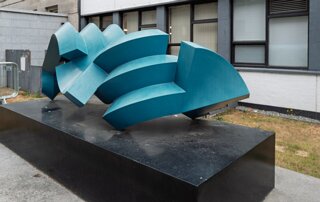
CHAC MOOL IN BLUE BY SEBASTIAN PHOTOGRAPHED USING A LEICA Q3 - NEAR THE LINCON GATE ENTRANCE TO TRINITY COLLEGE
Sebastián’s Chac Mool: A Vibrant Mesoamerican Dialogue at Trinity College
Positioned near the Lincoln Gate entrance to Trinity College Dublin, Chac Mool (2002) by the renowned Mexican sculptor Sebastián (born Enrique Carbajal González) is a striking, steel-built intervention in the urban landscape. Formally unveiled on 18 September 2015 by Provost Dr Patrick Prendergast and the Mexican Ambassador to Ireland, Carlos García de Alba Zepeda, the piece was presented to mark 40 years of Mexican-Irish diplomatic relations.
It is one of four public sculptures generously gifted to Ireland by the artist. Born in Chihuahua in 1947, Carbajal adopted the moniker "Sebastián" in homage to Sandro Botticelli’s depiction of the martyred Saint Sebastian. Today, he is internationally celebrated for his monumental geometric abstractions constructed from steel and concrete.
The Evolutionary Lineage of Form
The ancient Mesoamerican Chac Mool—defined by its upward-bent knees, elbows resting, and head turned 90 degrees—branches into two distinct modern trajectories on the Trinity College campus:
Geometric Constructivism — Sebastián (2002): Executed in spray-painted mild steel with an industrial turquoise hue, composed of folded planes and sharp, faceted angles near the Lincoln Gate.
Organic Biomorphism — Henry Moore (1969): Executed in cast bronze with a tactile, earth-toned surface, composed of smooth, curved voids and shell-like interlocking forms at Library Square.
The Origins of the Reclining Form
The term Chac Mool refers to a distinct style of pre-Columbian Mesoamerican statue discovered across central Mexico and Yucatan temple sites. Serving as a sacred intermediary between mortals and deities, the figure traditionally sits in a reclining posture—knees drawn up, resting on its elbows, with its head turned sharply outward.
In ancient frescoes and codices, the vivid turquoise blue chosen by Sebastián signified members of the priesthood and sacred rituals. While historians continue to study their exact ritual role, these figures are widely understood as altars for sacrificial offerings or memorials to fallen warriors.
Chac Mool vs Reclining Connected Forms: A Campus Comparison
1. Chac Mool by Sebastián (2002)
Location: Lincoln Gate Entrance
Medium: Spray-painted mild steel (Turquoise)
Aesthetic: Geometric, angular, sharp faceted planes
Lineage: Modern Mexican constructivism rooted in Mayan heritage
2. Reclining Connected Forms by Henry Moore (1969)
Location: Library Square / Berkeley Library
Medium: Cast bronze (Patinated brown/green)
Aesthetic: Biomorphic, smooth, curved interlocking voids
Lineage: British modernist abstraction inspired by Mesoamerican stone carvings
Having both works on the Trinity College campus offers a fascinating lesson in art history. In the late 1920s, Henry Moore was profoundly inspired by a plaster cast of a Mayan Chac Mool he studied in Paris. That encounter led directly to his seminal 1929 Hornton stone Reclining Figure—a milestone he cited as the primary catalyst for his lifelong exploration of the reclining form. His 1969 bronze piece in Library Square, Reclining Connected Forms, represents the culmination of that journey, abstracting the body into smooth, bone-like shells and internal voids.
Sebastián approaches the very same archetype from a contrasting perspective. Where Moore softens stone and bronze into rolling, landscape-like curves, Sebastián uses folded, sheet-steel geometry and high-saturation turquoise paint. His Chac Mool translates an ancient sacred posture into a sharp, structural idiom.
Positioned near the Lincoln Gate entrance to Trinity College Dublin, Chac Mool (2002) by the renowned Mexican sculptor Sebastián (born Enrique Carbajal González) is a striking, steel-built intervention in the urban landscape. Formally unveiled on 18 September 2015 by Provost Dr Patrick Prendergast and the Mexican Ambassador to Ireland, Carlos García de Alba Zepeda, the piece was presented to mark 40 years of Mexican-Irish diplomatic relations.
It is one of four public sculptures generously gifted to Ireland by the artist. Born in Chihuahua in 1947, Carbajal adopted the moniker "Sebastián" in homage to Sandro Botticelli’s depiction of the martyred Saint Sebastian. Today, he is internationally celebrated for his monumental geometric abstractions constructed from steel and concrete.
The Evolutionary Lineage of Form
The ancient Mesoamerican Chac Mool—defined by its upward-bent knees, elbows resting, and head turned 90 degrees—branches into two distinct modern trajectories on the Trinity College campus:
Geometric Constructivism — Sebastián (2002): Executed in spray-painted mild steel with an industrial turquoise hue, composed of folded planes and sharp, faceted angles near the Lincoln Gate.
Organic Biomorphism — Henry Moore (1969): Executed in cast bronze with a tactile, earth-toned surface, composed of smooth, curved voids and shell-like interlocking forms at Library Square.
The Origins of the Reclining Form
The term Chac Mool refers to a distinct style of pre-Columbian Mesoamerican statue discovered across central Mexico and Yucatan temple sites. Serving as a sacred intermediary between mortals and deities, the figure traditionally sits in a reclining posture—knees drawn up, resting on its elbows, with its head turned sharply outward.
In ancient frescoes and codices, the vivid turquoise blue chosen by Sebastián signified members of the priesthood and sacred rituals. While historians continue to study their exact ritual role, these figures are widely understood as altars for sacrificial offerings or memorials to fallen warriors.
Chac Mool vs Reclining Connected Forms: A Campus Comparison
1. Chac Mool by Sebastián (2002)
Location: Lincoln Gate Entrance
Medium: Spray-painted mild steel (Turquoise)
Aesthetic: Geometric, angular, sharp faceted planes
Lineage: Modern Mexican constructivism rooted in Mayan heritage
2. Reclining Connected Forms by Henry Moore (1969)
Location: Library Square / Berkeley Library
Medium: Cast bronze (Patinated brown/green)
Aesthetic: Biomorphic, smooth, curved interlocking voids
Lineage: British modernist abstraction inspired by Mesoamerican stone carvings
Having both works on the Trinity College campus offers a fascinating lesson in art history. In the late 1920s, Henry Moore was profoundly inspired by a plaster cast of a Mayan Chac Mool he studied in Paris. That encounter led directly to his seminal 1929 Hornton stone Reclining Figure—a milestone he cited as the primary catalyst for his lifelong exploration of the reclining form. His 1969 bronze piece in Library Square, Reclining Connected Forms, represents the culmination of that journey, abstracting the body into smooth, bone-like shells and internal voids.
Sebastián approaches the very same archetype from a contrasting perspective. Where Moore softens stone and bronze into rolling, landscape-like curves, Sebastián uses folded, sheet-steel geometry and high-saturation turquoise paint. His Chac Mool translates an ancient sacred posture into a sharp, structural idiom.
CHAC MOOL IN BLUE BY SEBASTIAN