UNVEILING FAILING BETTER BY ROWAN GILLESPIE
Skyward Dreams in Bronze: Mapping Dublin’s Eccentric Pioneers of Flight
If you take a stroll through Dublin, you might spot a unexpected motif cast in bronze: propellers, flying apparatuses, and whimsical, skyward machines.
At first glance, seeing propellers incorporated into Irish public art might bring to mind the American slang idiom "propeller head"—a term born in 1980s US pop culture to describe tech-obsessed geeks and eccentric inventors. But while these sculptures certainly capture that same spirit of wild invention, their true origins lie much closer to home.
They pay homage to a rich, local history of Irish dreamers who attempted to conquer the skies long before modern aviation was proven. Here is the story of two remarkable sculptures in Dublin that celebrate the courage to innovate—and fail better.
1. Unveiling Failing Better: The Story Behind Trinity College’s Whimsical Bronze
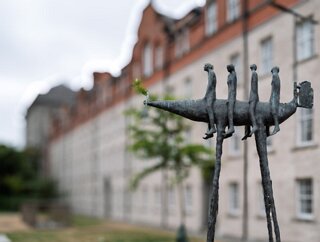
Tucked near the Pearse Street entrance (beside New Square), Rowan Gillespie’s bronze sculpture Failing Better stands on spindly, elongated legs. Complete with propellers, wheels, and slender riding figures, this surreal craft looks halfway between a mechanical horse and an early flying machine.
The Artist: Rowan Gillespie
Born in Dublin in 1953, Rowan Gillespie is world-famous for his expressive, site-specific figurative bronzes. You may recognise his evocative style from his iconic Famine memorial along Dublin’s Custom House Quay or Leap in Richmond, London.
Uniquely, Gillespie carries out every stage of the bronze casting process himself in his Dublin studio/foundry—from initial maquettes and wax models to the bronze pour and final welding. His work frequently explores themes of memory, endurance, human vulnerability, and ambition.
The Artwork: Failing Better
This bronze masterpiece is titled Failing Better. Cast in 2019, the sculpture is a whimsical blend of a horse, early modern mechanical apparatuses, wheels, and propellers.
Inspiration & Origins
The concept behind Failing Better brings together two distinct legacies from Trinity College’s history:
Samuel Beckett’s Philosophy: The title is directly borrowed from Trinity alumnus and Nobel laureate Samuel Beckett’s famous quote in Worstward Ho (1983):
"Ever tried. Ever failed. No matter. Try again. Fail again. Fail better."
George Francis FitzGerald’s Flying Experiments: In the late 19th century, Professor George Francis FitzGerald—a visionary Professor of Natural and Experimental Physics at Trinity—built and tested bizarre glider-like flying machines in the college quadrangles. While his inventions never truly achieved sustained flight, his optimistic spirit of experimentation captured Gillespie’s imagination.
Why Is It Located There?
Installed near the Pearse Street entrance (adjacent to the Science and Engineering facilities at New Square), the sculpture’s placement is highly intentional. Positioned close to where scientific discovery and academic pursuit flourish on campus, it serves as a daily tribute to curiosity, daring experimentation, and the essential role that failure plays on the road to success.
The machine depicted—a surreal hybrid that could never actually fly—celebrates the courage to try, fail, and try again.
Key Details At A Glance
Title: Failing Better
Artist: Rowan Gillespie
Date Installed: 2019
Location: Trinity College Dublin (Pearse Street Entrance / New Square)
Medium: Bronze
2. The Richard Crosbie Statue at Ranelagh Gardens
Travel a short distance south to Ranelagh Gardens, and you will find another tribute to an airborne pioneer. Crafted by sculptor Rory Breslin and unveiled in 2008 (commissioned by Dublin City Council via the Per Cent for Art Scheme), this bronze memorial honours Richard Crosbie—the first Irishman to make a manned aerial flight on 19 January 1785.
The Flying Barge & Propeller Link - Crosbie launched his historic hydrogen balloon flight right from Ranelagh Gardens.
When he originally showcased his design—the "Aeronautic Chariot"—it featured sails, a rudder, and a manual, propeller-like wheel (moulinet) intended to steer through the air.
Breslin’s sculpture captures a young Crosbie filled with curiosity, surrounded by airborne instruments, celebrating the dawn of Irish aviation.
Connecting the Trail: Dublin’s Airborne Innovators
Whether it is Rory Breslin’s depiction of 18th-century balloonist Richard Crosbie in Ranelagh Gardens or Rowan Gillespie’s 21st-century tribute to 19th-century flight experiments at Trinity College, these pieces form an unofficial trail across Dublin.
Neither artist set out to literalise the American "propeller head" phrase, yet both capture its heart: celebrating the visionary "tech heads" who dared to dream up flying machines and paved the way for modern discovery.
Here is a list of prominent public sculptures located across Greater Dublin by both Rowan Gillespie and Rory Breslin.
Sculptures by Rowan Gillespie
Rowan Gillespie’s work across Dublin is defined by expressive, lost-wax bronze castings, often addressing themes of human emotion, history, and struggle.
Failing Better (2019) — Trinity College Dublin (Pearse Street Entrance / New Square)
A surreal, spindly flying machine featuring propellers, wheels, and seated figures. Inspired by 19th-century flight experiments by Trinity’s Prof. George Francis FitzGerald and Samuel Beckett’s famous quote.
Famine (1997) — Custom House Quay, Dublin Docklands
Gillespie’s most famous public monument in Dublin. Features six emaciated, life-sized figures walking along the quay towards emigration ships, commemorating the victims of the Great Famine.
Proclamation (2007) — Kilmainham Gaol Plaza, Dublin 8
Situated directly across from Kilmainham Courthouse and Gaol, this powerful monument features 14 perforated, blindfolded bronze figures arranged in a stone circle surrounding a bronze plaque of the 1916 Proclamation.
Aspiration (1995) — Treasury Building, Grand Canal Street, Dublin 2
A slender female figure scaling the exterior wall of the building, symbolic of liberty and the struggle for freedom on the historic 1916 site.
The Blackrock Dolmen (1987) — Frascati Road / Temple Road Junction, Blackrock
A prominent bronze structure in South County Dublin that echoes ancient megalithic tombs.
Birdy (1979/1997) — Crescent Hall, Mount Street / Pembroke Road, Dublin 2
A bronze figure of a crouching woman perched on an exterior ledge above the doorway, representing a bird freed from a cage about to take flight.
The Kiss (1990) — Earlsfort Terrace / National Concert Hall Area, Dublin 2
An intimate bronze sculpture exploring human emotion and affection, set in central Dublin.
Sculptures by Rory Breslin
Rory Breslin is well known for his figurative bronze commissions, meticulous classical craft, and site-specific public art across Ireland.
Richard Crosbie Memorial (2008) — Ranelagh Gardens, Dublin 6
Commissioned by Dublin City Council, this bronze sculpture depicts a young boy with airborne instruments and paper planes, commemorating Ireland's first successful manned balloon flight launched by Richard Crosbie from the gardens in 1785.
River Gods & Custom House Mask Series (Various Editions/Collections)
A series of bronze sculptural heads and masks based on Edward Smyth’s 18th-century stone keystones at Dublin’s Custom House. While several of these site-specific adaptations are held in public and private institutional collections around Dublin (including Dublin Castle grounds studies), they pay homage to Dublin’s historic architectural heritage.
Aspiration was removed in late 2020.
When Google acquired the Treasury Building on Grand Canal Street from Ronan Group Real Estate in early 2020 and prepared the site for major redevelopment, the sculpture was taken down.
The piece has a fascinating history:
Material: Unlike Gillespie’s usual lost-wax bronzes, Aspiration was an experimental piece crafted from foam-filled fibreglass to keep it lightweight enough to mount directly onto the building facade.
The "Sex Change": Gillespie originally designed and modelled the figure as a nude man scaling the wall. However, developer Johnny Ronan famously rejected the male figure—insisting he would not have a "naked man climbing up the wall" outside his office—and instructed Gillespie to alter the anatomical design into a woman. Gillespie happily adapted the piece, noting later that he felt the change actually improved the final result.
Symbolism: Positioned on the site of the former Boland's Mills (a key locus during the 1916 Rising), the figure was intended as an allegory for Ireland—symbolising the country's arduous struggle for freedom.
Since its removal, the physical sculpture has been in private hands.
If you take a stroll through Dublin, you might spot a unexpected motif cast in bronze: propellers, flying apparatuses, and whimsical, skyward machines.
At first glance, seeing propellers incorporated into Irish public art might bring to mind the American slang idiom "propeller head"—a term born in 1980s US pop culture to describe tech-obsessed geeks and eccentric inventors. But while these sculptures certainly capture that same spirit of wild invention, their true origins lie much closer to home.
They pay homage to a rich, local history of Irish dreamers who attempted to conquer the skies long before modern aviation was proven. Here is the story of two remarkable sculptures in Dublin that celebrate the courage to innovate—and fail better.
1. Unveiling Failing Better: The Story Behind Trinity College’s Whimsical Bronze
Tucked near the Pearse Street entrance (beside New Square), Rowan Gillespie’s bronze sculpture Failing Better stands on spindly, elongated legs. Complete with propellers, wheels, and slender riding figures, this surreal craft looks halfway between a mechanical horse and an early flying machine.
The Artist: Rowan Gillespie
Born in Dublin in 1953, Rowan Gillespie is world-famous for his expressive, site-specific figurative bronzes. You may recognise his evocative style from his iconic Famine memorial along Dublin’s Custom House Quay or Leap in Richmond, London.
Uniquely, Gillespie carries out every stage of the bronze casting process himself in his Dublin studio/foundry—from initial maquettes and wax models to the bronze pour and final welding. His work frequently explores themes of memory, endurance, human vulnerability, and ambition.
The Artwork: Failing Better
This bronze masterpiece is titled Failing Better. Cast in 2019, the sculpture is a whimsical blend of a horse, early modern mechanical apparatuses, wheels, and propellers.
Inspiration & Origins
The concept behind Failing Better brings together two distinct legacies from Trinity College’s history:
Samuel Beckett’s Philosophy: The title is directly borrowed from Trinity alumnus and Nobel laureate Samuel Beckett’s famous quote in Worstward Ho (1983):
"Ever tried. Ever failed. No matter. Try again. Fail again. Fail better."
George Francis FitzGerald’s Flying Experiments: In the late 19th century, Professor George Francis FitzGerald—a visionary Professor of Natural and Experimental Physics at Trinity—built and tested bizarre glider-like flying machines in the college quadrangles. While his inventions never truly achieved sustained flight, his optimistic spirit of experimentation captured Gillespie’s imagination.
Why Is It Located There?
Installed near the Pearse Street entrance (adjacent to the Science and Engineering facilities at New Square), the sculpture’s placement is highly intentional. Positioned close to where scientific discovery and academic pursuit flourish on campus, it serves as a daily tribute to curiosity, daring experimentation, and the essential role that failure plays on the road to success.
The machine depicted—a surreal hybrid that could never actually fly—celebrates the courage to try, fail, and try again.
Key Details At A Glance
Title: Failing Better
Artist: Rowan Gillespie
Date Installed: 2019
Location: Trinity College Dublin (Pearse Street Entrance / New Square)
Medium: Bronze
2. The Richard Crosbie Statue at Ranelagh Gardens
Travel a short distance south to Ranelagh Gardens, and you will find another tribute to an airborne pioneer. Crafted by sculptor Rory Breslin and unveiled in 2008 (commissioned by Dublin City Council via the Per Cent for Art Scheme), this bronze memorial honours Richard Crosbie—the first Irishman to make a manned aerial flight on 19 January 1785.
The Flying Barge & Propeller Link - Crosbie launched his historic hydrogen balloon flight right from Ranelagh Gardens.
When he originally showcased his design—the "Aeronautic Chariot"—it featured sails, a rudder, and a manual, propeller-like wheel (moulinet) intended to steer through the air.
Breslin’s sculpture captures a young Crosbie filled with curiosity, surrounded by airborne instruments, celebrating the dawn of Irish aviation.
Connecting the Trail: Dublin’s Airborne Innovators
Whether it is Rory Breslin’s depiction of 18th-century balloonist Richard Crosbie in Ranelagh Gardens or Rowan Gillespie’s 21st-century tribute to 19th-century flight experiments at Trinity College, these pieces form an unofficial trail across Dublin.
Neither artist set out to literalise the American "propeller head" phrase, yet both capture its heart: celebrating the visionary "tech heads" who dared to dream up flying machines and paved the way for modern discovery.
Here is a list of prominent public sculptures located across Greater Dublin by both Rowan Gillespie and Rory Breslin.
Sculptures by Rowan Gillespie
Rowan Gillespie’s work across Dublin is defined by expressive, lost-wax bronze castings, often addressing themes of human emotion, history, and struggle.
Failing Better (2019) — Trinity College Dublin (Pearse Street Entrance / New Square)
A surreal, spindly flying machine featuring propellers, wheels, and seated figures. Inspired by 19th-century flight experiments by Trinity’s Prof. George Francis FitzGerald and Samuel Beckett’s famous quote.
Famine (1997) — Custom House Quay, Dublin Docklands
Gillespie’s most famous public monument in Dublin. Features six emaciated, life-sized figures walking along the quay towards emigration ships, commemorating the victims of the Great Famine.
Proclamation (2007) — Kilmainham Gaol Plaza, Dublin 8
Situated directly across from Kilmainham Courthouse and Gaol, this powerful monument features 14 perforated, blindfolded bronze figures arranged in a stone circle surrounding a bronze plaque of the 1916 Proclamation.
Aspiration (1995) — Treasury Building, Grand Canal Street, Dublin 2
A slender female figure scaling the exterior wall of the building, symbolic of liberty and the struggle for freedom on the historic 1916 site.
The Blackrock Dolmen (1987) — Frascati Road / Temple Road Junction, Blackrock
A prominent bronze structure in South County Dublin that echoes ancient megalithic tombs.
Birdy (1979/1997) — Crescent Hall, Mount Street / Pembroke Road, Dublin 2
A bronze figure of a crouching woman perched on an exterior ledge above the doorway, representing a bird freed from a cage about to take flight.
The Kiss (1990) — Earlsfort Terrace / National Concert Hall Area, Dublin 2
An intimate bronze sculpture exploring human emotion and affection, set in central Dublin.
Sculptures by Rory Breslin
Rory Breslin is well known for his figurative bronze commissions, meticulous classical craft, and site-specific public art across Ireland.
Richard Crosbie Memorial (2008) — Ranelagh Gardens, Dublin 6
Commissioned by Dublin City Council, this bronze sculpture depicts a young boy with airborne instruments and paper planes, commemorating Ireland's first successful manned balloon flight launched by Richard Crosbie from the gardens in 1785.
River Gods & Custom House Mask Series (Various Editions/Collections)
A series of bronze sculptural heads and masks based on Edward Smyth’s 18th-century stone keystones at Dublin’s Custom House. While several of these site-specific adaptations are held in public and private institutional collections around Dublin (including Dublin Castle grounds studies), they pay homage to Dublin’s historic architectural heritage.
Aspiration was removed in late 2020.
When Google acquired the Treasury Building on Grand Canal Street from Ronan Group Real Estate in early 2020 and prepared the site for major redevelopment, the sculpture was taken down.
The piece has a fascinating history:
Material: Unlike Gillespie’s usual lost-wax bronzes, Aspiration was an experimental piece crafted from foam-filled fibreglass to keep it lightweight enough to mount directly onto the building facade.
The "Sex Change": Gillespie originally designed and modelled the figure as a nude man scaling the wall. However, developer Johnny Ronan famously rejected the male figure—insisting he would not have a "naked man climbing up the wall" outside his office—and instructed Gillespie to alter the anatomical design into a woman. Gillespie happily adapted the piece, noting later that he felt the change actually improved the final result.
Symbolism: Positioned on the site of the former Boland's Mills (a key locus during the 1916 Rising), the figure was intended as an allegory for Ireland—symbolising the country's arduous struggle for freedom.
Since its removal, the physical sculpture has been in private hands.
FAILING BETTER