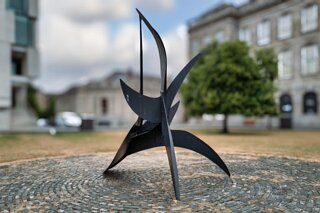
NOT A TYPICAL GENERIC RED METAL SCULPTURE
CACTUS AT TRINITY COLLEGE IN DUBLIN 27 JULY 2026 [AN EXCELLENT SCULPTURE BY ALEXANDER CALDER]
A Black Cactus on Fellows’ Square At Trinity College
In the high-energy landscape of urban public art, certain pieces command attention not through loud colours or sprawling footprints, but through pure structural presence. Positioned on the circular lawn of Fellows’ Square at Trinity College Dublin, Alexander Calder’s 1967 sculpture Cactus Provisoire stands as a masterclass in form, material, and spatial discipline.
Executed in heavy welded sheet steel and finished in a flat, light-absorbing matt black, the work provides a striking visual anchor against the board-marked concrete of Paul Koralek’s landmark Berkeley Library. Where the Brutalist library emphasises heavy horizontal weight and geometric regularity, Calder’s biomorphic silhouette reads as an organic entity frozen mid-growth. The stark monochrome finish sets it apart from the surrounding historic stone and green lawns, allowing its silhouette to sharpen under changing light conditions throughout the day.
Unlike Calder’s famed kinetic "mobiles"—suspended, delicately balanced structures that dance on ambient air currents—Cactus Provisoire belongs to his celebrated genre of "stabiles." Coined by artist Jean Arp in 1932, the term describes static, ground-anchored steel compositions. The sculpture relies on intersecting planar plates secured with heavy, visible industrial rivets. Rather than disguising the engineering, Calder celebrated the mechanical assembly, turning raw structural fasteners into an aesthetic feature. Despite remaining completely static, the composition creates dynamic movement through spatial overlap: walking around the perimeter of Fellows' Square reveals shifting negative spaces, framing distant architectural details through its steel voids.
Alexander Calder: Engineering the Static and the Kinetic
Alexander Calder (1898–1976) occupied a unique position in twentieth-century art, bridging the gap between mechanical engineering and abstract sculpture. Having trained in mechanical engineering at the Stevens Institute of Technology before studying fine art in New York and Paris, Calder brought a precise understanding of forces, balance, and material tolerances to modern sculpture.
His contributions transformed public art across several key dimensions:
Invention of the Mobile: Dubbed "mobiles" by Marcel Duchamp in 1931, these suspended works introduced real-time movement into modern art, allowing chance currents to dictate ever-shifting visual relationships.
Monumental Stabiles: Developed alongside his mobiles, Calder’s ground-based stabiles brought abstract geometry to civic plazas and academic campuses worldwide on a massive scale.
Foundry Collaboration: Calder pioneered working directly with heavy industrial ironworks, such as the Établissements Biémont in Tours, France, translating small sheet-metal maquettes into multi-ton public structures built to withstand extreme environmental wind loads.
Calder notably resisted over-analysing his own creations, famously stating that theories belong to the artist alone and need not be broadcast to the audience. He preferred to let the raw physical presence of the metal engage directly with civic space.
The Phenomenon of "Red Metal Yokes" in Public Art
In Irish colloquial speech, the word "yoke" serves as a universal shorthand for any item or object defying immediate explanation. Across towns, corporate plazas, and road bypasses throughout Ireland, a vast collection of unlabelled, bright primary-coloured steel fabrications—often referred to as "red metal yokes"—form a recurring feature of the built environment. While many of these local public pieces are untitled or blend into general street furniture, the phenomenon is part of a global mid-to-late twentieth-century trend in civic space design.
The ubiquity of these bright steel structures rests on several key historical and logistical factors:
Impact on Public Art - The Modernist Civic Trend: During the postwar development boom of the 1960s to 1980s, municipal authorities and universities sought abstract steel art to signal economic modernization and progress.
Percent for Art Procurement - State statutory rules requiring a percentage of capital building funds to go toward art led to widespread purchases from art-foundry catalogues, generating an "off-the-shelf" uniformity across regions.
The Precedent of "Calder Red" - Calder’s signature matte orange-red paint (famously used on works like Chicago's Flamingo) established primary red as the global industry standard for civic steel, providing maximum visual contrast against grey concrete.
Industrial Material Durability - Structural mild steel treated with marine-grade anti-corrosive primers and polyurethane paints offered municipal bodies low-maintenance durability within public budgets.
While generic off-the-shelf fabrications often fade into urban background noise, masterworks like Cactus Provisoire demonstrate how structural steel, when handled by a master engineer-artist, transforms an open courtyard into a lasting architectural dialogue.
A Black Cactus on Fellows’ Square At Trinity College
In the high-energy landscape of urban public art, certain pieces command attention not through loud colours or sprawling footprints, but through pure structural presence. Positioned on the circular lawn of Fellows’ Square at Trinity College Dublin, Alexander Calder’s 1967 sculpture Cactus Provisoire stands as a masterclass in form, material, and spatial discipline.
Executed in heavy welded sheet steel and finished in a flat, light-absorbing matt black, the work provides a striking visual anchor against the board-marked concrete of Paul Koralek’s landmark Berkeley Library. Where the Brutalist library emphasises heavy horizontal weight and geometric regularity, Calder’s biomorphic silhouette reads as an organic entity frozen mid-growth. The stark monochrome finish sets it apart from the surrounding historic stone and green lawns, allowing its silhouette to sharpen under changing light conditions throughout the day.
Unlike Calder’s famed kinetic "mobiles"—suspended, delicately balanced structures that dance on ambient air currents—Cactus Provisoire belongs to his celebrated genre of "stabiles." Coined by artist Jean Arp in 1932, the term describes static, ground-anchored steel compositions. The sculpture relies on intersecting planar plates secured with heavy, visible industrial rivets. Rather than disguising the engineering, Calder celebrated the mechanical assembly, turning raw structural fasteners into an aesthetic feature. Despite remaining completely static, the composition creates dynamic movement through spatial overlap: walking around the perimeter of Fellows' Square reveals shifting negative spaces, framing distant architectural details through its steel voids.
Alexander Calder: Engineering the Static and the Kinetic
Alexander Calder (1898–1976) occupied a unique position in twentieth-century art, bridging the gap between mechanical engineering and abstract sculpture. Having trained in mechanical engineering at the Stevens Institute of Technology before studying fine art in New York and Paris, Calder brought a precise understanding of forces, balance, and material tolerances to modern sculpture.
His contributions transformed public art across several key dimensions:
Invention of the Mobile: Dubbed "mobiles" by Marcel Duchamp in 1931, these suspended works introduced real-time movement into modern art, allowing chance currents to dictate ever-shifting visual relationships.
Monumental Stabiles: Developed alongside his mobiles, Calder’s ground-based stabiles brought abstract geometry to civic plazas and academic campuses worldwide on a massive scale.
Foundry Collaboration: Calder pioneered working directly with heavy industrial ironworks, such as the Établissements Biémont in Tours, France, translating small sheet-metal maquettes into multi-ton public structures built to withstand extreme environmental wind loads.
Calder notably resisted over-analysing his own creations, famously stating that theories belong to the artist alone and need not be broadcast to the audience. He preferred to let the raw physical presence of the metal engage directly with civic space.
The Phenomenon of "Red Metal Yokes" in Public Art
In Irish colloquial speech, the word "yoke" serves as a universal shorthand for any item or object defying immediate explanation. Across towns, corporate plazas, and road bypasses throughout Ireland, a vast collection of unlabelled, bright primary-coloured steel fabrications—often referred to as "red metal yokes"—form a recurring feature of the built environment. While many of these local public pieces are untitled or blend into general street furniture, the phenomenon is part of a global mid-to-late twentieth-century trend in civic space design.
The ubiquity of these bright steel structures rests on several key historical and logistical factors:
Impact on Public Art - The Modernist Civic Trend: During the postwar development boom of the 1960s to 1980s, municipal authorities and universities sought abstract steel art to signal economic modernization and progress.
Percent for Art Procurement - State statutory rules requiring a percentage of capital building funds to go toward art led to widespread purchases from art-foundry catalogues, generating an "off-the-shelf" uniformity across regions.
The Precedent of "Calder Red" - Calder’s signature matte orange-red paint (famously used on works like Chicago's Flamingo) established primary red as the global industry standard for civic steel, providing maximum visual contrast against grey concrete.
Industrial Material Durability - Structural mild steel treated with marine-grade anti-corrosive primers and polyurethane paints offered municipal bodies low-maintenance durability within public budgets.
While generic off-the-shelf fabrications often fade into urban background noise, masterworks like Cactus Provisoire demonstrate how structural steel, when handled by a master engineer-artist, transforms an open courtyard into a lasting architectural dialogue.
CACTUS AT TRINITY COLLEGE IN DUBLIN