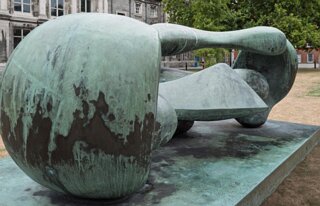
RECLINING AND CONNECTED FORMS BY HENRY MOORE
Reclining and Connected Forms by Henry Moore - Trinity College Dublin
The last time I photographed this piece, I used a Sony FX30 paired with a Sony 18–105mm lens; today, I captured it using a Leica Q3.
For some strange reason, this sculpture appears to be largely ignored by visitors and tourists—the same crowds who obsessively photograph almost everything else on campus bypass this astonishingly complex work. Today, however, I did overhear a few passers-by refer to it as "obscene."
While that comment might sound surprising today, reactions of discomfort or moral outrage toward Henry Moore's art are far from new. Throughout his career, Moore’s abstract, organic interpretations of the human form—characterized by undulating contours, pierced cavities, and suggestive curves—frequently provoked strong reactions from traditionalists who found his sensual, hollowed-out figures unsettling or even vulgar. What some view as a graceful dialogue between geometry and the human body, others still perceive through a lens of visual awkwardness or anatomical impropriety.
The Journey to Library Square
The presence of Reclining Connected Forms at Trinity College Dublin came after a prolonged search for the right artistic fit:
The King and Queen: Years ago, Henry Moore generously loaned a sculpture known as The King and Queen, which was placed on the Library forecourt. However, Moore was dissatisfied with the setting—feeling the piece conflicted with the forecourt lanterns and suffered from a lack of sunlight on the north-facing site—and requested its return.
The Pomodoro Replacement: Trinity worked persistently to find a suitable replacement. They eventually selected Arnaldo Pomodoro’s Sphere Within Sphere, which now stands permanently on the forecourt and feels as though it were custom-made for the location—a perfect outcome.
A Permanent Home: Trinity ultimately secured another work by Moore, agreeing on a site in Library Square where Reclining Connected Forms has proudly remained ever since.
About the Artist
Henry Spencer Moore OM CH FBA (30 July 1898 – 31 August 1986) was an acclaimed English artist, world-renowned for his semi-abstract monumental bronze sculptures installed in public spaces globally. Alongside his sculpture, Moore produced extensive graphic works, including a famous series of drawings depicting Londoners sheltering in the Underground during the Blitz.
Moore’s forms are typically abstractions of the human figure, most notably reclining figures and mother-and-child motifs. Aside from a phase in the 1950s focused on family groups, his works are heavily suggestive of the female form, often pierced or containing hollow spaces. Many art historians liken the undulating contours of his figures to the rolling hills and landscape of his native Yorkshire.
Instrumental in introducing a distinct form of modernism to the United Kingdom, Moore achieved immense international recognition. His ability to fulfil large-scale commissions made him exceptionally wealthy in later life, yet he maintained a frugal lifestyle—directing the majority of his earnings into endowing the Henry Moore Foundation, which continues to support arts education and promotion today.
The last time I photographed this piece, I used a Sony FX30 paired with a Sony 18–105mm lens; today, I captured it using a Leica Q3.
For some strange reason, this sculpture appears to be largely ignored by visitors and tourists—the same crowds who obsessively photograph almost everything else on campus bypass this astonishingly complex work. Today, however, I did overhear a few passers-by refer to it as "obscene."
While that comment might sound surprising today, reactions of discomfort or moral outrage toward Henry Moore's art are far from new. Throughout his career, Moore’s abstract, organic interpretations of the human form—characterized by undulating contours, pierced cavities, and suggestive curves—frequently provoked strong reactions from traditionalists who found his sensual, hollowed-out figures unsettling or even vulgar. What some view as a graceful dialogue between geometry and the human body, others still perceive through a lens of visual awkwardness or anatomical impropriety.
The Journey to Library Square
The presence of Reclining Connected Forms at Trinity College Dublin came after a prolonged search for the right artistic fit:
The King and Queen: Years ago, Henry Moore generously loaned a sculpture known as The King and Queen, which was placed on the Library forecourt. However, Moore was dissatisfied with the setting—feeling the piece conflicted with the forecourt lanterns and suffered from a lack of sunlight on the north-facing site—and requested its return.
The Pomodoro Replacement: Trinity worked persistently to find a suitable replacement. They eventually selected Arnaldo Pomodoro’s Sphere Within Sphere, which now stands permanently on the forecourt and feels as though it were custom-made for the location—a perfect outcome.
A Permanent Home: Trinity ultimately secured another work by Moore, agreeing on a site in Library Square where Reclining Connected Forms has proudly remained ever since.
About the Artist
Henry Spencer Moore OM CH FBA (30 July 1898 – 31 August 1986) was an acclaimed English artist, world-renowned for his semi-abstract monumental bronze sculptures installed in public spaces globally. Alongside his sculpture, Moore produced extensive graphic works, including a famous series of drawings depicting Londoners sheltering in the Underground during the Blitz.
Moore’s forms are typically abstractions of the human figure, most notably reclining figures and mother-and-child motifs. Aside from a phase in the 1950s focused on family groups, his works are heavily suggestive of the female form, often pierced or containing hollow spaces. Many art historians liken the undulating contours of his figures to the rolling hills and landscape of his native Yorkshire.
Instrumental in introducing a distinct form of modernism to the United Kingdom, Moore achieved immense international recognition. His ability to fulfil large-scale commissions made him exceptionally wealthy in later life, yet he maintained a frugal lifestyle—directing the majority of his earnings into endowing the Henry Moore Foundation, which continues to support arts education and promotion today.
SCULPTURE BY HENRY MOORE