WHY IS IT KNOWN AS THE MAD MILKMAN
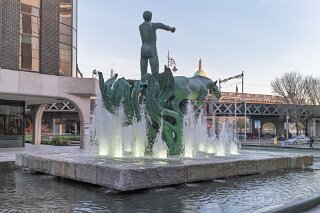
THE MAD MILKMAN IN ALL HIS GLORY [THE CHARIOT OF LIFE BY OISIN KELLY]
The Chariot of Life: A Dublin Icon
"The Chariot of Life" is a monumental piece of public art situated on the central plaza of the Irish Life Centre on Lower Abbey Street, Dublin. Unveiled in 1982, this striking copper-bronze sculpture dominates the open space, serving as a dramatic focal point amidst the surrounding modern architecture.
Artistic Vision and Symbolism
Created by the renowned Irish sculptor Oisín Kelly, the artwork is much more than a simple depiction of a chariot race. It is a visual representation of a philosophical concept, often attributed to Plato’s "Chariot Allegory" from the Phaedrus.
The Charioteer: Represents the human soul or Reason. He is depicted leaning back, straining to maintain control.
The Horses: Represent the dual nature of human Emotions and Passions. The horses are rearing up, wild and powerful, symbolizing the difficulty of keeping one's impulses in check.
The sculpture suggests that a successful life—and by extension, a successful society—requires the mastery of reason over emotion.
Construction and Legacy
The piece is significant in the timeline of Irish art history as it was one of Oisín Kelly’s final major works. Sadly, Kelly passed away in 1981, a year before the sculpture was officially unveiled, making it a posthumous legacy to the city. The sculpture is constructed from sheets of copper, giving it a distinctive texture and a dark, burnished finish that contrasts with the grey stone of the plaza.
The Story Behind the Nickname: "The Mad Milkman"
Despite its high-minded philosophical origins, Dubliners—famous for their irreverent wit and habit of rhyming slang—quickly christened the piece "The Mad Milkman."
This nickname was inspired by the visual similarity between the charioteer’s box-like carriage and the traditional horse-drawn milk carts that were once a staple of Dublin streets. The association was incredibly timely: the last horse-drawn milk delivery service in Dublin (operated by Premier Dairies) had only ceased operations in 1978, just four years before the statue was unveiled.
With the memory of those carts still fresh in the local psyche, the sight of a figure leaning back frantically while his horses reared up did not look like a Greek philosopher; it looked like a milkman whose morning delivery run had gone spectacularly and chaotically wrong.
The Chariot of Life: A Dublin Icon
"The Chariot of Life" is a monumental piece of public art situated on the central plaza of the Irish Life Centre on Lower Abbey Street, Dublin. Unveiled in 1982, this striking copper-bronze sculpture dominates the open space, serving as a dramatic focal point amidst the surrounding modern architecture.
Artistic Vision and Symbolism
Created by the renowned Irish sculptor Oisín Kelly, the artwork is much more than a simple depiction of a chariot race. It is a visual representation of a philosophical concept, often attributed to Plato’s "Chariot Allegory" from the Phaedrus.
The Charioteer: Represents the human soul or Reason. He is depicted leaning back, straining to maintain control.
The Horses: Represent the dual nature of human Emotions and Passions. The horses are rearing up, wild and powerful, symbolizing the difficulty of keeping one's impulses in check.
The sculpture suggests that a successful life—and by extension, a successful society—requires the mastery of reason over emotion.
Construction and Legacy
The piece is significant in the timeline of Irish art history as it was one of Oisín Kelly’s final major works. Sadly, Kelly passed away in 1981, a year before the sculpture was officially unveiled, making it a posthumous legacy to the city. The sculpture is constructed from sheets of copper, giving it a distinctive texture and a dark, burnished finish that contrasts with the grey stone of the plaza.
The Story Behind the Nickname: "The Mad Milkman"
Despite its high-minded philosophical origins, Dubliners—famous for their irreverent wit and habit of rhyming slang—quickly christened the piece "The Mad Milkman."
This nickname was inspired by the visual similarity between the charioteer’s box-like carriage and the traditional horse-drawn milk carts that were once a staple of Dublin streets. The association was incredibly timely: the last horse-drawn milk delivery service in Dublin (operated by Premier Dairies) had only ceased operations in 1978, just four years before the statue was unveiled.
With the memory of those carts still fresh in the local psyche, the sight of a figure leaning back frantically while his horses reared up did not look like a Greek philosopher; it looked like a milkman whose morning delivery run had gone spectacularly and chaotically wrong.
THE MAD MILKMAN