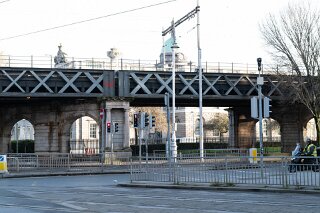
LOWER ABBEY STREET IN LATE NOVEMBER 2025
A WALK ALONG LOWER ABBEY STREET [LATE NOVEMBER 2025]
Lower Abbey Street is one of Dublin's most historically and culturally significant thoroughfares, yet it is often defined today by its duality: it is both a center of high art and history, and a gritty, bustling transit hub.
Located in Dublin 1 on the Northside, the street runs east from O'Connell Street towards the Custom House and Beresford Place. It is distinct from Middle and Upper Abbey Street, which lie to the west of O'Connell Street.
Here is a discussion of the street broken down by its key aspects:
1. The Cultural Anchor: The Abbey Theatre
The street is most famous for housing The Abbey Theatre (26/27 Lower Abbey Street), the National Theatre of Ireland.
Significance: Founded by W.B. Yeats and Lady Gregory in 1904, it was the cradle of the Irish Literary Revival. The original building was destroyed by fire in 1951, and the current modern brick building opened in 1966.
Current Status: It remains the premier destination for Irish drama. The "Peacock Theatre," a smaller experimental studio, is located in the basement.
2. Historic Hospitality
Despite the modern hustle, the street retains some "old Dublin" charm through its key hospitality venues:
Wynn’s Hotel: Located near the O'Connell Street junction, this is one of Dublin's most historic hotels. It is famous for its connections to the 1916 Rising (it was destroyed and rebuilt) and for being a meeting place for the founders of the Irish Volunteers. It retains a Victorian, traditional feel that contrasts with the fast-food outlets nearby.
The Flowing Tide: Located at the corner of Marlborough Street, this is a classic "theatrical pub" frequented by actors, playwrights, and audiences from the Abbey Theatre across the road. It has resisted modernization better than many other city center pubs.
The Silver Penny: A relatively recent addition (opened by JD Wetherspoon), this pub is housed in a stunning converted building that was formerly a bank and a chapel. It provides a rare glimpse into the street's architectural heritage, featuring high ceilings and preserved stonework.
3. Architecture and Atmosphere
The Look: The street is dominated by the Luas Red Line tracks running down its center, which brings constant noise and movement.
Architectural Mix: You will notice a clash of styles. The western end (near O'Connell St) features red-brick buildings reconstructed after the 1916 Rising. As you move east, the streetscape becomes dominated by the Irish Life Centre, a large, modernist office and retail complex with a brick plaza that often feels quieter and more sterile than the rest of the street.
The "Gritty" Reality: It is important to note that Lower Abbey Street has a reputation for being somewhat "rough around the edges." As a major transit artery with high footfall, it often struggles with issues visible in many city centers, such as loitering and anti-social behavior, particularly near the Luas stops and the boardwalk entrance.
4. Commercial & Transit
Transport Hub: The street is a vital artery for public transport. The Abbey Street Luas stop is one of the busiest on the network, connecting the Red Line (Tallaght/Saggart to the Point) to the city center.
Retail: The retail mix is largely functional, catering to commuters. You will find convenience stores (Spar), newsagents like the long-standing Reynolds Newsagents (known for tobacco and pipes), and discount stores alongside the cultural landmarks.
Summary for the Visitor
If you are visiting, Lower Abbey Street is essential for a trip to the Abbey Theatre or a pint in The Flowing Tide to soak up literary history. However, it is generally not a street for leisurely strolling or window shopping in the same way Grafton Street is; it is a place of transit, history, and stark contrasts.
Lower Abbey Street is one of Dublin's most historically and culturally significant thoroughfares, yet it is often defined today by its duality: it is both a center of high art and history, and a gritty, bustling transit hub.
Located in Dublin 1 on the Northside, the street runs east from O'Connell Street towards the Custom House and Beresford Place. It is distinct from Middle and Upper Abbey Street, which lie to the west of O'Connell Street.
Here is a discussion of the street broken down by its key aspects:
1. The Cultural Anchor: The Abbey Theatre
The street is most famous for housing The Abbey Theatre (26/27 Lower Abbey Street), the National Theatre of Ireland.
Significance: Founded by W.B. Yeats and Lady Gregory in 1904, it was the cradle of the Irish Literary Revival. The original building was destroyed by fire in 1951, and the current modern brick building opened in 1966.
Current Status: It remains the premier destination for Irish drama. The "Peacock Theatre," a smaller experimental studio, is located in the basement.
2. Historic Hospitality
Despite the modern hustle, the street retains some "old Dublin" charm through its key hospitality venues:
Wynn’s Hotel: Located near the O'Connell Street junction, this is one of Dublin's most historic hotels. It is famous for its connections to the 1916 Rising (it was destroyed and rebuilt) and for being a meeting place for the founders of the Irish Volunteers. It retains a Victorian, traditional feel that contrasts with the fast-food outlets nearby.
The Flowing Tide: Located at the corner of Marlborough Street, this is a classic "theatrical pub" frequented by actors, playwrights, and audiences from the Abbey Theatre across the road. It has resisted modernization better than many other city center pubs.
The Silver Penny: A relatively recent addition (opened by JD Wetherspoon), this pub is housed in a stunning converted building that was formerly a bank and a chapel. It provides a rare glimpse into the street's architectural heritage, featuring high ceilings and preserved stonework.
3. Architecture and Atmosphere
The Look: The street is dominated by the Luas Red Line tracks running down its center, which brings constant noise and movement.
Architectural Mix: You will notice a clash of styles. The western end (near O'Connell St) features red-brick buildings reconstructed after the 1916 Rising. As you move east, the streetscape becomes dominated by the Irish Life Centre, a large, modernist office and retail complex with a brick plaza that often feels quieter and more sterile than the rest of the street.
The "Gritty" Reality: It is important to note that Lower Abbey Street has a reputation for being somewhat "rough around the edges." As a major transit artery with high footfall, it often struggles with issues visible in many city centers, such as loitering and anti-social behavior, particularly near the Luas stops and the boardwalk entrance.
4. Commercial & Transit
Transport Hub: The street is a vital artery for public transport. The Abbey Street Luas stop is one of the busiest on the network, connecting the Red Line (Tallaght/Saggart to the Point) to the city center.
Retail: The retail mix is largely functional, catering to commuters. You will find convenience stores (Spar), newsagents like the long-standing Reynolds Newsagents (known for tobacco and pipes), and discount stores alongside the cultural landmarks.
Summary for the Visitor
If you are visiting, Lower Abbey Street is essential for a trip to the Abbey Theatre or a pint in The Flowing Tide to soak up literary history. However, it is generally not a street for leisurely strolling or window shopping in the same way Grafton Street is; it is a place of transit, history, and stark contrasts.
LOWER ABBEY STREET