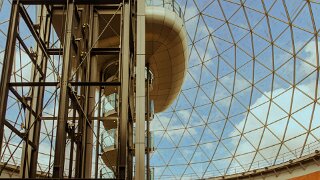
VICTORIA SQUARE SHOPPING CENTRE
THE GREAT 2012 SONY SHORTAGE - BUYING A CAMCORDER TO GET THE NECESSARY LENS [VICTORIA SQUARE SHOPPING CENTRE BELFAST]
Title: The Great 2012 Gear Shortage: Buying a Camcorder Just to Get a Lens
Sometimes, the story behind how we acquire a piece of gear is just as interesting as the photos we take with it.
Recently, I was looking back at the metadata of some photos taken during a trip to Belfast in May 2012. The images captured the stunning architecture of the city, specifically the Victoria Square Shopping Centre. However, I was surprised to be reminded that I wasn’t using a standard camera for these shots.
I was shooting with a Sony VG10E, a dedicated interchangeable lens camcorder, fitted with the massive silver Sony E 18-200mm F3.5-6.3 OSS lens.
Seeing that specific combination brought back memories of a unique moment in camera history—a time of transition, frustration, and expensive workarounds.
The Subject: Victoria Square, Belfast
The resulting photos were excellent, and looking at the subject matter, I can see why that lens was the perfect tool for the job.
Victoria Square, which opened in March 2008, is a masterpiece of urban regeneration. It blends the city’s history with modern "open street" design, protecting shoppers from the elements while maintaining a connection to the city's fabric. One minute you are looking at the historic Jaffe Fountain (restored from 1874), and the next you are standing under its standout feature: a massive glass dome measuring 37 meters in diameter.
The dome serves as a viewing gallery, offering 360-degree panoramic views of the skyline, including the famous Harland & Wolff cranes. To capture both the interior geometry of the dome and the distant city details, I needed a versatile super-zoom. But in early 2012, getting my hands on one was nearly impossible.
The Mirrorless Migration and the Flood
Back then, I was in the middle of a major shift, migrating from a bulky Canon DSLR system to the emerging world of Sony Mirrorless. The camera I really wanted—and had already purchased the body for—was the Sony NEX-7. It was a sleek, 24-megapixel powerhouse that cost about €1,200 and promised DSLR quality in a tiny package.
However, there was a massive logistical problem. Devastating floods in Thailand in late 2011 had crippled Sony’s manufacturing facilities. While camera bodies were trickling out, lenses were almost non-existent. The standalone E 18-200mm lens (which usually sold for around €750-€800) was sold out globally, with waiting lists stretching into months.
The €2,000 Solution
A few days before my trip to Belfast, my dealer phoned with an unusual proposition. They still didn't have the standalone lens, but they did have a Sony VG10E camcorder in stock.
The VG10E was a unique beast—the first consumer camcorder to use the large APS-C sensor from stills cameras. Crucially, it shipped as a kit. The dealer confirmed that the camcorder came with the coveted Sony E 18-200mm lens right in the box.
The price for the kit was €2,000.
It was a steep price to pay when I primarily wanted the glass, but given the shortages, it was the only way to get it in time for my trip. I bought the kit, took the lens out for my NEX-7, and ended up with a high-end camcorder as a bonus.
A Look Back at the Gear
In hindsight, the VG10E was an underrated tool for photography. While it was built for video, it was capable of capturing stills. I still own that camcorder today, and it continues to work very well. Although it is limited to shooting stills in JPG format only (no RAW), the image quality is genuinely excellent, even by modern standards.
And then there was that lens. The original silver 18-200mm was a tank—big, heavy, and metal. While optical compromises are usually made for such a massive focal range, it was surprisingly sharp. Its real superpower, however, was the "Active" Optical SteadyShot. Designed for video, it smoothed out walking motion almost like a gimbal, making it the perfect companion for the VG10E.
Regrets and Modern Equivalents
As the years passed, I transitioned from the APS-C E-mount system to the Full Frame "FE" system. In that process, I made a mistake many photographers recognize: I gave that original silver 18-200mm lens to a friend.
I deeply regret doing so. Even on modern high-resolution bodies, having that incredible range in a single lens is invaluable for travel.
Recently, I noticed that a Sony E 18-200mm F3.5-6.3 OSS LE lens is retailing locally for about €689. However, this new version is black, not silver. It begs the question: Is it the same lens I used to own?
The answer, unfortunately, is no.
The lens I acquired with the VG10E was the original model (SEL18200). The one currently available in black is the "LE" or "Light Edition" (SEL18200LE). While the specifications look similar, the LE version is actually a rebadged Tamron design. It is significantly lighter and smaller than my old silver tank, which is a plus for portability, but many reviews suggest that the "Active" image stabilization for video is not quite as robust as the system in the original silver version.
It just goes to show that sometimes the older, heavier glass holds a unique value that newer versions can't quite replicate. If you still have your original silver 18-200mm, hold onto it tight!
Title: The Great 2012 Gear Shortage: Buying a Camcorder Just to Get a Lens
Sometimes, the story behind how we acquire a piece of gear is just as interesting as the photos we take with it.
Recently, I was looking back at the metadata of some photos taken during a trip to Belfast in May 2012. The images captured the stunning architecture of the city, specifically the Victoria Square Shopping Centre. However, I was surprised to be reminded that I wasn’t using a standard camera for these shots.
I was shooting with a Sony VG10E, a dedicated interchangeable lens camcorder, fitted with the massive silver Sony E 18-200mm F3.5-6.3 OSS lens.
Seeing that specific combination brought back memories of a unique moment in camera history—a time of transition, frustration, and expensive workarounds.
The Subject: Victoria Square, Belfast
The resulting photos were excellent, and looking at the subject matter, I can see why that lens was the perfect tool for the job.
Victoria Square, which opened in March 2008, is a masterpiece of urban regeneration. It blends the city’s history with modern "open street" design, protecting shoppers from the elements while maintaining a connection to the city's fabric. One minute you are looking at the historic Jaffe Fountain (restored from 1874), and the next you are standing under its standout feature: a massive glass dome measuring 37 meters in diameter.
The dome serves as a viewing gallery, offering 360-degree panoramic views of the skyline, including the famous Harland & Wolff cranes. To capture both the interior geometry of the dome and the distant city details, I needed a versatile super-zoom. But in early 2012, getting my hands on one was nearly impossible.
The Mirrorless Migration and the Flood
Back then, I was in the middle of a major shift, migrating from a bulky Canon DSLR system to the emerging world of Sony Mirrorless. The camera I really wanted—and had already purchased the body for—was the Sony NEX-7. It was a sleek, 24-megapixel powerhouse that cost about €1,200 and promised DSLR quality in a tiny package.
However, there was a massive logistical problem. Devastating floods in Thailand in late 2011 had crippled Sony’s manufacturing facilities. While camera bodies were trickling out, lenses were almost non-existent. The standalone E 18-200mm lens (which usually sold for around €750-€800) was sold out globally, with waiting lists stretching into months.
The €2,000 Solution
A few days before my trip to Belfast, my dealer phoned with an unusual proposition. They still didn't have the standalone lens, but they did have a Sony VG10E camcorder in stock.
The VG10E was a unique beast—the first consumer camcorder to use the large APS-C sensor from stills cameras. Crucially, it shipped as a kit. The dealer confirmed that the camcorder came with the coveted Sony E 18-200mm lens right in the box.
The price for the kit was €2,000.
It was a steep price to pay when I primarily wanted the glass, but given the shortages, it was the only way to get it in time for my trip. I bought the kit, took the lens out for my NEX-7, and ended up with a high-end camcorder as a bonus.
A Look Back at the Gear
In hindsight, the VG10E was an underrated tool for photography. While it was built for video, it was capable of capturing stills. I still own that camcorder today, and it continues to work very well. Although it is limited to shooting stills in JPG format only (no RAW), the image quality is genuinely excellent, even by modern standards.
And then there was that lens. The original silver 18-200mm was a tank—big, heavy, and metal. While optical compromises are usually made for such a massive focal range, it was surprisingly sharp. Its real superpower, however, was the "Active" Optical SteadyShot. Designed for video, it smoothed out walking motion almost like a gimbal, making it the perfect companion for the VG10E.
Regrets and Modern Equivalents
As the years passed, I transitioned from the APS-C E-mount system to the Full Frame "FE" system. In that process, I made a mistake many photographers recognize: I gave that original silver 18-200mm lens to a friend.
I deeply regret doing so. Even on modern high-resolution bodies, having that incredible range in a single lens is invaluable for travel.
Recently, I noticed that a Sony E 18-200mm F3.5-6.3 OSS LE lens is retailing locally for about €689. However, this new version is black, not silver. It begs the question: Is it the same lens I used to own?
The answer, unfortunately, is no.
The lens I acquired with the VG10E was the original model (SEL18200). The one currently available in black is the "LE" or "Light Edition" (SEL18200LE). While the specifications look similar, the LE version is actually a rebadged Tamron design. It is significantly lighter and smaller than my old silver tank, which is a plus for portability, but many reviews suggest that the "Active" image stabilization for video is not quite as robust as the system in the original silver version.
It just goes to show that sometimes the older, heavier glass holds a unique value that newer versions can't quite replicate. If you still have your original silver 18-200mm, hold onto it tight!
VICTORIA SQUARE SHOPPING CENTRE