THE ART AND THE ARTIST
RESTLESS LIFFEY LOVE BY RHONA BYRNE [DUBLIN NORTH WALL 29 NOVEMBER 2025]
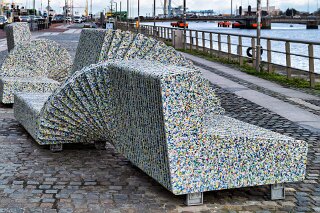
RESTLESS: Liffey Love is a significant public art installation by Irish artist Rhona Byrne, unveiled in September 2024. It stands as both a functional social space and a commentary on urban sustainability.
The artwork consists of two large, brightly coloured "love seats" that act as social sculptures. Their design and composition are deeply symbolic:
Material: The sculptures are fabricated entirely from waste plastic salvaged directly from the River Liffey. Over a period of eight months, the "Liffey Sweeper" (an environmental vessel operated by the Irish Nautical Trust) collected discarded plastic, which was then processed and engineered into a durable polymer material.
Form: The seats feature a modular, wave-like design that mimics the movement of water and the wake of boats. They are tactile and designed to invite physical interaction—visitors are encouraged to sit, perch, or lounge on them.
Concept: The title "Restless" reflects the anxiety of a changing climate and the "restless" urge to take action, while "Liffey Love" posits care for the environment as an act of civic love. It transforms a negative byproduct of the city (pollution) into a positive social amenity.
Relevance of the Location (North Wall Quay)
The location on the North Wall Quay Campshires (the stretch of pavement between the road and the river wall) is crucial to the artwork's meaning for several reasons:
Source to Site: The most direct relevance is that the sculpture sits beside the very body of water from which its materials were rescued. It creates a closed loop—returning the "waste" to the riverbank not as trash, but as a valuable object of beauty.
Industrial Heritage: The North Wall was historically a hub of shipping, industry, and goods transport. Placing a sculpture made of processed industrial materials here nods to the area's history of manufacturing and trade, but updates it for a modern era focused on the "circular economy" rather than extraction.
Confluence Views: The specific siting faces south toward the confluence of the River Dodder and the Liffey. This is a meeting point of waters, mirroring the sculpture's purpose as a meeting point for people.
Regeneration: The Dublin Docklands is an area of massive urban regeneration. Placing "social furniture" here softens the hard landscaping of the financial district, attempting to reclaim the quayside as a place for community connection rather than just commerce.
RESTLESS: Liffey Love is a significant public art installation by Irish artist Rhona Byrne, unveiled in September 2024. It stands as both a functional social space and a commentary on urban sustainability.
The artwork consists of two large, brightly coloured "love seats" that act as social sculptures. Their design and composition are deeply symbolic:
Material: The sculptures are fabricated entirely from waste plastic salvaged directly from the River Liffey. Over a period of eight months, the "Liffey Sweeper" (an environmental vessel operated by the Irish Nautical Trust) collected discarded plastic, which was then processed and engineered into a durable polymer material.
Form: The seats feature a modular, wave-like design that mimics the movement of water and the wake of boats. They are tactile and designed to invite physical interaction—visitors are encouraged to sit, perch, or lounge on them.
Concept: The title "Restless" reflects the anxiety of a changing climate and the "restless" urge to take action, while "Liffey Love" posits care for the environment as an act of civic love. It transforms a negative byproduct of the city (pollution) into a positive social amenity.
Relevance of the Location (North Wall Quay)
The location on the North Wall Quay Campshires (the stretch of pavement between the road and the river wall) is crucial to the artwork's meaning for several reasons:
Source to Site: The most direct relevance is that the sculpture sits beside the very body of water from which its materials were rescued. It creates a closed loop—returning the "waste" to the riverbank not as trash, but as a valuable object of beauty.
Industrial Heritage: The North Wall was historically a hub of shipping, industry, and goods transport. Placing a sculpture made of processed industrial materials here nods to the area's history of manufacturing and trade, but updates it for a modern era focused on the "circular economy" rather than extraction.
Confluence Views: The specific siting faces south toward the confluence of the River Dodder and the Liffey. This is a meeting point of waters, mirroring the sculpture's purpose as a meeting point for people.
Regeneration: The Dublin Docklands is an area of massive urban regeneration. Placing "social furniture" here softens the hard landscaping of the financial district, attempting to reclaim the quayside as a place for community connection rather than just commerce.
LIFFEY LOVE SCULPTURE