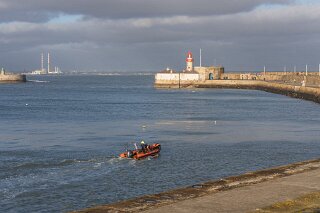
EAST PIER LIGHTHOUSE IN DUN LAOGHAIRE
A Beacon with a Bang: The Hidden History of Dún Laoghaire’s East Pier Lighthouse
If you have ever taken a stroll down the East Pier in Dún Laoghaire, you know the routine: you battle the wind, admire the yachts, and perhaps reward yourself with a Teddy’s ice cream. But when you finally reach the end of that mile-long granite arm, have you ever looked closely at the lighthouse?
Nestled at the pier head isn't just a navigational aid; it is a fortified battery. To the surprise of many first-time visitors, this beacon of safety is still flanked by guns.
A Guiding Light
The lighthouse itself is a quintessential piece of Irish maritime engineering. Designed by George Halpin, the Chief Engineer of the Ballast Board, it was established on 1st October 1847.
Its purpose was vital. Dún Laoghaire (then Kingstown) was constructed as an "Asylum Harbour"—a safe refuge for ships trying to escape the treacherous sandbars of Dublin Bay during storms. The lighthouse was the final signal that a vessel had reached safety.
Originally standing 41 feet above the high-water mark, the tower was actually heightened by another 12 feet in the 1890s. The Commissioners of Irish Lights needed to improve its range to ensure the beam could reach the Mugglins rocks near Dalkey, preventing further shipwrecks.
The Guns at the End of the Pier
While the lighthouse guided friends in, the battery was built to keep enemies out. The fortification surrounding the lighthouse was known as Kingstown Fort.
Constructed in the mid-19th century, during a time of anxiety over potential French invasion, the battery was designed to defend the mouth of the harbour. It was originally armed with heavy 68-pounder and 32-pounder guns, capable of crippling enemy ships. Fortunately, the guns were never fired in anger; the fort’s military service was entirely peaceful.
Today, the site remains one of the most unique spots in Ireland. It serves as a gun saluting station—one of only two in the entire Republic of Ireland (the other being Spike Island in Cork).
The guns you see there now are QF 12-pounders. They are not there to ward off invaders, but to offer a thunderous welcome. They are used for ceremonial 21-gun salutes for visiting naval vessels and foreign dignitaries. If you are lucky enough to be on the pier when a foreign warship visits Dublin, you might just catch the impressive spectacle of the Irish Defence Forces manning the battery to exchange salutes.
A Walk Through History
There is also a second piece of artillery history on the East Pier, separate from the lighthouse battery. Not far down down the pier, in the gardens, sits a Russian 24-pounder cannon. This is a "trophy gun" captured during the Crimean War (specifically the Siege of Sevastopol) and brought back to Ireland in 1857.
So, the next time you walk the East Pier, take a moment at the end. You are standing on a unique intersection of history: a place designed to save lives with its light, and defend them with its might.
If you have ever taken a stroll down the East Pier in Dún Laoghaire, you know the routine: you battle the wind, admire the yachts, and perhaps reward yourself with a Teddy’s ice cream. But when you finally reach the end of that mile-long granite arm, have you ever looked closely at the lighthouse?
Nestled at the pier head isn't just a navigational aid; it is a fortified battery. To the surprise of many first-time visitors, this beacon of safety is still flanked by guns.
A Guiding Light
The lighthouse itself is a quintessential piece of Irish maritime engineering. Designed by George Halpin, the Chief Engineer of the Ballast Board, it was established on 1st October 1847.
Its purpose was vital. Dún Laoghaire (then Kingstown) was constructed as an "Asylum Harbour"—a safe refuge for ships trying to escape the treacherous sandbars of Dublin Bay during storms. The lighthouse was the final signal that a vessel had reached safety.
Originally standing 41 feet above the high-water mark, the tower was actually heightened by another 12 feet in the 1890s. The Commissioners of Irish Lights needed to improve its range to ensure the beam could reach the Mugglins rocks near Dalkey, preventing further shipwrecks.
The Guns at the End of the Pier
While the lighthouse guided friends in, the battery was built to keep enemies out. The fortification surrounding the lighthouse was known as Kingstown Fort.
Constructed in the mid-19th century, during a time of anxiety over potential French invasion, the battery was designed to defend the mouth of the harbour. It was originally armed with heavy 68-pounder and 32-pounder guns, capable of crippling enemy ships. Fortunately, the guns were never fired in anger; the fort’s military service was entirely peaceful.
Today, the site remains one of the most unique spots in Ireland. It serves as a gun saluting station—one of only two in the entire Republic of Ireland (the other being Spike Island in Cork).
The guns you see there now are QF 12-pounders. They are not there to ward off invaders, but to offer a thunderous welcome. They are used for ceremonial 21-gun salutes for visiting naval vessels and foreign dignitaries. If you are lucky enough to be on the pier when a foreign warship visits Dublin, you might just catch the impressive spectacle of the Irish Defence Forces manning the battery to exchange salutes.
A Walk Through History
There is also a second piece of artillery history on the East Pier, separate from the lighthouse battery. Not far down down the pier, in the gardens, sits a Russian 24-pounder cannon. This is a "trophy gun" captured during the Crimean War (specifically the Siege of Sevastopol) and brought back to Ireland in 1857.
So, the next time you walk the East Pier, take a moment at the end. You are standing on a unique intersection of history: a place designed to save lives with its light, and defend them with its might.
THE EAST PIER LIGHTHOUSE