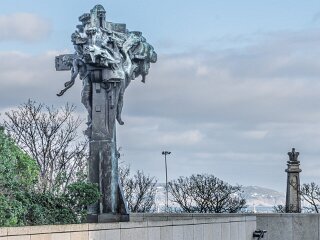
CHRIST THE KING IS LOCATED IN FRONT OF THE ROYAL MARINE HOTEL
The Hidden History of Dún Laoghaire’s "Triple Cross": The Journey of Christ the King
If you have walked through Moran Park in Dún Laoghaire recently, you likely noticed the striking, bronze monument standing guard near the contemporary architecture of the dlr LexIcon library. This is the Christ the King statue—or the "Triple Cross"—a sculpture with a backstory as dramatic and complex as the figure it depicts.
While it now stands proudly in the centre of town, this monument spent decades in exile, hidden in a suburban back garden due to a clash between artistic modernism and conservative clerical authority.
A Vision in Bronze (1925–1931)
The statue was the creation of the celebrated American-Irish sculptor Andrew O’Connor (1874–1941). Born in Massachusetts to a family of stonecutters, O'Connor became a distinguished artist in Paris and London. In 1925, he designed this piece, originally titled the Triple Cross, which was exhibited to acclaim at the 1926 Paris Salon.
The design is unique and iconographically complex. It does not depict a single moment but rather three distinct aspects of Christ’s life woven into one "Tree of Life":
Desolation: The suffering Christ on the cross.
Consolation: The resurrected Christ with arms outstretched to comfort humanity.
Triumph: Christ the King in majesty, emerging from the tomb.
In 1931, a local committee of clerical and lay members was founded in Dún Laoghaire to select a monument for the Feast of Christ the King. They chose O’Connor’s bold design and began fundraising to have it cast in bronze in France.
War and Rejection (1939–1951)
History intervened in the statue’s journey. Cast in Paris during the early 1930s, the monument was stranded in France by the outbreak of the Second World War. To protect the valuable bronze from being melted down for munitions, it was hidden in Paris for the duration of the conflict.
It finally arrived in Ireland in 1949, but its troubles were far from over. The statue immediately divided opinion. Its modernist style and unconventional "triple" depiction baffled traditionalists. The local parish priest objected to its installation, and the powerful John Charles McQuaid, Archbishop of Dublin, intervened.
The three-ton sculpture was hauled to the Archbishop’s House in Drumcondra for inspection. McQuaid was unimpressed—not only by the avant-garde aesthetic but by the fact that the Church had not been consulted during the commissioning process. He dismissed the work, and the installation was deferred indefinitely.
The Wilderness Years (1951–1978)
With no public home and no resolution in sight, the statue was quietly removed in 1951. It was taken to the private back garden of Edward J. Kenny, a member of the committee, located off Rochestown Avenue.
For nearly thirty years, this masterpiece of 20th-century sculpture lay on its side in the grass, hidden behind a suburban hedge. This long period of exposure to the elements in a horizontal position resulted in the statue's unusual and distinctive weathering pattern, which is still visible today.
A Permanent Home
By the 1960s, local support for the statue grew, and the rigid clerical opposition began to soften. Yet, the trustees remained fiercely protective, refusing offers to sell or move the statue outside the borough.
Finally, in 1978—nearly fifty years after it was cast—the Borough of Dún Laoghaire approved its erection. It was unveiled at Haigh Terrace, overlooking the sea, where it became a familiar landmark for a generation of locals.
The Statue Today
In 2012, the statue was temporarily removed to facilitate the construction of the new central library, the dlr LexIcon. After undergoing essential restoration work, Christ the King was returned to the public in 2014. It now stands in a prominent, elevated position at the western end of Moran Park, creating a fascinating dialogue between historic religious art and the modern civic architecture of the library.
Discover the Archive
The story of the statue is preserved in the Christ the King Collection, a generous archive donated to the dlr LexIcon’s Local Studies Department in 2015. This collection includes the records of the original 1931 committee, detailing the fundraising, the design selection, and the decades-long battle to find the statue a home.
The archive was catalogued, digitised, and exhibited in collaboration with the UCD School of History (2015–16) and is available to researchers by appointment.
For more information or to view the collection records, you can search the Irish Archives Resource at www.iar.ie.
If you have walked through Moran Park in Dún Laoghaire recently, you likely noticed the striking, bronze monument standing guard near the contemporary architecture of the dlr LexIcon library. This is the Christ the King statue—or the "Triple Cross"—a sculpture with a backstory as dramatic and complex as the figure it depicts.
While it now stands proudly in the centre of town, this monument spent decades in exile, hidden in a suburban back garden due to a clash between artistic modernism and conservative clerical authority.
A Vision in Bronze (1925–1931)
The statue was the creation of the celebrated American-Irish sculptor Andrew O’Connor (1874–1941). Born in Massachusetts to a family of stonecutters, O'Connor became a distinguished artist in Paris and London. In 1925, he designed this piece, originally titled the Triple Cross, which was exhibited to acclaim at the 1926 Paris Salon.
The design is unique and iconographically complex. It does not depict a single moment but rather three distinct aspects of Christ’s life woven into one "Tree of Life":
Desolation: The suffering Christ on the cross.
Consolation: The resurrected Christ with arms outstretched to comfort humanity.
Triumph: Christ the King in majesty, emerging from the tomb.
In 1931, a local committee of clerical and lay members was founded in Dún Laoghaire to select a monument for the Feast of Christ the King. They chose O’Connor’s bold design and began fundraising to have it cast in bronze in France.
War and Rejection (1939–1951)
History intervened in the statue’s journey. Cast in Paris during the early 1930s, the monument was stranded in France by the outbreak of the Second World War. To protect the valuable bronze from being melted down for munitions, it was hidden in Paris for the duration of the conflict.
It finally arrived in Ireland in 1949, but its troubles were far from over. The statue immediately divided opinion. Its modernist style and unconventional "triple" depiction baffled traditionalists. The local parish priest objected to its installation, and the powerful John Charles McQuaid, Archbishop of Dublin, intervened.
The three-ton sculpture was hauled to the Archbishop’s House in Drumcondra for inspection. McQuaid was unimpressed—not only by the avant-garde aesthetic but by the fact that the Church had not been consulted during the commissioning process. He dismissed the work, and the installation was deferred indefinitely.
The Wilderness Years (1951–1978)
With no public home and no resolution in sight, the statue was quietly removed in 1951. It was taken to the private back garden of Edward J. Kenny, a member of the committee, located off Rochestown Avenue.
For nearly thirty years, this masterpiece of 20th-century sculpture lay on its side in the grass, hidden behind a suburban hedge. This long period of exposure to the elements in a horizontal position resulted in the statue's unusual and distinctive weathering pattern, which is still visible today.
A Permanent Home
By the 1960s, local support for the statue grew, and the rigid clerical opposition began to soften. Yet, the trustees remained fiercely protective, refusing offers to sell or move the statue outside the borough.
Finally, in 1978—nearly fifty years after it was cast—the Borough of Dún Laoghaire approved its erection. It was unveiled at Haigh Terrace, overlooking the sea, where it became a familiar landmark for a generation of locals.
The Statue Today
In 2012, the statue was temporarily removed to facilitate the construction of the new central library, the dlr LexIcon. After undergoing essential restoration work, Christ the King was returned to the public in 2014. It now stands in a prominent, elevated position at the western end of Moran Park, creating a fascinating dialogue between historic religious art and the modern civic architecture of the library.
Discover the Archive
The story of the statue is preserved in the Christ the King Collection, a generous archive donated to the dlr LexIcon’s Local Studies Department in 2015. This collection includes the records of the original 1931 committee, detailing the fundraising, the design selection, and the decades-long battle to find the statue a home.
The archive was catalogued, digitised, and exhibited in collaboration with the UCD School of History (2015–16) and is available to researchers by appointment.
For more information or to view the collection records, you can search the Irish Archives Resource at www.iar.ie.
THE ART AND THE ARTIST