CAPTAIN BOYD AND HIS DOG
The Captain, The Storm, and The Wave: The Tragedy of the East Pier
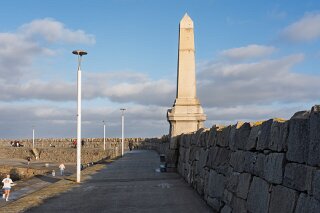
If you walk down the East Pier in Dún Laoghaire today, past the Victorian bandstand and the ice cream sellers, you will come across a grey granite obelisk. It is weathered by time and salt spray, easy to walk past without a second glance. But stop for a moment. This stone marks the spot of a Victorian tragedy that brought the city of Dublin to a standstill.
The Great Storm of 1861
On the 9th of February 1861, a hurricane battered the east coast of Ireland. It was a storm of such ferocity that the "Asylum Harbour" of Kingstown (now Dún Laoghaire)—built specifically to save ships—became a death trap.
Captain John McNeill Boyd was the commander of the HMS Ajax, the Royal Navy guardship stationed in the harbour. He was a man known for his bravery, and when he saw ships being driven onto the jagged rocks behind the East Pier, he didn't hesitate.
The Rescue and The Wave
Boyd and his crew rushed to the pier. They weren't fighting the sea from the deck of a ship; they were standing on the granite walls of the pier itself, battling gale-force winds to throw ropes to the terrified sailors on the wrecked brig Neptune below.
They were succeeding. Lives were being saved. But the sea was not done.
Without warning, a monstrous wave—described by witnesses as a mountain of water—rose up and crashed over the East Pier. In a single, devastating moment, Captain Boyd and five of his brave crewmen (Thomas Murphy, John Curry, John Russell, James Johnson, and Alexander Forsyth) were swept from the safety of the wall into the boiling ocean. They were never seen alive again.
A Dog's Devotion
The tragedy shocked the nation, but the aftermath gave rise to a legend that breaks hearts to this day. Boyd’s body was recovered weeks later and buried with full military honours at St Patrick's Cathedral.
It is said that his loyal black Newfoundland dog walked behind the hearse for the entire procession. When the Captain was lowered into the ground, the dog lay down on the grave. He refused food, refused water, and refused to leave his master’s side, eventually dying of a broken heart (and starvation) on the very spot where Boyd lay.
A Quiet Tribute
Today, the obelisk on the East Pier stands silent witness to that dark day. It was erected by the Royal St George Yacht Club to honour the men who died trying to save strangers. So, the next time you are enjoying a stroll on the pier, spare a thought for Captain Boyd, his brave crew, and the faithful dog who loved him to the end.
If you walk down the East Pier in Dún Laoghaire today, past the Victorian bandstand and the ice cream sellers, you will come across a grey granite obelisk. It is weathered by time and salt spray, easy to walk past without a second glance. But stop for a moment. This stone marks the spot of a Victorian tragedy that brought the city of Dublin to a standstill.
The Great Storm of 1861
On the 9th of February 1861, a hurricane battered the east coast of Ireland. It was a storm of such ferocity that the "Asylum Harbour" of Kingstown (now Dún Laoghaire)—built specifically to save ships—became a death trap.
Captain John McNeill Boyd was the commander of the HMS Ajax, the Royal Navy guardship stationed in the harbour. He was a man known for his bravery, and when he saw ships being driven onto the jagged rocks behind the East Pier, he didn't hesitate.
The Rescue and The Wave
Boyd and his crew rushed to the pier. They weren't fighting the sea from the deck of a ship; they were standing on the granite walls of the pier itself, battling gale-force winds to throw ropes to the terrified sailors on the wrecked brig Neptune below.
They were succeeding. Lives were being saved. But the sea was not done.
Without warning, a monstrous wave—described by witnesses as a mountain of water—rose up and crashed over the East Pier. In a single, devastating moment, Captain Boyd and five of his brave crewmen (Thomas Murphy, John Curry, John Russell, James Johnson, and Alexander Forsyth) were swept from the safety of the wall into the boiling ocean. They were never seen alive again.
A Dog's Devotion
The tragedy shocked the nation, but the aftermath gave rise to a legend that breaks hearts to this day. Boyd’s body was recovered weeks later and buried with full military honours at St Patrick's Cathedral.
It is said that his loyal black Newfoundland dog walked behind the hearse for the entire procession. When the Captain was lowered into the ground, the dog lay down on the grave. He refused food, refused water, and refused to leave his master’s side, eventually dying of a broken heart (and starvation) on the very spot where Boyd lay.
A Quiet Tribute
Today, the obelisk on the East Pier stands silent witness to that dark day. It was erected by the Royal St George Yacht Club to honour the men who died trying to save strangers. So, the next time you are enjoying a stroll on the pier, spare a thought for Captain Boyd, his brave crew, and the faithful dog who loved him to the end.
CAPTAIN BOYD