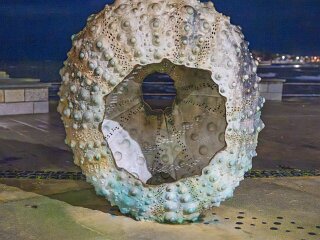
MOTHERSHIP WAS THE ORIGINAL TITLE FOR THIS SCULPTURE
MOTHERSHIP SCULPTURE BY RACHEL JOYNT IN SANDYCOVE DUN LAOGHAIRE {ALSO KNOWN AS THE SEA URCHIN]
The Art: Mothership (1999)
Mothership was commissioned by the Dún Laoghaire-Rathdown County Council as part of the Per Cent for Art Scheme, specifically connected to the Dún Laoghaire Drainage Scheme.
Visual Form: The sculpture is a large, cast bronze sea urchin, approximately 2 metres in height. It is tilted on its side, resting as if it has just washed ashore or is tumbling back into the Irish Sea.
+1
Materials: The body is made of textured bronze, while the "trail" left behind it consists of stainless steel studs and droplets embedded in the pavement. These mimic the glistening trail of water a sea creature might leave as it moves across the sand.
+1
Symbolism & Context:
The Drainage Link: The sculpture celebrates the cleaning of the coastline. The artist intended the urchin—a creature that thrives in clean water—to be a "confident statement of clear sea water" resulting from the new drainage works.
Structural Easter Egg: A subtle detail is that the diameter of the sculpture matches the exact diameter of the underground pipes laid during the drainage scheme, physically linking the art to the infrastructure beneath it.
Interactivity: Unlike many public monuments, Mothership invites physical interaction. It is hollow, allowing children (and agile adults) to climb inside or look through the apertures to frame views of the sea and the sky, creating a sheltered, womb-like experience.
The Artist: Rachel Joynt
Rachel Joynt (born 1966) is one of Ireland’s most respected sculptors, particularly renowned for her large-scale public installations.
Background: Born in County Kerry and educated at the National College of Art and Design (NCAD) in Dublin, she is a full member of the Royal Hibernian Academy (RHA) and Aosdána, the Irish association of artists.
Style & Themes: Joynt’s work often focuses on scale and nature. She frequently takes small, organic forms—such as acorns, eggs, or sea shells—and magnifies them to monumental sizes. This shift in scale forces the viewer to re-examine familiar objects with a sense of wonder. She often incorporates lighting or internal cavities to encourage viewers to look inside the work, not just at it.
+2
Other Notable Works:
Perpetual Motion (Naas Bypass): The famous large sphere with road markings.
Noah's Egg (UCD Veterinary School): A large bronze egg.
Dearcán na nDaoine (Áras an Uachtaráin): A giant bronze acorn commissioned for the 1916 Centenary.
Rachel Joynt comes from a very artistic family; her father was the renowned Irish sculptor Dick Joynt (1938–2003).
You can find a significant work by him just a short walk away from the Mothership.
The Sculpture: Celebration (1986)
Located in Eden Park, Glasthule, this sculpture is only about a 5-minute walk inland from Rachel Joynt's Mothership at Newtownsmith.
Subject: The sculpture depicts a mother holding a child high in the air, capturing a moment of pure joy and vitality.
Material: It is carved from Kilkenny limestone.
Style: Unlike Rachel's often metallic or mixed-media works (like the bronze Mothership), Dick Joynt is famous for his work in stone and wood. His style is characterized by bold, curvilinear forms that feel ancient and robust, often compared to Polynesian art or pre-Columbian statuary.
A "Family" Connection
It is a lovely coincidence (or perhaps curatorial planning) that two sculptures focusing on maternal themes—Rachel’s Mothership (protective/womb-like) and Dick’s Celebration (joyful/uplifting)—are located so close to one another in the same neighbourhood.
How to find it from Mothership:
Walk away from the sea, crossing the road from Newtownsmith. Head up Glasthule Road (towards the village shops). Eden Park is the small green space on your right, just before you reach the DART station turn-off. The sculpture stands prominently on the grass.
The Art: Mothership (1999)
Mothership was commissioned by the Dún Laoghaire-Rathdown County Council as part of the Per Cent for Art Scheme, specifically connected to the Dún Laoghaire Drainage Scheme.
Visual Form: The sculpture is a large, cast bronze sea urchin, approximately 2 metres in height. It is tilted on its side, resting as if it has just washed ashore or is tumbling back into the Irish Sea.
+1
Materials: The body is made of textured bronze, while the "trail" left behind it consists of stainless steel studs and droplets embedded in the pavement. These mimic the glistening trail of water a sea creature might leave as it moves across the sand.
+1
Symbolism & Context:
The Drainage Link: The sculpture celebrates the cleaning of the coastline. The artist intended the urchin—a creature that thrives in clean water—to be a "confident statement of clear sea water" resulting from the new drainage works.
Structural Easter Egg: A subtle detail is that the diameter of the sculpture matches the exact diameter of the underground pipes laid during the drainage scheme, physically linking the art to the infrastructure beneath it.
Interactivity: Unlike many public monuments, Mothership invites physical interaction. It is hollow, allowing children (and agile adults) to climb inside or look through the apertures to frame views of the sea and the sky, creating a sheltered, womb-like experience.
The Artist: Rachel Joynt
Rachel Joynt (born 1966) is one of Ireland’s most respected sculptors, particularly renowned for her large-scale public installations.
Background: Born in County Kerry and educated at the National College of Art and Design (NCAD) in Dublin, she is a full member of the Royal Hibernian Academy (RHA) and Aosdána, the Irish association of artists.
Style & Themes: Joynt’s work often focuses on scale and nature. She frequently takes small, organic forms—such as acorns, eggs, or sea shells—and magnifies them to monumental sizes. This shift in scale forces the viewer to re-examine familiar objects with a sense of wonder. She often incorporates lighting or internal cavities to encourage viewers to look inside the work, not just at it.
+2
Other Notable Works:
Perpetual Motion (Naas Bypass): The famous large sphere with road markings.
Noah's Egg (UCD Veterinary School): A large bronze egg.
Dearcán na nDaoine (Áras an Uachtaráin): A giant bronze acorn commissioned for the 1916 Centenary.
Rachel Joynt comes from a very artistic family; her father was the renowned Irish sculptor Dick Joynt (1938–2003).
You can find a significant work by him just a short walk away from the Mothership.
The Sculpture: Celebration (1986)
Located in Eden Park, Glasthule, this sculpture is only about a 5-minute walk inland from Rachel Joynt's Mothership at Newtownsmith.
Subject: The sculpture depicts a mother holding a child high in the air, capturing a moment of pure joy and vitality.
Material: It is carved from Kilkenny limestone.
Style: Unlike Rachel's often metallic or mixed-media works (like the bronze Mothership), Dick Joynt is famous for his work in stone and wood. His style is characterized by bold, curvilinear forms that feel ancient and robust, often compared to Polynesian art or pre-Columbian statuary.
A "Family" Connection
It is a lovely coincidence (or perhaps curatorial planning) that two sculptures focusing on maternal themes—Rachel’s Mothership (protective/womb-like) and Dick’s Celebration (joyful/uplifting)—are located so close to one another in the same neighbourhood.
How to find it from Mothership:
Walk away from the sea, crossing the road from Newtownsmith. Head up Glasthule Road (towards the village shops). Eden Park is the small green space on your right, just before you reach the DART station turn-off. The sculpture stands prominently on the grass.
THE SEA URCHIN