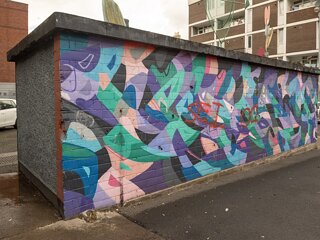
YORK STREET AND NEARBY
YORK STREET AND EAST BOW LANE AREA [PHOTOGRAPHED USING A FUJIFILM GFX100RF]
I updated to the latest version of Lightroom Classic and the plugin that I use to produce web galleries broke as a result and unfortunately it took me about 48 hours to discover the cause of the problem. The only solution to work was to downgrade to an older version of Lightroom.
York Street
Laid out around 1685 and named after James, Duke of York (later King James II), York Street connects St Stephen's Green West with Aungier Street. Over the 18th and 19th centuries, it served as a major residential street for Dublin’s medical, legal, and literary figures. Gothic writer Charles Maturin lived here in the early 1800s, and several presidents of the Royal College of Surgeons in Ireland (RCSI) maintained residences along its terraces.
As the south inner city transitioned in the late 19th and early 20th centuries, many of the Georgian red-bricks were converted into high-density tenements, leading to severe overcrowding. In the 1960s, York Street became a central site of public activism and anti-eviction protests before municipal social housing schemes replaced the decaying structures.
Today, York Street functions as a vital institutional and residential corridor. The eastern end is anchored by the modern extension of RCSI York St, featuring state-of-the-art medical education facilities at No. 26. Moving west toward Aungier Street, the streetscape transitions into mid-century and modern social housing blocks, local student accommodation, and vibrant street-level commerce.
Key Institutional Footprint: RCSI's expanded academic campus dominates the eastern flank near St Stephen's Green.
Architectural Mix: Features a blend of modern educational facilities, infill residential developments, and Victorian corner commercial plots.
Bow Lane East
Bow Lane East is a narrow, historical laneway running parallel between Mercer Street and Aungier Street. Originally established to service the rear yards, stables, and small workshops of the larger residential properties facing York Street and Stephen Street, 19th-century trade directories list it as home to horse shoers, small artisans, and dense residential tenement rooms.
In the contemporary urban layout, Bow Lane East serves as a quiet inner-block passageway providing access to modern apartments, commercial delivery lanes, and service quarters for the surrounding shopping and dining districts off Aungier Street.
Laneway Character: Retains its compact medieval-to-Georgian plot orientation amidst back-of-house city infrastructure.
Access Hub: Provides pedetrian and service connectivity between Mercer Street Upper and Aungier Street.
The White Swan (The Swan Bar)
Located at the corner of York Street and Aungier Street, The Swan Bar is one of Dublin's most famous Victorian pubs with roots dating back several centuries. Historical records trace a licensed premises on or near this site to at least 1661, following Sir Francis Aungier’s development of the area. It was known historically as Ye Signe of Ye White Swan (and recorded in a 1723 lease as The White Swan Inn).
In 1897, proprietor Thomas F. O'Reilly undertook a major redesign of the building, shortening its name to "The Swan" and creating the preserved Victorian pub interior seen today. The building played a direct role in the 1916 Easter Rising; situated opposite military positions, its red-brick exterior was struck by gunfire, and bullet indentations remain visible on the brickwork.
The pub continues to operate as an authentic Victorian heritage pub under the stewardship of the O'Reilly family, retaining its original mahogany counters, ornate snugs, brass fittings, and historical character.
Victorian Interior: Features original 1897 wood paneling, tiled flooring, glasswork, and traditional private snug seating.
1916 Heritage: Known for its surviving exterior bullet scars from the Easter Rising skirmishes along the Aungier Street corridor.
I updated to the latest version of Lightroom Classic and the plugin that I use to produce web galleries broke as a result and unfortunately it took me about 48 hours to discover the cause of the problem. The only solution to work was to downgrade to an older version of Lightroom.
York Street
Laid out around 1685 and named after James, Duke of York (later King James II), York Street connects St Stephen's Green West with Aungier Street. Over the 18th and 19th centuries, it served as a major residential street for Dublin’s medical, legal, and literary figures. Gothic writer Charles Maturin lived here in the early 1800s, and several presidents of the Royal College of Surgeons in Ireland (RCSI) maintained residences along its terraces.
As the south inner city transitioned in the late 19th and early 20th centuries, many of the Georgian red-bricks were converted into high-density tenements, leading to severe overcrowding. In the 1960s, York Street became a central site of public activism and anti-eviction protests before municipal social housing schemes replaced the decaying structures.
Today, York Street functions as a vital institutional and residential corridor. The eastern end is anchored by the modern extension of RCSI York St, featuring state-of-the-art medical education facilities at No. 26. Moving west toward Aungier Street, the streetscape transitions into mid-century and modern social housing blocks, local student accommodation, and vibrant street-level commerce.
Key Institutional Footprint: RCSI's expanded academic campus dominates the eastern flank near St Stephen's Green.
Architectural Mix: Features a blend of modern educational facilities, infill residential developments, and Victorian corner commercial plots.
Bow Lane East
Bow Lane East is a narrow, historical laneway running parallel between Mercer Street and Aungier Street. Originally established to service the rear yards, stables, and small workshops of the larger residential properties facing York Street and Stephen Street, 19th-century trade directories list it as home to horse shoers, small artisans, and dense residential tenement rooms.
In the contemporary urban layout, Bow Lane East serves as a quiet inner-block passageway providing access to modern apartments, commercial delivery lanes, and service quarters for the surrounding shopping and dining districts off Aungier Street.
Laneway Character: Retains its compact medieval-to-Georgian plot orientation amidst back-of-house city infrastructure.
Access Hub: Provides pedetrian and service connectivity between Mercer Street Upper and Aungier Street.
The White Swan (The Swan Bar)
Located at the corner of York Street and Aungier Street, The Swan Bar is one of Dublin's most famous Victorian pubs with roots dating back several centuries. Historical records trace a licensed premises on or near this site to at least 1661, following Sir Francis Aungier’s development of the area. It was known historically as Ye Signe of Ye White Swan (and recorded in a 1723 lease as The White Swan Inn).
In 1897, proprietor Thomas F. O'Reilly undertook a major redesign of the building, shortening its name to "The Swan" and creating the preserved Victorian pub interior seen today. The building played a direct role in the 1916 Easter Rising; situated opposite military positions, its red-brick exterior was struck by gunfire, and bullet indentations remain visible on the brickwork.
The pub continues to operate as an authentic Victorian heritage pub under the stewardship of the O'Reilly family, retaining its original mahogany counters, ornate snugs, brass fittings, and historical character.
Victorian Interior: Features original 1897 wood paneling, tiled flooring, glasswork, and traditional private snug seating.
1916 Heritage: Known for its surviving exterior bullet scars from the Easter Rising skirmishes along the Aungier Street corridor.
YORK STREET AND NEARBY